Choosing the right welding fume extraction unit is essential for a safer, healthier workspace. This guide highlights five reliable models designed to capture smoke, dust, and hazardous gases at the source. Each option features strong filtration, user-friendly controls, and suitability for common welding, cutting, and soldering tasks. Read on to compare capabilities and pick the unit that best fits your shop size and workflow.
| Product | Brand | Key Benefit |
|---|---|---|
| New-Type Industrial Mobile Welding Fume Purifier | Generic | Pulse-driven, unified central control |
| KQZ-B1 Solder Fume Extractor | KQZ | Fast suction with dual-layer filtration |
| Adjustable 245W Fume Extractor | CINDENDOOUNK | Five-stage filtration, high-iodine carbon |
| KQZ-W1 Solder Fume Extractor | KQZ | Dual-layer design, high purification efficiency |
| KINGSOM Solder Fume Extractor | KINGSOM | Compact desktop with 2-in-1 filter |
New-Type Industrial Mobile Welding Fume Purifier

The New-Type Industrial Mobile Welding Fume Purifier is designed for flexible, mobile use in workshops with multiple welding and cutting tasks. It provides full coverage across various scenarios, including plasma cutting and laser welding. Its core filtration uses H13-grade media to capture 0.3 μm particles with up to 99% efficiency, helping compliance with strict environmental standards. The unit supports an intelligent centralized dust management system, enabling remote monitoring, one-click start/stop, and automatic ash cleaning. This reduces manual maintenance and helps keep a clean, safe air environment.
KQZ-B1 Solder Fume Extractor
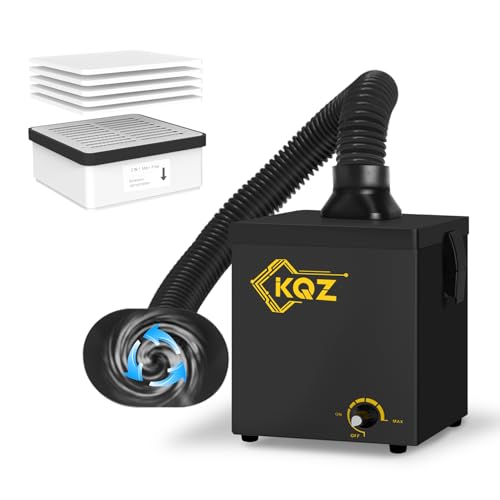
The KQZ B1 combines strong suction (168 m³/h) with a dual-layer filtration approach for effective purification. Its 9mm initial efficiency filter plus H13 HEPA and coal-based activated carbon cartridge target dust, smoke, and odors, offering 99.99% purification at 0.3 μm. This model is suitable for welding, soldering, 3D printing, and other environments prone to fine particle exposure. The compact design supports stable operation across a range of voltages, with a simple one-button activation for quick cleanup of fumes.
Adjustable 245W Fume Extractor

This 5-stage filtration system emphasizes odor control and fine particle capture. The main carbon filter uses high-iodine coconut shell carbon, delivering enhanced adsorption of soot and odors with a service life exceeding 4,000 hours. The included 5-stage filter set promises 99.97% filtration efficiency, making it suitable for laser cutting, engraving, and other processes that generate smoke and fumes. A dedicated set of primary and oil-absorbing filters adds to the system’s versatility, and the manufacturer offers responsive after-sales support.
KQZ-W1 Solder Fume Extractor

The KQZ-W1 mirrors the B1’s emphasis on a robust purification chain with 168 m³/h air flow and a dual-layer design. It employs a 9mm pre-filter paired with H13 HEPA and coal-based activated carbon cartridge to achieve 99.99% purification of smoke and gases, including metals such as lead and mercury. The unit supports a wide voltage range (110–220V) for consistent performance in varied workshop setups, and its one-button activation enables straightforward operation for quick fume removal during soldering and welding tasks.
KINGSOM Solder Fume Extractor

The KINGSOM desktop fume extractor is designed for compact workstations, delivering up to 180 m³/h of airflow. It uses an integrated 2-in-1 filter system (HEPA H13 plus activated carbon) to achieve 99.97% filtration efficiency for fumes and dust larger than 0.3 μm. The device features knob-based suction control, an LED status indicator, and a small footprint that fits neatly on benchtops. It is suitable for soldering, welding, small-scale laser work, and nail or cosmetic shop environments where space is at a premium.
Buying Guide: Key Purchase Considerations
When selecting a welding fume extraction unit, consider the following factors to ensure you get the best fit for your shop:
- Filtration stages and efficiency: Look for multi-stage filtration (pre-filter, HEPA or H13, activated carbon) to capture particles and gases. Aim for 99.97% or higher for submicron particles.
- Airflow capacity: Match the unit’s CFM or m³/h rating to your workshop size and the number of processes running concurrently. Higher airflow supports larger spaces and multiple workers.
- Filtration life and replacement costs: Longer-lasting filters reduce maintenance downtime. Check the availability and cost of replacement cartridges.
- Mobility and footprint: For small shops, compact desktop units are practical; for larger spaces, mobile or ceiling-mounted options may be better.
- Control features: Centralized control, remote monitoring, and automatic ash or filter cleaning can reduce labor and improve reliability.
- Electrical requirements: Ensure compatibility with your workshop’s voltage (110–120V or 220–240V) and consider inverter or stable power support for variable supplies.
- Noise levels: For labs and classrooms, quieter models reduce disruption while maintaining performance.
- Safety and compliance: Select units that meet relevant environmental and occupational safety standards, especially for metal fumes containing heavy metals.
Depth of filtration versus total cost is a common trade-off. High-efficiency units with dual-layer filters deliver superior purification but may come with higher upfront and replacement costs. For hobbyist or small-scale work, compact units with strong 2-in-1 filters can provide adequate protection with lower expense. In larger workshops with continuous welding, cutting, or 3D printing, consider modular or centralized systems that support remote monitoring and automated maintenance to minimize downtime.