Choosing the right pump for construction sites means balancing power, durability, and ease of use. This guide highlights five reliable options that handle dewatering, sludge, and water transfer in demanding environments. Each model offers solid performance, proven build quality, and practical features to keep projects on schedule.
| Product | Brand | Discharge | Key Benefit |
|---|---|---|---|
| Tsurumi HS2.4S Submersible Trash Pump | Tsurumi Pump | 2 in | Agitator for debris; 0.3″ solids |
| LB-800 Submersible Dewatering Pump | Tsurumi Pump | 2″ | Slim design; long cord; durable seals |
| FOTING Sump Pump 1HP | FOTING | 2″ (typical 1 HP) | High flow; debris filtering; portable |
| SEAFLO 33-Series Water Pump | SEAFLO | 1/2″ MNPT | Accumulator tank reduces cycling; compact |
| Myers HJ100S Shallow Well Jet Pump | Myers | Optional 1 HP | Durable cast iron body; adjustable settings |
Tsurumi HS2.4S Submersible Trash Pump

The HS2.4S is a compact, powerful trash pump designed for dewatering tasks common on construction sites. Its semi-vortex impeller and integrated agitator enable efficient handling of small solids up to 0.3 inches, reducing clogging in sandy or debris-filled water. A 1/2 horsepower motor provides strong performance from a standard 115V power source, suitable for remote site work. The pump includes a 20-foot cord and a 2-inch angled discharge, offering flexibility for hose routing and setup in tight spaces. This model is ideal for quick cleanup after rain, trench draining, or site remediation where solids are present.
Tsurumi LB-800 Submersible Dewatering Pump

The LB-800 combines a slim profile with robust construction ideal for confined spaces such as 8-inch caissons. A 2-inch discharge design supports steady pumping, while a 50-foot cord provides reach across large sites. Built with urethane impeller wear plates and dual Silicon Carbide mechanical seals, it delivers long-lasting performance in wet, abrasive environments. The top-discharge design improves motor cooling and offers dependable dry-run capability, making it suitable for continuous dewatering during project work.
FOTING Sump Pump 1HP
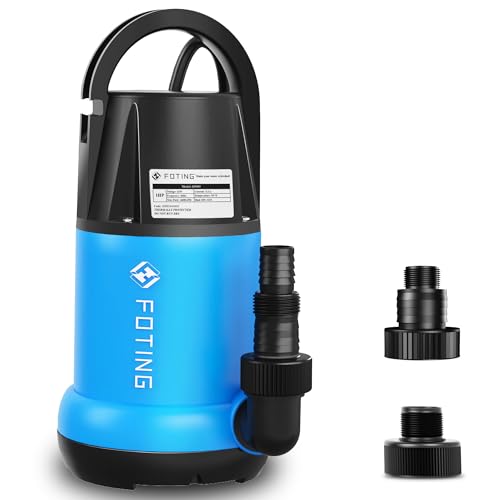
FOTING’s 1HP submersible pump is designed for both dirty and clean water applications, delivering up to 4600 GPH (76 GPM) with a lift of up to 31 feet. It can remove debris down to 1/5 inch, making it suitable for basements, pools, ponds, and flooded job sites. The unit includes a 10-foot power cord and a removable bottom for easy cleaning and maintenance. A rugged thermoplastic housing provides corrosion resistance, while the rounded handle facilitates transport and setup on site.
SEAFLO 33-Series Pump With Accumulator

The SEAFLO 33-Series combines a compact 12V DC pump with an accumulator tank to reduce cycling, ensuring smooth water delivery and longer life. With a 3.0 GPM flow rate and 45 PSI shut-off, this system can service multiple fixtures from boats and RVs to cabins and tiny homes. Its self-priming capability and robust diaphragm design provide reliable performance in intermittent use, making it a practical option for off-grid or lightweight construction tasks where electrical access may be limited.
Myers HJ100S Shallow Well Jet Pump

The Myers HJ100S provides durability with a cast iron body and precision components designed for shallow well and dewatering tasks. The pump features accurately engineered impellers and diffusers for reliable performance and efficiency. A high-quality pressure switch with adjustable on/off settings enables quick fine-tuning to match water demand, typically around a 20 PSI differential. This model is suited for small-scale dewatering projects or temporary water transfer needs where a rugged, long-lasting pump is required.
Buying Guide: Key Considerations for Construction Pumps
- Concrete and debris handling: If debris, sand, or solids are present, choose a pump with an integrated agitator or a semi-vortex/solids handling design to reduce clogs and downtime.
- Discharge size and compatibility: A 2-inch discharge often balances flow with hose availability on typical construction sites; verify hose fittings and adapters for quick setup.
- Power requirements and flexibility: 115V models are common on sites with standard electrical outlets, while portable or battery options suit remote locations. Consider longer cords or built-in thermal protection for reliability.
- Durability and seals: Pumps used in abrasive water require wear-resistant impellers and strong mechanical seals. Dual seals and silicon carbide faces increase longevity in harsh environments.
- Maintenance and ease of use: Removable bottoms, simple cleaning, and accessible strainers reduce downtime between tasks. Self-priming features are beneficial for initial startup at job sites.
- Running time and efficiency: Look for pumps designed for continuous duty in wet conditions. Accumulator tanks or softer cycling configurations help extend pump life and stabilize pressure.
- Portability and storage: Slimline or compact designs fit into tight spaces, while long cords aid in reach. A durable handle and weather-resistant components are practical.
When selecting a pump for construction, assess site conditions, expected solids content, power accessibility, and maintenance readiness. The models highlighted above provide a mix of high flow, solids handling, and durability to support dewatering, transfer, and drainage tasks across typical job sites.