For warehousing, manufacturing, and recycling facilities, choosing the right forklift-accessible trash hopper can boost productivity and safety. This guide highlights top self-dumping hopper models designed for forklift use, focusing on capacity, build quality, and safety features. Each option is well-suited for loading, transporting, and dumping waste in a controlled, single-motion operation.
Summary of selected products:
- Global Industrial 2 Cu Yd Gray Medium Duty Self Dumping Forklift Hopper — 4000 lbs capacity, 11 gauge steel walls, standard fork pockets.
- Apex HD200 Forklift Heavy Duty Self-Dumping Hopper — 2 cu yd, up to 6000 lb capacity, made in the USA, EZ Release latch.
- Apex HD100 Forklift Heavy Duty Self-Dumping Hopper — 1 cu yd, 6000 lb capacity, USA-made, EZ Release latch.
- Global Industrial 2 Cu Yd Medium Duty Self Dumping Forklift Hopper — 4000 lbs, one-person operation design, standard fork pockets.
- Apex HD75 Forklift Heavy Duty Self-Dumping Hopper — 3/4 cu yd, 6000 lb capacity, USA-made, EZ Release latch.
Global Industrial 2 Cu Yd Gray Medium Duty Self Dumping Hopper

This medium-duty hopper is designed for forklift integration with a 2 cubic yard capacity and a robust 11-gauge steel wall. The hopper features a 4000 lb load rating and 3-inch high by 28.5-inch wide fork pockets, enabling straightforward mounting on standard forks. The design supports one-person operation and provides a practical option for mid-volume waste handling in industrial settings. Suitable for routine material recovery tasks where stable dumping is critical.
Apex HD200 Forklift Heavy Duty Self-Dumping Hopper, 2 Cu Yd

APEX’s HD200 is a heavier-duty, 2 cubic yard model offering a 6000 lb capacity and rugged steel construction. It is proudly made in the USA and ships with safety-focused features, including a single-motion self-dumping mechanism and an EZ Release latch to help keep operators safe during dumping. The model is supported by an extended warranty and emphasizes American manufacturing standards. This hopper is ideal for high-volume waste streams and demanding environments.
Apex HD100 Forklift Heavy Duty Self-Dumping Hopper, 1 Cu Yd
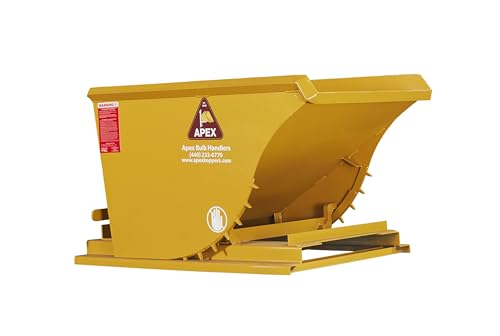
The HD100 is a 1 cubic yard capacity hopper designed for heavy-duty use with a 6000 lb load rating. It shares Apex’s USA-made construction and safety features, including the E-Z Release latch mechanism for safe detachment between hopper and forklift. This size balances compact footprint with strong dumping performance, suitable for smaller spaces or frequent dumps in production lines.
Global Industrial 2 Cu Yd Medium Duty Self Dumping Forklift Hopper, Yellow

This Global Industrial model emphasizes operability with a 2 cubic yard capacity and a 4000 lb rating. The hopper design supports one-person operation and includes a straightforward fork pocket configuration. The yellow finish enhances visibility in busy work environments. It is positioned as a reliable choice for everyday utility and easy maintenance in warehouses and light manufacturing settings.
Global Industrial 1 Cubic Yard Low-Profile Self-Dumping Forklift Hopper

With a lower-profile footprint, this 1 cubic yard hopper is optimized for tight spaces while maintaining a robust 6000 lb capacity. It includes a 4-foot pull chain for manual operation and specifies standard fork openings for compatibility with common forklift configurations. This model is suitable where ceiling clearance, doorways, or narrow aisles constrain equipment size.
Apex HD75 Forklift Heavy Duty Self-Dumping Hopper, 3/4 Cu Yard

The HD75 offers three-quarters of a cubic yard in a compact, high-strength design suitable for frequent, smaller dumps. It shares Apex’s USA-made construction, a safety-first single-motion dumping system, and the EZ Release latch. This size is particularly well-suited for operations where space is at a premium but dumping safety remains a priority.
Buying Guide: Key Purchase Considerations
- Capacity needs: Assess daily waste load and choose a hopper with an appropriate cubic yard capacity and weight rating to minimize frequent dumping cycles.
- Fork compatibility: Verify fork pocket dimensions (width and height) to ensure a secure fit on your forklift. Consider models with adjustable or standard pocket spacing for versatility.
- Dumping mechanism and safety: Prioritize single-motion or EZ Release latches that reduce operator exposure during dumping. Look for self-locking features and clear release paths.
- Material and durability: Steel construction (11- or heavier-gauge) offers better wear resistance for dense or abrasive waste streams. Corrosion-resistant finishes extend life in humid environments.
- Mobility and footprint: Assess aisle widths and storage footprint. Low-profile designs help in tight spaces, while larger hoppers maximize payload between dumps.
- Made-in-USA options: For buyers prioritizing domestic manufacturing, models labeled as Made in the USA can align with supplier diversity goals and support local suppliers.
- Maintenance and warranty: Check for warranties and service support. Durable steel hoppers with simple latching mechanisms typically require less ongoing maintenance.
- Safety integration: Ensure the hopper is compatible with your forklift’s load rating and that safety features guard against accidental dumping or cab exposure.
Comparative Considerations
- Capacity vs. footprint: Larger capacities reduce trips but may require more space. Balance payload with your available storage and aisle constraints.
- Durability vs. cost: Heavier, USA-made hoppers often cost more upfront but provide longer service life in demanding environments.
- Ease of operation: Models with one-person operation features and simple dumping mechanisms lower labor requirements and training time.
- Safety emphasis: Prioritize hoppers with clearly defined dumping releases and stable transport during movement to prevent tipping or uncontrolled dumps.
Selected models in this guide cover a range of capacities, from 0.75 to 2 cubic yards, with dimensions and features designed to fit common forklift configurations. Each option emphasizes safe, efficient waste handling while accommodating diverse warehouse layouts and waste streams. Users should match model choice to the specific throughput, space, and safety requirements of their facility.