Finding the right TIG welding rod for 304 stainless steel helps ensure strong, corrosion-resistant welds with clean, smooth beads. This guide reviews top ER308L rods designed for general purpose 304 stainless work, highlighting material composition, shielding gas needs, and best-use scenarios. Each product section includes a direct link to Amazon for quick access, plus visuals to help you compare at a glance.
Summary of selected products:
| Product | Brand | Size & Type | Key Advantage |
|---|---|---|---|
| ER308L TIG Welding Rod | YESWELDER | 1/16″ x 16″ (5LB) | Low carbon content for intergranular corrosion resistance |
| ER308L TIG Welding Rod | YESWELDER | 3/32″ x 16″ (5LB) | General purpose with good penetration when using shielding gas |
| ER308L TIG Welding Rod | SONNLER | 3/32″ x 16″ (5LB) | Low splatter and strong corrosion resistance |
| ER308L TIG Filler Rod | ARCCAPTAIN | 1/16″ x 16″ (5LB) | Low-carbon formula with dependable welding performance |
| ER308L TIG Rod | WISUNO | 1/16″ x 17″ (1LB) | Ultra-low carbon design with robust corrosion resistance |
YESWELDER ER308L 1/16×16 5LB TIG Rod

ER308L is widely used for general-purpose stainless welding where corrosion is moderate and resilient at cryogenic temperatures. Shield gas guidance recommends 100% Argon or Argon/Helium blends to enhance penetration and speed. The low carbon content (max 0.03%) helps reduce intergranular corrosion in the weld metal.
YESWELDER ER308L 3/32×16 5LB TIG Rod

This ER308L variant offers a slightly thicker diameter for faster deposition without sacrificing corrosion resistance. Shield gas recommendations align with 100% Argon or Argon/Helium to achieve deeper penetration and higher welding speeds. The rod’s low carbon content maintains resistance to intergranular corrosion in the weld zone.
SONNLER ER308L 3/32×16 5LB TIG Rod

SONNLER’s ER308L package emphasizes low splatter and consistent corrosion resistance, with AWS A5.9 specification confirmation. The set includes rod sizes that support 16″ lengths and standard 1/32″ to 3/32″ diameters. Shield gas guidance remains 100% Argon or Argon/Helium combinations for clearer welds and speed gains.
ARCCAPTAIN ER308L 1/16×16 5LB TIG Rod

ARCCAPTAIN emphasizes low-carbon stainless steel TIG filler with proven anti-crystal interval corrosion properties. The 1/16″ diameter suits intricate welds and projects requiring precise control. Shield gas recommendations include 100% Argon or Argon/Helium to optimize penetration and speed.
WISUNO ER308L 1/16×17 1LB TIG Rod

WISUNO’s rods feature ultra-low carbon content (≤0.03%), reducing carbide precipitation and intergranular corrosion risk in welds on 304 and similar low-carbon stainless steels. The product is praised for stable arc behavior, smooth molten pools, minimal spatter, and suitability for all-position welding with standard shielding gases.
Blue Demon ER308L 1/16×36″ TIG Rod

Blue Demon’s ER308L 1/16″ x 36″ rod is compatible with stainless grades 321 and 347 in addition to 304. It supports cryogenic temperature applications and adheres to AWS A5.9 specifications. DCEN welding current is commonly used with these rods for 304 stainless welding tasks.
Verdanzia 30 Pcs ER308L TIG Rods
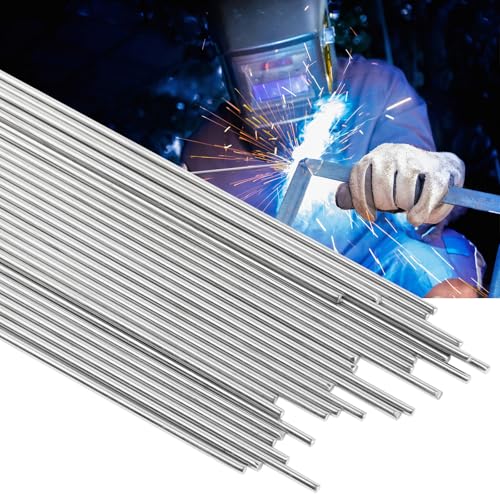
Verdanzia offers a bulk option with uniform 1/16″ x 16″ rods designed for versatility across construction, engineering machinery, shipbuilding, and home projects. The set emphasizes smooth, clean welds with low spatter and dependable performance for professionals and DIY welders alike.
YESWELDER ER308L 1/8×16 5LB TIG Rod

This thicker diameter option supports higher deposition rates and is useful for larger 304 stainless welds where more metal is deposited per pass. Shield gas guidance remains consistent with 100% Argon or Argon/Helium blends to optimize penetration and welding speed, while maintaining corrosion resistance from the low-carbon composition.
Buying Guide: Key Considerations When Choosing ER308L TIG Rods for 304 Stainless
Selection factors vary by project, but critical considerations include alloy composition, shielding gas, and welding setup. ER308L is a low-carbon stainless steel filler designed to resist intergranular corrosion and maintain strength in a range of environments.
- Alloy chemistry: Look for low carbon content (approximately 0.03% max) to minimize sensitization and intergranular corrosion in 304 stainless.
- Shielding gas: 100% Argon provides clean, stable arcs; Argon/Helium blends can increase penetration and speed for specific joint configurations.
- Rod diameter and length: Choose a size that matches the joint type and welding position to control heat input and deposition rate.
- Welding position: All-position rods are versatile, but some formulations perform best in flat or horizontal positions.
- Control of heat input: Lower carbon content helps reduce carbide precipitation; manage amperage to avoid warping or burn-through on thin sections.
- Quality and consistency: Bulk packs are cost-efficient for large projects, while smaller packs can suit frequent, on-site welding.
- Compatibility with base metal: While rated for 304, consider any alloy variations (304L, 304V, etc.) and application environment (marine, chemical exposure, cryogenic use).
Comparison Snapshot
- All listed ER308L rods share low carbon content for corrosion resistance.
- Most recommendations call for 100% Argon or Argon/Helium shielding gas to maximize penetration and weld quality.
- Rod diameters range from 1/16″ to 3/32″ and up to thicker 1/8″ options, affecting heat input and deposition rate.
- Some brands emphasize ultra-low carbon content, minimizing carbide precipitation, while others highlight low splatter or all-position viability.
Across these options, the best choice depends on your project scale, joint design, and preferred welding setup. For small, intricate welds on 304 stainless, 1/16″ or 3/32″ rods with Argon shielding are typically ideal. For larger passes, thicker diameters like 1/8″ can boost efficiency, provided heat input is controlled. Always verify your base material specification (such as 304 vs 304L) and ensure your shielding gas and amperage settings align with the rod manufacturer’s guidelines for optimal results.