The tension link load cells below cover a range of capacities and form factors, from compact micro-sbeam sensors to bellows-style load cells designed for precise tension and compression measurement. Each option emphasizes accuracy, stability, and resistance to interference in real-world conditions. Use this guide to compare performance and choose the best match for your weighing or force measurement needs.
| Product | Brand | Capacity | Type | Key Strength |
|---|---|---|---|---|
| ATO 300kg Load Cell | ATO | 300 kg | Pancake / Spoke | High accuracy, low profile |
| DYLY106 Micro Size 2KG S Beam | CALT | 2 kg | S Beam | Small footprint, stable |
| Mini Load Cell Bellows 0-20KG | QILICHUANGAN | 0-20 kg | Bellows | High precision, robust against interference |
| Mini Load Cell Bellows 0-50/0-500/0-1000 | QILICHUANGAN | 0-500 kg | Bellows | Wide range, strong anti-interference |
| S Type Load Cell With Indicator 0-500KG | QILICHUANGAN | 0-500 kg | S Type / With Display | Dual relay output for automation |
The following selections are the five most relevant tension link load cells for precision force measurement in various applications, from compact lab setups to scalable industrial scales.
ATO 300kg Load Cell: High-Precision Pancake Sensor

The ATO spoke-type load cell combines tension and compression capabilities in a compact pancake form factor. It features an accuracy of 0.03% F.S. (including linearity, hysteresis, and repeatability) and a sensitivity of 2.0±0.1 mV/V. With a DC 10V bridge excitation, this sensor delivers reliable measurements while maintaining a low profile suitable for constrained spaces. Anti-eccentric load performance helps preserve accuracy under off-axis loading, making it a strong candidate for calibrated force measurements in testing rigs or industrial scales.
DYLY106 Micro Size 2KG S Beam Load Cell

The DYLY106 offers a compact S-beam load cell suitable for small-scale measurements. It supports both tension and compression with solid stability and high accuracy in a 2 kg range. Its four-wire connection simplifies integration into electronic weighing systems, while the micro footprint enables placement in tight spaces. This sensor is appropriate for research setups, portable scales, and lightweight testing apparatus where precise force readings are required within a limited envelope.
Mini 0-20KG Bellows Load Cell
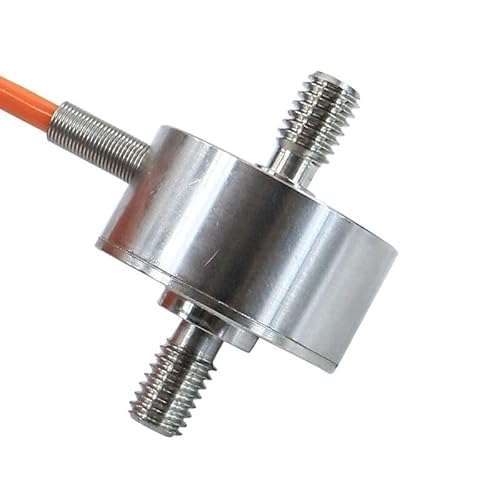
This bellows-type sensor delivers precise force measurement across a modest 0-20 kg range. It emphasizes high-precision weighings with robust anti-interference characteristics. The stainless-steel construction and 3-meter cable enhance durability and flexibility for bench- or process-scale setups, where stable readings are essential in fluctuating environmental conditions.
Mini Bellows Load Cell 0-50/0-500/0-1000KG

Designed for scalable force measurement, this bellows load cell family offers multiple ranges including 0-50 kg, up to 0-1000 kg. It provides 0.2% accuracy at the maximum range, making it suitable for precise weighing and force-monitoring tasks. The stainless-steel build supports long-term stability in varied environments, while its anti-interference features help maintain accuracy amid temperature shifts and electromagnetic disturbances.
S Type 0-500KG With Indicator

The S Type load cell with an indicator displays a wide measurement range (0-500 kg) and supports flexible weighing and force measurement. It provides 0.2% accuracy and features dual relay output for automatic control, alarms, or data logging. This configuration is well-suited for scale systems requiring automated thresholds or embedded display feedback to operators for monitoring and safety purposes.
S Type Load Cell With Indicator 0-1000KG
The larger variant of the S-Type with an indicator expands to 1000 kg, maintaining 0.2% accuracy and dual relay output. This model supports higher-capacity weighing and monitoring tasks, enabling automated thresholds and data capture across industrial or laboratory environments where consistent precision and visibility are required.
Buying Guide: Key Purchase Considerations
- Capacity and range: Match the sensor’s maximum load to your application, considering future needs.
- Measurement accuracy: Look for specified percent full-scale accuracy (e.g., 0.2% or 0.03% F.S.) and factors like linearity and hysteresis.
- Load cell type: Choose between pancake, S-beam, or bellows forms based on space constraints, mounting method, and environmental exposure.
- Environmental resistance: Consider anti-interference features, temperature range, and enclosure materials (stainless steel often preferred).
- Electrical interface: Confirm excitation voltage (e.g., DC 10V) and wiring (four-wire, two-wire) compatible with your data loggers or controllers.
- Output and automation: Dual relay outputs or integrated indicators support automated control, alarms, and data logging.
- Physical integration: Assess mounting holes, footprint, and the presence of any protective housings or adapters required for your system.
- Quality and support: Review brand reputation, documentation, calibration options, and availability of replacement parts.