Temperature calibrators are essential for maintaining accuracy in laboratories, industrial control rooms, and field service. This article highlights reliable options capable of sourcing and measuring temperature, voltage, resistance, and more. The picks emphasize high precision, multi-sensor compatibility, and practical features for both lab benches and on-site work.
| Product | Brand | Key Capabilities |
|---|---|---|
| Triplett PCAL100 High Precision Temperature Calibrator | Triplett | 11 thermocouple types, 5 RTD types, 0.05% accuracy |
| Triplett PCAL200 Precision DC Voltage and Current Source Calibrator | Triplett | 0-10V DC, 0-20mA/4-20mA current, dynamic output |
| Triplett PCAL100 High Precision Temperature Calibrator with NIST Certificate | Triplett | 0.05% accuracy, multi-sensor, traceable |
| Fluke 724 Temperature Calibrator | Fluke | Dual display, measures RTDs/thermocouples/ohms/volts |
| LB02A Digital Signal Generator Calibrator | Cloudpower | Voltage/current/resistance/temperature testing |
These selections provide a mix of high-precision temperature calibration and versatile signal generation, suitable for engineering labs, calibration services, and field maintenance. Each product below is documented with specifications and typical use scenarios to help buyers compare capabilities and fit with their workflows.
Triplett PCAL100 High Precision Temperature Calibrator

The Triplett PCAL100 provides high-precision temperature sourcing and measurement with an accuracy specification up to 0.05%, supporting reliable data in critical applications. It offers multi-sensor capability, enabling measurement and sourcing of 11 thermocouple types and 5 RTD types. An adjustable temperature compensation feature helps maintain accurate readings across different environments, reducing drift in challenging field or lab conditions. This model is well-suited for calibrating temperature sensors, transmitters, and related instrumentation where traceability and repeatability are important.
Triplett PCAL200 Precision DC Voltage and Current Source Calibrator

The PCAL200 focuses on precision with DC voltage and current source capabilities. It supports a current span adjustment from 0-20 mA and 4-20 mA with a percentage readout, along with dynamic output functions for automated waveform stepping. The DC voltage range extends from 0 to 10V with fine resolution, making it suitable for calibrating loop-powered transmitters, process controllers, and other devices requiring stable, controllable output for verification and adjustment tasks.
Triplett PCAL100 High Precision Temperature Calibrator with Certificate

This variant carries a Certificate of Traceability to NIST, reinforcing confidence in measurement integrity for quality-controlled environments. Like the standard PCAL100, it offers high precision (up to 0.05%), multi-sensor support for 11 thermocouples and 5 RTDs, and adjustable temperature compensation. The certificate can be important for audits, calibration labs, and industries requiring documented traceability for temperature data.
Fluke 724 Temperature Calibrator
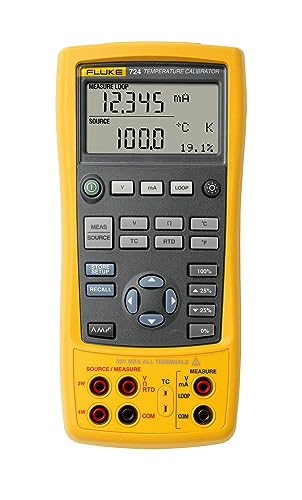
The Fluke 724 is known for its dual-display capability, allowing simultaneous viewing of input and output. It supports measuring RTDs, thermocouples, ohms, and volts to test sensors and transmitters, while also providing source or simulate functions for thermocouples, RTDs, volts, and ohms. This makes it practical for on-site calibration of transmitter loops, field sensors, and lab-based sensor verification, with the reliability expected from Fluke’s calibration lineage.
LB02A Digital Signal Generator Calibrator

The LB02A from Cloudpower provides a versatile signal calibrator platform with voltage (0-11V), current (0-24mA), and resistance (20-400Ω) testing ranges, plus frequency (100-10kHz) and temperature inputs via thermocouples (EKBRSTTJN) and thermistors (Pt100/Cu50). It suits laboratory testing, industrial control systems, and field maintenance. Its protections include a disposable fuse and a robust battery design for extended field use, improving resilience in challenging environments.
Buying Guide: Key Considerations for Temperature Calibrators and Test Equipment
- Accuracy and traceability: Look for devices with high precision (0.05% or better where required) and, if audits are needed, certificates of traceability to national standards (like NIST).
- Sensor compatibility: Assess whether the unit supports multiple thermocouple types and RTDs, as well as compatibility with Pt100 and other sensors used in your processes.
- Output versatility: Consider models with DC voltage, current, and resistance capabilities, plus thermocouple and RTD simulation, to cover calibration for transmitters and field instruments.
- Temperature compensation and environment: Devices with adjustable temperature compensation help maintain accuracy across ambient variations. Evaluate environmental operating ranges for field use.
- Ease of use and readability: Dual displays, intuitive controls, and clear documentation reduce setup time during routine calibrations and field tasks.
- Durability and field readiness: For on-site work, prioritize units with rugged housings, battery operation, and protective features to withstand harsh conditions.
- Size, weight, and portability: Balanced form factor affects transportability between lab benches and field locations.
- Connectivity and data recording: Some calibrators offer logging, USB/RS-232 outputs, or integration with calibration management software for trace logs and batch documentation.
- Certification and manufacturer support: Reputable brands with service networks provide easierWarranty coverage, firmware updates, and calibration services.
- Cost of ownership: Consider not only initial price but also required accessories, calibration intervals, and potential long-term savings from accuracy and efficiency gains.