Auger conveyor systems, especially those crafted from stainless steel, offer reliable material handling for powders, granules, and bulk materials. This article highlights five top-rated models that balance performance, durability, and ease of maintenance. Each section provides key specifications and practical considerations to help you choose the right system for your operation.
| Product | Brand | Capacity | Height | Voltage |
|---|---|---|---|---|
| TECHTONGDA Stainless Steel Screw Auger Conveyor | TECHTONGDA | 600 lb/min | 1.65 m | 220V |
| INTBUYING Automatic Screw Conveyor Feeder | INTBUYING | 3 m³/h | 1.7 m | 110V |
| INTBUYING Incline Auger Screw Conveyor | INTBUYING | 441-661 lb/min | 1.7 m | 220V |
| Yokoma Screw Type Powder Conveyor | Yokoma | 3 m³/h | 1.7 m | 220V |
| HayWHNKN Screw Feeder Machine | HayWHNKN | 3 m³/h | 1.7 m | 220V |
TECHTONGDA Stainless Steel Screw Auger Conveyor
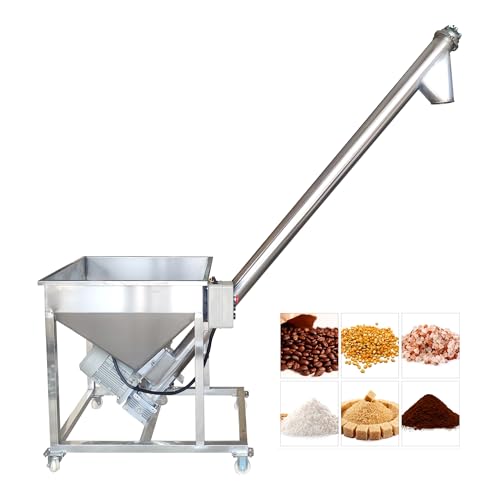
The TECHTONGDA model features a powerful 1100W motor with a rigid drive shaft and spiral blades designed to enhance efficiency and safety. Its 1.65 m effective conveying height supports a capacity of up to 600 lb/min, reducing labor intensity and streamlining feeding tasks. The design minimizes powder scatter and is suitable for cement, ore, coal, grain, and other bulk materials. This makes it a solid choice for grain processing, building materials, and casting operations that require steady, dust-controlled material transfer.
INTBUYING Automatic Screw Conveyor Feeder

This unit emphasizes high efficiency and large capacity, with a conveying capacity of 3 m³/h and a robust 1.1 kW motor. Constructed with food-grade stainless steel, all contact parts are designed for easy cleaning and safety in food processing, plastics, mining, and other industries. The machine includes portable wheels with brakes, enabling mobility and stable positioning during operation, making it well-suited for dynamic production lines that require frequent reconfiguration.
INTBUYING Incline Auger Screw Conveyor

This incline model provides convenient and portable installation with a 1.7 m height and a 441-661 lb/min capacity. It is designed for easy integration with mixing machines and other equipment, reducing manual handling and worker fatigue. The solid stainless steel construction and a heavy-duty frame contribute to long-term reliability in demanding environments such as powder processing and plastic production.
Yokoma Screw Type Powder Conveyor

The Yokoma model offers a 3 m³/h capacity with a 1.7 m conveying height, powered by a 1.1 kW motor. It features a 32mm/2mm inner pipe and a 102mm/1.5mm outer pipe, with wheels on the base for easy movement. The inclined design promotes space efficiency and smooth material flow, suitable for batch feeding and continuous operation in powder and bulk handling tasks.
HayWHNKN Screw Feeder Machine
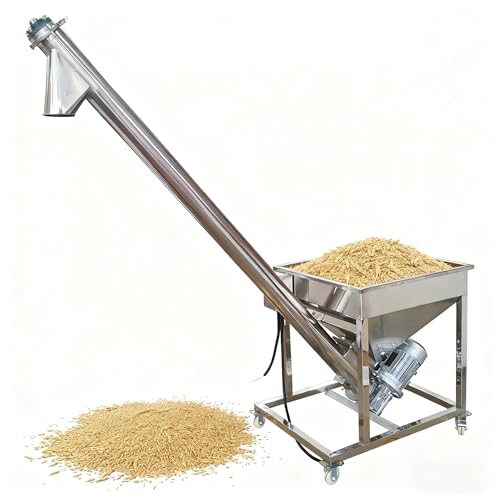
The HayWHNKN model emphasizes high feeding rates with a 3 m³/h capacity and a 1.7 m height. Built from SUS201 stainless steel, it supports reliable performance in granule and particle handling. The 1.1 kW motor drives a robust conveyor with vibrating hopper features to ensure consistent material flow. Its mobile design with wheels makes it practical for flexible industrial layouts and multi-unit feeding setups.
Buying Guide: Key Considerations For Stainless Steel Auger Conveyors
- Material compatibility and cleanliness: Confirm food-grade or industrial-grade stainless steel (e.g., 304/316) for safe contact with your materials and easy cleaning requirements.
- Capacity and height: Match the conveying capacity (lb/min or m³/h) and the vertical lift height to your production line’s throughput and layout constraints.
- Drive system and motor power: Consider motor wattage (e.g., 1.1 kW vs 1100W) and speed to ensure reliable material handling without overheating or excessive wear.
- Construction and hygiene: Look for robust frames, sealed joints, and minimal crevices to facilitate sanitation and maintenance in food or pharmaceutical environments.
- Portability and installation: Check for wheels with brakes, modular components, and incline configurations that fit your space and workflow.
- Maintenance and serviceability: Prioritize models with readily accessible blades, shafts, and bearings; verify availability of replacement parts and support.
- Safety features: Ensure protection against dust escape, proper motor guards, and easy shutdown protocols to protect workers during feeding operations.
- Cost of ownership: Evaluate not just the purchase price but also energy consumption, maintenance frequency, and anticipated lifespan in your application.
- Compliance and certifications: If applicable, verify food-grade standards, hygiene certifications, and conformity with local regulations for your industry.
- System interoperability: Consider compatibility with existing feeders, hoppers, or mixers to minimize integration complexities and downtime.