This article showcases compact, six-axis robotic arms ideal for learning robotics, programming, and experiment-driven projects. Each selection emphasizes build quality, precision, and ease of use for students and hobbyists. Explore how these desktop arms enable remote operation, programming, and hands-on experimentation without requiring industrial-scale equipment.
Summary of chosen products:
| Product | Brand | Key Strength | Payload (approx.) |
|---|---|---|---|
| Hiwonder-xArm1S | LewanSoul | High-precision servos, wireless control | Up to 500g |
| myCobot 280 M5 | ELEPHANT ROBOTICS | Ultra-compact, dual displays, precise | ~800g |
| LewanSoul 6DOF Arm (Assembled) | LewanSoul | Full metal build, versatile control | Moderate |
| LK COKOINO 6-Axis Arm | LK COKOINO | Joystick control, Arduino-ready | Heavier loads |
| Pavv 6DOF Arm Kit | Pavv | Educational kit, MG996 option | Standard servos |
Note: All products listed below are six-axis configurations suitable for STEM learning, coding exercises, and small-scale automation projects. Specifications reflect available product listings and are subject to change.
Hiwonder-xArm1S 6 Axis Desktop Robotic Arm
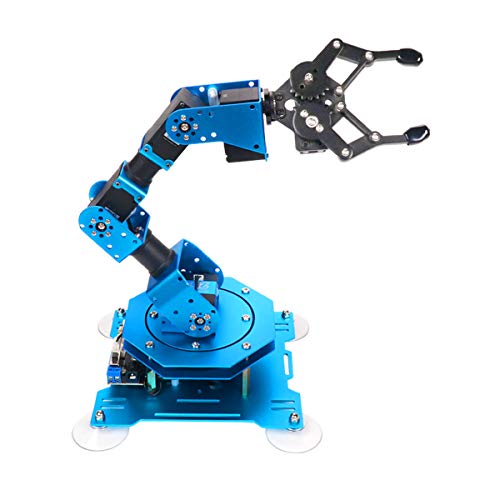
The Hiwonder-xArm1S provides a complete desktop robotic arm experience with six intelligent serial bus servos, delivering position, voltage, and temperature feedback. Its robust aluminum alloy frame and high-torque base bearings ensure stability during grasping and object transportation. The kit supports remote control via wireless devices and can be programmed graphically, aiding students in visualizing robotic actions while exploring bionic principles. The arm’s capability to lift objects up to 500g makes it suitable for classroom demos and hobby projects that require reliable grip strength.
LewanSoul 6DOF Educational Arm (Assembled)
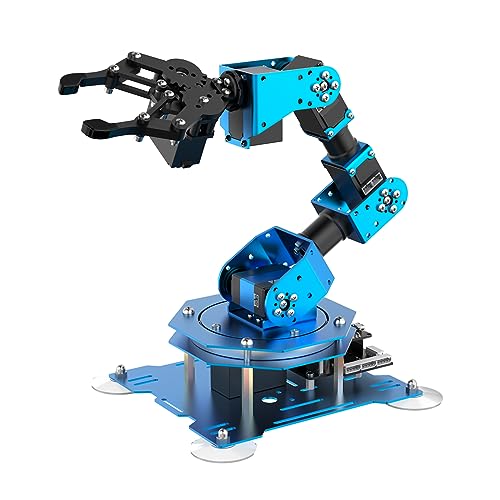
This LewanSoul assembled six-axis robotic arm focuses on Arduino coding and STEM learning. The design emphasizes a premium metal structure with an aluminum alloy bracket and high-torque servos for stable operation. The included control options span PC, app, and mouse control, enabling flexible experimentation—from basic pick-and-place tasks to more complex motion sequences. Students can experiment with graphical programming, sensor feedback, and remote manipulation, making it a strong educational tool for robotics curriculums and maker projects.
ELEPHANT ROBOTICS MyCobot 280 M5

The myCobot 280 M5 is a compact, six-axis collaborative robot designed for education and research. Weighing under a kilogram with a 250g-maximum payload, it remains highly portable while offering precise repeatability (±0.5mm). Its dual displays enhance user interaction, and six high-performance servos drive smooth movements suitable for classroom demonstrations and lightweight automation tasks. The open ecosystem supports Python, ROS, and various development tools, enabling learners to explore programming, robotics control, and automation concepts in a real-world context.
LK COKOINO 6-Axis Metal Robot Arm Kit

This kit emphasizes a precision joystick control system, enabling intuitive manipulation for pick-and-place or drawing activities. It is Arduino-compatible for coding practice in C/C++, supporting STEM learning and hands-on automation development. The metal construction and high-torque servos provide durability for ongoing classroom use and hobbyist projects, with an emphasis on reliable performance under repeated motions. The kit is well-suited for projects requiring accurate positioning and repeatable servo-driven tasks.
Pavv 6DOF Robotic Arm Kit

The Pavv 6DOF kit targets educational settings and introductory robotics programs. With six servo-driven axes and a robust aluminum chassis, it supports demonstrations of fundamental robotics concepts, including forward and reverse kinematics and multi-joint control. The kit’s compatibility with standard MG996 servos and options for higher-performance servos makes it adaptable for increased strength and precision, especially in classroom demonstrations and student-led projects focused on mechanical design and control theory.
Buying Guide: Key Considerations For Selecting A Small 6-Axis Robot Arm
- Intended use: Classroom demos, programming practice, or lightweight automation projects influence payload needs and precision requirements.
- Build quality: Metal frames and robust joints provide stability for repeated movements, while plastic builds may reduce weight but affect durability.
- Control options: Look for arms with multiple control modes (PC, app, joystick, wireless) to support diverse learning scenarios.
- Joint precision and repeatability: Servo quality and feedback mechanisms determine how reliably the arm returns to a target position.
- Ease of programming: Arduino-compatible or Python/ROS support expands learning opportunities and project complexity.
- Payload capacity: Ensure the arm can handle the intended objects, especially when teaching manipulation tasks or tooling.
- Expansion and sensors: Availability of expansion ports, sensors, and peripherals enables secondary development and experimentation.
- Size and footprint: Desktop-friendly dimensions ensure compatibility with classroom desks or maker spaces.
- Cost and upgrade path: Consider future upgrades, servo options, and compatibility with common servo families for scalability.
- Safety and stability: Stable bases and secure joint connections reduce tipping risk during demonstrations and student use.
In choosing a small six-axis robot arm, align features with your curriculum goals, technical skill level, and project scope. Starting with a metal-frame, Arduino-ready option can provide a solid balance of robustness, educational value, and ease of use for beginners while still supporting advanced experiments as proficiency grows.