Single axis motion controllers are essential for precise, repeatable movement in compact CNC setups, 3D printers, and automation projects. This guide highlights five reliable options designed to drive a single axis efficiently, with features ranging from simple pulse/direction control to advanced auto-run and programmable sequencing. Each product is evaluated for compatibility with common stepper and servo motors, ease of integration, and control capabilities to help you choose the right model for your project.
| Product | Brand | Key Features | Image |
|---|---|---|---|
| STEPPERONLINE Stepper Motor Controller | STEPPERONLINE | Single-axis support, fixed operation modes, save settings after power cycle |  |
| SainSmart 1 Axis CNC Servo Stepper Motion Controller | SainSmart | Single axis, 8-digit display, manual/automatic status, autorun via panel |  |
| CNCTOPBAOS Single Axis CNC Motion Controller 40KHz | CNCTOPBAOS | 40KHz, 8-digit display, auto-run, programmable, wide displacement range | 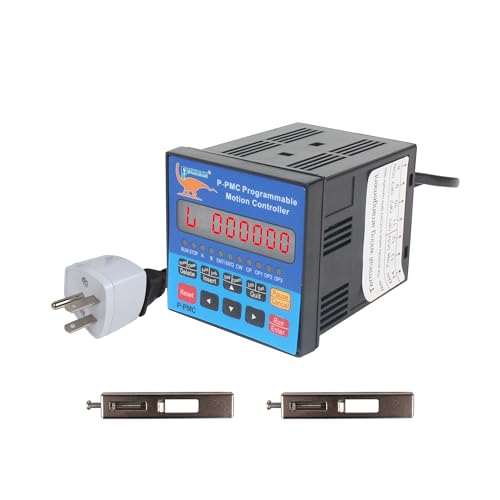 |
| CNCTOPBAOS CNC Single Axis Driver Controller Integrated Board | CNCTOPBAOS | Forward/reverse control, 9 predefined motion modes, LCD display, microstep tuning |  |
| DWEII Mach3 USB Interface Board | DWEII | USB Mach3 motion control, up to 100KHz pulse rate, 4-relay outputs |  |
STEPPERONLINE Stepper Motor Controller
The STEPPERONLINE single-axis controller is designed for compact automation projects using Nema 17 or Nema 23 stepper motors. It offers built-in fixed operation modes to quickly select a motion trajectory, simplifying setup for basic CNC tasks or precise positioning. A notable feature is the ability to save and restore distance, speed, delay, and cycle counts after power-down, helping maintain configuration across restarts without reprogramming.
Key considerations include compatibility with your motor voltage (5–30 VDC typical), and whether the preset modes cover your required path shapes. It is well-suited for straightforward single-axis tasks where quick setup and reliable repeatability are priorities.
SainSmart 1 Axis CNC Servo Stepper Motion Controller
The SainSmart 1 Axis CNC controller integrates an 8-digit display to show steps, counts, procedure IDs, and status indicators. It supports both manual and automatic modes and can auto-run through programmed sequences via the panel, enabling more complex single-axis motion profiles. This model focuses on ease of use and visibility of status, which helps operators monitor live movement without external instrumentation.
Suitable for users who want clear feedback and straightforward operation. Potential limits include the single-axis constraint and reliance on onboard displays for monitoring rather than external diagnostics.
CNCTOPBAOS Single Axis CNC Motion Controller 40KHz
This CNCTOPBAOS model emphasizes a high maximum output frequency of 40KHz with 1 Hz frequency resolution, making it suitable for fast, precise single-axis motion. It offers an 8-digit display for real-time readouts and supports a large programmable instruction set for complex sequences. The device includes dual aspects: a continuous displacement range appropriate for long travel, and a robust set of program editing functions, including insertion and deletion of instructions, to tailor motion paths precisely.
Consider this option when you need tighter control over timing and positioning with a broader range of programmable operations, while still focusing on a single axis.
CNCTOPBAOS CNC Single Axis Driver Controller Integrated Board
This integrated board combines pulse/direction control with forward/reverse angle direction and speed management, designed for Nema 17 and Nema 23 motors. It includes 9 predefined motion modes, a clear LCD readout, and extensive tuning options such as microsteps (1–128) and acceleration/deceleration settings (1–100). The controller also highlights a robust feature set for error handling and a return-to-zero function, which helps maintain predictable positioning across cycles.
Ideal for users needing predefined modes alongside flexible timing and positioning controls, all within a compact single-axis footprint.
DWEII Mach3 USB Interface Board
The DWEII Mach3 USB interface board provides a USB-based Mach3 motion control solution for up to four axes, adapted for servo and stepping motors. Although focused on Mach3, its single-axis applicability makes it a strong option for projects that require a standard PC-based control workflow. The card supports a high pulse rate (up to 100 KHz) and includes four general-purpose relay outputs for spindle control and other devices, expanding the controller’s ability to integrate with ancillary equipment.
Consider this option if your system benefits from a computer-hosted control environment and you need a USB interface with reliable timing for single-axis motion alongside optional amortized expansion via the relay outputs.
Buying Guide: Key Considerations For Single Axis Motion Controllers
- Motor compatibility: Verify voltage range, current rating, and microstepping options to ensure smooth, accurate motion with your specific stepper or servo motors.
- Control mode and programmability: Some controllers offer fixed operation modes, while others support custom sequences, user programs, and auto-run features. Match the required level of control with your project complexity.
- Resolution and speed: Look for frequency ranges (e.g., up to 40KHz) and resolution (1 Hz steps, microstep settings) to achieve the desired precision and throughput on the axis.
- Feedback and stability: Consider whether you need closed-loop feedback, error detection, or programmable error handling to improve reliability under varying loads.
- Power requirements and safety: Ensure the supply voltage and current ratings align with your motor and load, and check for protections such as overcurrent or short-circuit safeguards.
- Diagnostics and usability: LCD displays, status indicators, and intuitive programming interfaces can reduce setup time and troubleshooting efforts, especially for single-axis applications.
- Integration with control systems: If planning to interface with PC-based software or PLCs, consider compatibility with common protocols, such as pulse/direction, TTL, or USB/serial.
- Size, mounting, and environment: For compact builds, verify footprint, mounting options, and environmental tolerance (temperature, dust, vibration) to maintain performance.
- Documentation and support: Availability of manuals, example configurations, and responsive vendor support matter for long-term project success and maintenance.
- Cost vs. features: Weigh the value of additional features (multi-mode operation, auto-run, advanced editing) against budget constraints and project requirements.