When workplaces lack readily available plumbing, self-contained eye wash stations provide immediate, compliant eye irrigation. This guide reviews top options that integrate water storage, simple operation, and ANSI/OSHA compliance. Each pick features portability, durable construction, and clear instructional components to support quick first aid in emergencies.
Summary table of chosen products:
| Product | Brand | Capacity | Key Benefit |
|---|---|---|---|
| 8-Gallon Portable Eye Wash Station | Frifreego | 8 gallons | Wall-mount or portable; quick setup |
| 14gal Portable Eye Wash Station (15min) | Frifreego | 14 gallons | Heavy-duty, gravity-fed, dual mounting options |
| 14gal Portable Eye Wash Station with Dual Nozzles | Frifreego | 14 gallons | Simultaneous dual nozzle flushing |
| 9 Gallon Portable Eye Wash Station | Magula | 9 gallons | One-piece blow-molded, OSHA/ANSI certified |
| Portable Eye Wash Station with Bottle Kit | Frifreego | Bottles included (no solution) | Flexible temporary emergency solution |
Frifreego 8-Gallon Portable Eye Wash Station

This self-contained unit supports eye irrigation for up to 15 minutes with eight gallons of water. The portable design provides flexible placement where plumbing is unavailable, and it can be wall-mounted for quick access. Made from non-toxic polyethylene, it aligns with ANSI Z358.1-2014 standards and is OSHA approved. Installation is simple: fill with clean water and mount at a reachable height to ensure rapid response in emergencies.
Frifreego 14gal Portable Eye Wash Station

This gravity-fed station carries 14 gallons for extended emergency use. It’s designed for environments without plumbing, offering wall-mount or portable deployment. The unit uses non-toxic polyethylene and adheres to ANSI Z358.1-2014 and OSHA guidelines. It supports at least 15 minutes of continuous eye irrigation once filled, making it suitable for industrial and construction settings where quick access matters.
14gal Portable Eye Wash Station with Dual Nozzles

Equipped with dual nozzles, this station enables simultaneous eye flushing for faster relief. It operates as a self-contained unit, requiring no external plumbing. The heavy-duty design emphasizes durability and leak resistance, meeting OSHA and ANSI standards for safe emergency response. The included eye wash signage and labeling support rapid user training and compliance in busy work environments.
Magula 9 Gallon Portable Eye Wash Station

Magula’s 9-gallon self-contained unit is a one-piece blow-molded design, reducing leaks and improving durability in challenging work zones. It’s OSHA-approved and ANSI Z358.1-2014 certified, with a suitable capacity to sustain roughly 15 minutes of eye irrigation. The unit is portable, easy to deploy anywhere, and designed for use with purified water or saline solutions to support rapid first aid.
Frifreego Portable Eye Wash Station with Eyewash Bottles
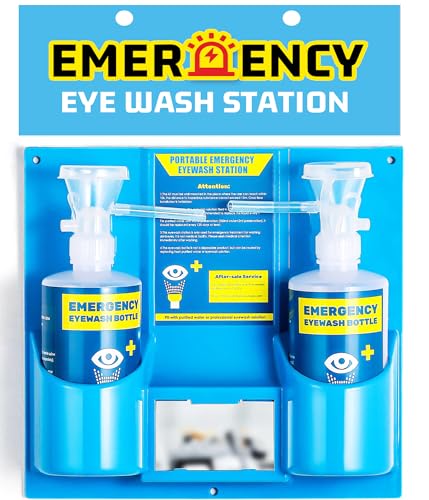
This kit focuses on temporary emergency response, featuring portable eyewash bottles and a wall-mount option for flexible placement. It doesn’t include eyewash solution, allowing users to select appropriate saline or rinsing fluids. The design supports quick deployment near the point of need, with two 16.09-ounce bottles providing immediate flushing before reaching a larger self-contained unit.
PhysiciansCare Wall-Mountable Eyewash Station

PhysiciansCare offers a wall-mountable eyewash station with dual 32-ounce bottles for convenient, sterile isotonic eye rinse. Each bottle is intended for single use, supporting rapid flushing to remove debris and chemicals. This option emphasizes readiness and straightforward operation, fitting workplaces that prioritize quick access and simple maintenance.
SAS Safety Preservatives for Eyewash Station

Preservative solutions for eyewash stations are designed to maintain sterility and readiness of the eyewash system. SAS Safety provides a broad safety portfolio, and these items help ensure ongoing compliance and product quality across industrial, automotive, and construction environments.
Buying Guide
- Capacity and duration: Look for a unit that delivers at least 15 minutes of continuous flush. Higher capacity enables longer actions in larger spaces or when plumbing access is limited.
- Compliance: Prioritize ANSI Z358.1-2014 quality and OSHA approval. These standards ensure proper flow, solution compatibility, and reliability during emergencies.
- Portability vs. fixed mounting: Decide between truly portable units and wall-mounted builds. Portable units offer flexibility across worksites, while wall-mounted models provide constant accessibility and minimal relocation needs.
- Dual nozzles and signage: Dual nozzles speed flushing and improve safety. Clear labeling, emergency signs, and training aids help reduce response times for first responders and bystanders.
- Material and durability: Non-toxic polyethylene or blow-molded construction enhances durability, leak resistance, and resistance to environmental conditions in workshops, labs, and outdoor sites.
- Maintenance and solutions: For self-contained kits, choose options that specify whether solutions are included or require separate purchase. Ensure a clean water source and regular replacement schedules for eyewash solution.
- Placement strategy: Install units near potential hazards, with clear paths and floor drainage considerations when feasible. Ensure mounting height aligns with user reach and visibility requirements.
- Training and readiness: Use included signs, labels, and quick-reference guides. Regular drills improve familiarity and compliance with regulatory expectations.
- Compatibility with environments: For dusty or chemical-heavy settings, consider units with robust seals, corrosion resistance, and easy-to-clean surfaces to maintain hygiene and performance.
- Cost of ownership: Factor in replacement bottles or solutions, potential maintenance wear, and the frequency of refills. A slightly higher upfront cost may reduce long-term maintenance hassles.
Choosing the right self-contained eye wash station involves balancing capacity, portability, and compliance with workplace needs. The options listed above provide a spectrum of configurations—from portable gravity-fed units to wall-mounted kits—designed to support rapid, compliant eye irrigation and swift first aid response in diverse American work environments.