When operations demand confined space entry, a reliable rescue tripod is crucial for safety and efficiency. The right model balances load capacity, leg height, stability, and ease of use in tight environments. Below is a curated list of five top-performing tripods designed to handle common rescue scenarios, with attention to durability, portability, and integrated fall protection features.
| Product | Brand | Load Capacity | Leg Height Range | Cable Length |
|---|---|---|---|---|
| VEVOR Confined Space Tripod Kit, 1800 lbs | VEVOR | 1800 lbs | 7′ legs | 98′ cable |
| VEVOR Confined Space Tripod Kit, 2600 lbs | VEVOR | 2600 lbs | 8′ legs | 98′ cable |
| TRSMIMA Confined Space Tripod Kit | TT TRSMIMA | 1200 lbs | 7′ adjustable | 98′ cable |
| VEVOR Confined Space Tripod Kit, 1200 lbs | VEVOR | 1200 lbs | 7′ legs | 98′ cable |
| YATOINTO Confined Space Tripod Kit | YATOINTO | 1200 lbs | 4.4′ to 7′ legs | 98′ cable |
The selections emphasize robust lifting capacity, durable one-piece construction, and reliable fall protection components. Each kit includes a winch or lift mechanism, a fall arrester, and a carrying bag for on-site versatility. For responders and industrial teams, these options aim to deliver dependable performance in challenging confined-space environments.
VEVOR Confined Space Tripod Kit, 1800 LBS

This tripod offers an 1800 lbs towing capacity and a 32.8′ fall protection line. It features a Φ5 mm steel wire cable with a lift capacity of 397 lbs, suitable for heavy-duty rescue tasks. The design is a one-piece molded metal body with secure connections; an alloy steel pulley locks the cable smoothly. The anti-rotation aviation-grade steel cable enhances safety, and the kit includes a 350 lbs full-body harness and a storage bag for easy transport.
VEVOR Confined Space Tripod Kit, 2600 LBS
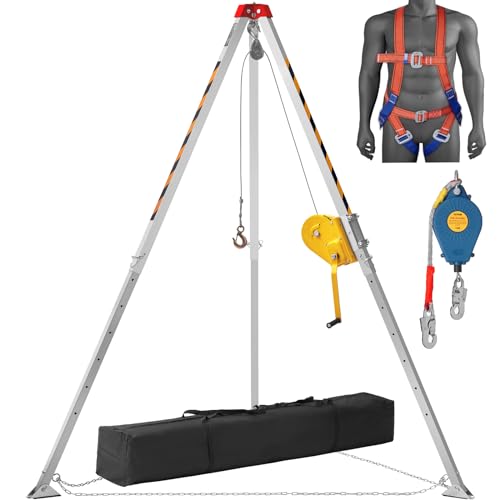
This model doubles the towing capacity to 2600 lbs while retaining the same 98′ cable length and a rugged 8′ leg span. The Φ6 mm steel wire cable maintains a high-strength profile, and the kit remains a one-piece molded, durable construction with secure connections. A full-body security harness and fall arrester are included, with compact storage in a black bag for field use. Ideal for more demanding rescue scenarios where heavier loads are anticipated.
TRSMIMA Confined Space Tripod Kit

The TRSMIMA offering features a 1200 lbs winch with 98′ cable and 7′ adjustable legs. Its self-locking device ensures safe ascent and descent, while the extendable handle provides ergonomic operation. The kit includes a foldable tripod, fall arrester, reflective safety chain, and a carry bag. Built for emergency responders and municipal crews, it balances portability with resilience in variable terrains and temperatures.
VEVOR Confined Space Tripod Kit, 1200 LBS

Designed for lighter-duty rescue tasks, this 1200 lbs model retains the core features of VEVOR’s line: a rugged one-piece molded design, secure pulley mechanism, and anti-rotation steel cable. The kit includes an efficient fall arrester and a convenient storage bag, ensuring quick deployment and transport to confined spaces where moderate loads are anticipated.
YATOINTO Confined Space Tripod Kit

The YATOINTO kit provides 1200 lbs load capacity with a versatile 4.4′ to 7′ leg range and a 98′ winch cable. It integrates a 32.8′ self-retracting fall arrester for automatic locking during descents. The legs feature ring-type protection chains and adjustable feet with reflective strips for visibility. The design emphasizes secure operation on uneven surfaces and during rapid setup in critical rescue scenes.
Yellulu Confined Space Tripod Kit

The Yellulu kit extends the lineup with a 2600 lbs capacity and an 8.04′ leg span, offering a robust option for heavier loads. Its 1102.31 lbs load-bearing capability and 65.62 ft steel wire rope length cover a broad range of rescue profiles. The set emphasizes stability on irregular terrain and ease of transport for rapid deployments in industrial or municipal settings.
Buying Guide
When selecting a confined-space rescue tripod, consider these key factors to align with your operation needs:
- Load Capacity: Choose a model that exceeds the maximum anticipated load, including the rescuer, any rescue gear, and potential gear weight. Higher ratings often correlate with more durable construction but may add weight.
- Leg Height and Adjustability: A broader height range increases versatility for different hole sizes and terrain. Look for retractable or adjustable legs with secure locking mechanisms.
- Cable and Winch System: Assess cable diameter, length, and material. Self-locking or auto-locking designs enhance safety during ascent and descent. Ensure the winch handles are ergonomic and within reach for responders wearing gloves.
- Fall Protection Features: An integrated fall arrester or self-retracting mechanism minimizes uncontrolled descents. Confirm it locks reliably and is compatible with your existing safety gear.
- Durability and Material: Stainless steel or high-strength aluminum constructions offer corrosion resistance and long service life in harsh environments. Consider anti-rotation cables for added stability during movement.
- Portability and Storage: Kits with compact storage bags or cases facilitate on-the-go deployment. Weight and balance affect transport between sites.
- Included Accessories: Harnesses, safety chains, and protective brackets add value. Check whether the kit provides a full set of PPE-compatible components.
- Maintenance and Compatibility: Verify availability of spare parts, pulleys, and cables. Ensure compatibility with common rescue harnesses and anchors used by your team.
- Certifications and Standards: Look for equipment meeting relevant safety standards and industry guidelines to ensure reliability in critical scenarios.
In choosing among these options, teams should balance maximum load requirements with portability, compatibility with existing gear, and the typical work environment. A higher-capacity model may be prudent for industrial settings, while lighter-duty kits can be preferable for rapid response tasks where quick deployment is essential.