Choosing the right rack is essential for organizing servers, switches, UPS devices, and AV gear in a data center or office IT room. The following picks come from reputable brands and offer a range of depths, weights, and mounting options to fit different equipment footprints. Each product is evaluated for versatility, ease of assembly, airflow, and secure mounting. Use this guide to compare open-frame racks, wall-mount shelves, and center-weighted shelves that optimize space without compromising accessibility or safety.
| Product | ||
|---|---|---|
| StarTech 4-Post 42U Mobile Open Frame Rack | Open frame | High capacity, versatile mounting, mobile options |
| Vivlly 10U Server Rack | Open frame / floor standing | Heavy-duty capacity, quick assembly |
| StarTech 2U Center-Mounted Shelf | Center-mounted shelf | Easy access front/back, supports 2U equipment |
| StarTech 8U Wall Mount Rack RK812WALLOA | Wall-mount 2-post | Compact, adjustable depth, good airflow |
| NavePoint 19″ Center Weight Rack Shelf | Center-weighted shelf | Additional mounting flexibility for depth-heavy gear |
StarTech 4-Post 42U Open Frame Server Rack

This 4-post, 42U open frame rack is built to host servers, switches, and AV gear with a 600 kg (1320 lb) weight capacity in either casters, leveling feet, or floor mounting configurations. It supports adjustable mounting depth from 22″ to 40″ (56 cm to 101 cm), enabling installation of a wide range of equipment. The design emphasizes ventilation and accessibility, helpful when cable routing and gear swapping are routine tasks. It is compliant with EIA/ECA-310-E standards and ships flat-packed for protection during transit and efficient assembly.
Key considerations include overall height of 80.3″ with casters or 78″ without, ensuring it fits the allotted space, and the ability to reconfigure the rack layout as your data center evolves. The durable cold-rolled steel construction supports heavy loads while maintaining airflow through 42U of mounting height. This makes it suitable for expanding environments that require mobility and flexible deployment in server rooms or IT closets.
Vivlly 10U Server Rack Open Frame

The Vivlly 10U open-frame rack is designed for floor-standing use, with a robust 400 lb capacity on the floor-standing model and lighter wall-mount options up to 150 lb with included hardware. It provides 17.5″ tall by 20.24″ deep frame space to accommodate most 19″ rack-mount servers, switches, routers, and UPS systems from major brands. The design prioritizes quick installation, with mounting screws, wall brackets, and adjustable vented shelves included for flexible configuration. Open-frame construction supports airflow and straightforward cable management.
Consider how this unit balances weight capacity with footprint. It’s ideal when you anticipate future expansion or need a straightforward, fast-to-deploy solution in a data center or tech room. The option for wall mounting is beneficial for smaller rooms or areas where floor space is at a premium. The kit’s versatility helps IT teams respond quickly to changing rack equipment needs.
Jingchengmei 2U Cantilever Server Shelf Rack Mount
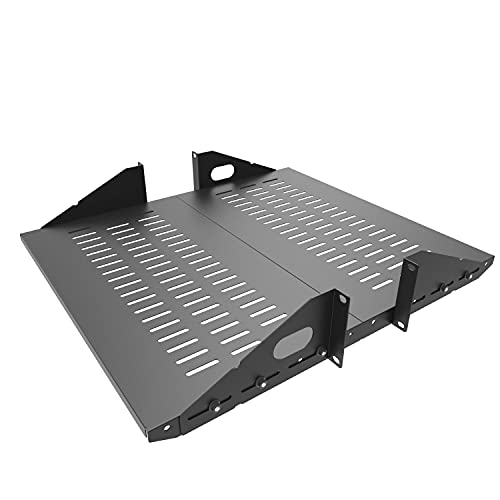
This 2U center-weighted cantilever shelf fits all 19″ racks and cabinets, providing a compact solution for mounting shelves that need center support. The kit includes two shelves with vented designs to promote airflow and compatibility with a broad range of IT gear. Dimensions specify 19″ width with a 10″ depth per shelf, suitable for equipment that benefits from a center-mounted, easy-access layout. Its center-weighted construction helps distribute weight to reduce rack leaning, especially when heavier devices occupy the front or rear bay.
When selecting a shelf, evaluate compatibility with your rack depth, mounting post spacing, and the ability to reconfigure orientation as equipment changes. This option caters to environments where adding shelves without full cage racks is advantageous, offering a flexible path to expand capacity without replacing existing racks.
StarTech 2U Server Rack Shelf, Center Mounted

This universal 2U center-mounted vented shelf is designed for 19″ racks with a maximum internal depth of 20″ (50.8 cm). The center-mount design provides convenient front-to-back access for installation, maintenance, and cable management, making it easy to service equipment from either side. Fabricated from 1/16″ (1.5 mm) SPCC steel, the shelf supports up to 200 lbs (91 kg), delivering reliable durability for various IT components. The vented construction supports airflow to maintain equipment temperatures within acceptable ranges.
Key considerations include the need for accessible front and back sides of equipment and ensuring proper depth alignment with existing rack rails. This shelf offers a practical approach to integrating non-rack-mountable devices or additional gear into a 19″ rack without committing to a full cage or cabinet.
NavePoint 19″ Center Weight Shelf

The NavePoint 19″ center-weight rack shelf emphasizes balanced weight distribution with a depth of 18.75″ and a 132 lb capacity per shelf. Its profile is designed for center-weighted mounting, providing an additional mounting surface within existing racks that may already be near full width. The slotted venting promotes airflow, helping prevent hotspots in dense rack configurations. This shelf suits environments where equipment placement is front-to-back and weight distribution is a factor in maintaining rack stability.
When evaluating this option, consider rack rail spacing and overall system weight to ensure stability and safety. Center-weight shelves help optimize space usage and can be a practical addition to data centers needing more mounting surfaces without expanding rack footprints.
Buying Guide: Key Purchase Considerations
- Rack type and space: Open-frame racks offer airflow and accessible front/back, while wall-mount and center-weight shelves save floor space in smaller rooms. Assess room dimensions and future expansion plans.
- Weight capacity: Choose a rack or shelf that supports both current and anticipated equipment load. Verify both static and dynamic load ratings and ensure adequate margin for future gear.
- Depth and footprint: Depth compatibility is critical for servers and switches. Adjustable-depth racks add flexibility, while fixed-depth shelves simplify installation.
- Ventilation and cable management: Ventilation is essential for preventing overheating. Look for vented shelves and racks with cable-routing options or grommets to reduce airflow obstruction.
- Ease of assembly and mobility: Flat-pack, pre-drilled kits speed up setup. If space or access is limited, consider racks with caster wheels or easy relocation features.
- Material and durability: Cold-rolled steel provides strength and longevity; check the finish and corrosion resistance for reliability in data centers or harsh environments.
- Security and access: Locking doors or secure mounting hardware protect sensitive equipment. Determine whether you need front, back, or both-side access for maintenance.
- Compatibility: Ensure racks and shelves are compatible with standard 19″ equipment and the weight distribution requirements of your devices.
- Shipping and installation: Flat-pack or pre-assembled options affect installation time and protection during transit. Review included hardware and mounting options.
- Cost vs. scalability: Balance upfront costs with long-term scalability. A modular solution may reduce total cost of ownership as equipment grows.
In summary, selecting the right data center rack depends on space, weight requirements, airflow, and serviceability. Open-frame racks suit high-heat environments with flexible configurations, while wall-mount and center-weight shelves add space-saving options for smaller rooms or incremental upgrades. Consider combining different rack types to optimize airflow and accessibility across the data center floor.