Choosing the right pressure reducing valve (PRV) helps protect pipes, fixtures, and appliances while conserving water. This guide highlights top PRVs suited for residential and light commercial use, with simple gauge monitoring and durable brass construction. Read on to compare features, installation notes, and performance considerations.
| Product | Brand | Size | Key Feature |
|---|---|---|---|
| Water Pressure Regulator 1/2″ with Gauge | FASBET | 1/2 inch | Gauge included; brass body; kit includes wrench and seal tape |
| Water Pressure Regulator 3/4″ with Gauge | FASBET | 3/4 inch | Gauge included; versatile DN20; high-pressure tolerance |
| Cash Acme EB45 Double Union 3/4″ | Cash Acme | 3/4 inch | Tamper-resistant; inline design; NSF/ANSI 372 compliant |
| Zurn Wilkins 34-NR3XLDU 3/4″ | Zurn | 3/4 inch | Compact, cartridge-loaded; quick repairs; multiple tailpieces |
| Watts LF25AUB-Z3 3/4″ | Watts | 3/4 inch | Wide pressure range; lead-free; replaceable seat module |
Water Pressure Regulator 1/2 Inch With Gauge

The FASBET 1/2 inch water pressure regulator is crafted from 100% brass for durability and corrosion resistance. It includes a pressure gauge, wrench, and sealing tape for complete installation. The device supports up to 1.6 MPa (about 232 psi) and is designed to be installed before most household water appliances, helping to prevent damage from spikes and prolong plumbing life. The kit’s gauge allows real-time monitoring to maintain consistent downstream pressure.
Water Pressure Regulator 3/4 Inch With Gauge

The 3/4 inch FASBET regulator mirrors the 1/2 inch model with a larger flow path, maintaining up to 1.6 MPa pressure tolerance. It ships with a pressure gauge, wrench, and sealing tape for straightforward, turnkey installation. Suitable for homes, multi-unit buildings, and light commercial use, it helps stabilize water pressure for showers, faucets, and appliances, reducing strain on fixtures and saving water over time.
Cash Acme EB45 Double Union 3/4″ PRV
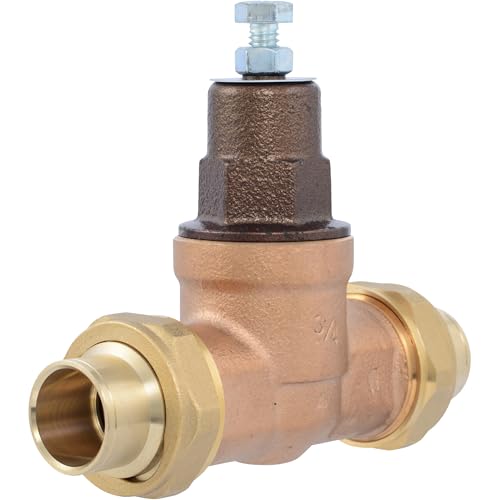
The EB45 Double Union PRV from Cash Acme features a compact inline design with easy access to the pressure-adjusting screw. Its double-union configuration simplifies disassembly for maintenance, and construction combines brass and stainless components for durability. The valve is NSF/ANSI 372 compliant, making it suitable for potable water systems in both residential and commercial settings, with robust tamper-resistant features to prevent unintended changes to system pressure.
Zurn Wilkins 34-NR3XLDU 3/4″ PRV

Featuring a short lay length and compact profile, the 34-NR3XLDU is designed for tight installations. Its cartridge-loaded system simplifies future repairs, and tailpiece options—threaded, PEX, copper sweat, and CPVC—provide flexible connection choices. This model is well-suited for spaces where a smaller footprint is essential, offering dependable downstream pressure regulation in various plumbing configurations.
Watts LF25AUB-Z3 3/4″ PRV

The Watts LF25AUB-Z3 reduces incoming water pressure to protect plumbing systems across commercial, industrial, and residential applications. It covers a widely adjustable range from 25 to 75 psi, with a standard setting around 50 psi. Made from lead-free copper silicon alloy with a stainless steel strainer and corrosion-resistant components, this model features a replaceable seat module for long-term maintenance and reliable performance under fluctuating water pressures.
Buying Guide: Key Considerations And Comparisons
- Pressure range and setting: Choose a PRV capable of handling your building’s typical pressure and peak spikes. Models listed here commonly support 25–75 psi or higher, with adjustable settings for precise control.
- Material and durability: Brass bodies with stainless components resist corrosion and deployment in various environments. Lead-free materials are preferable for potable water systems.
- Connection type and size: Common residential sizes include 1/2″ and 3/4″. Verify thread types (NPT, sweat, compression) and compatibility with existing piping.
- Gauge inclusion: Valves with built-in gauges enable ongoing monitoring and rapid diagnostics, especially in buildings with fluctuating pressure.
- Maintenance and serviceability: Cartridge-based designs and double/unions offer easier maintenance and faster replacement of internals without full valve removal.
- Certifications: Look for NSF/ANSI 372 or other potable-water certifications to ensure safety and compliance in family homes.
- Installation context: In tight spaces or before multiple appliances, compact designs and alternative tailpieces enhance fit and ease of installation.
- Maintenance access: Tamper-resistant features prevent accidental adjustments in commercial or shared-practice environments.
In summary, selecting a PRV involves matching pressure range, material quality, and installation constraints to your plumbing needs. The five highlighted products offer various configurations—single and double unions, gauges, compact footprints, and flexible tailpieces—that address common residential and light commercial scenarios. Always follow manufacturer guidelines and local code requirements during installation.