Choosing a portable fume extractor for welding involves balancing strong suction, filter quality, noise level, and ease of use. The right unit protects lungs, reduces lingering odors, and improves workspace comfort, whether you’re at a home shop or a dedicated studio. Below, five top options from trusted brands offer robust filtration, practical features, and portability to fit different welding and soldering tasks. Review each product’s filtration stack, airflow, and user-friendly design to identify the best fit for your setup.
| Product | Brand | Filtration | Airflow | Notes |
|---|---|---|---|---|
| KQZ-W1 Solder Fume Extractor | KQZ | 9mm pre-filter + H13 HEPA + activated carbon | 168 m³/h | Excellent for soldering, welding and small 3D printing spaces |
| KOTTO Strong Suction Smoke Absorber | KOTTO | HEPA/Carbon options; 24-inch hose | 52 CFM | Flexible directing with adjustable suction |
| KQZ 150W Solder Fume Extractor | KQZ | Multi-layer HEPA + activated carbon | 280 m³/h | High airflow with intelligent control |
| Upgraded ToolBud Solder Fume Extractor | ToolBud | Two detachable magnetic baffles + dual filters | Not specified | Portable with magnetic extensions |
| M-T Solder Fume Extractor | M-T | HEPA + carbon triple-layer | 168 m³/h | Three-speed adjustment |
Note: The table highlights filtration type, airflow, and portability considerations for practical welding and soldering environments. Always verify current specifications from the retailer before purchase as models may update filters or fan configurations.
KQZ-W1 Solder Fume Extractor

The KQZ W1 fume extractor uses a high-efficiency centrifugal motor delivering 168 m³/h of purified air. Its filtration stack combines a 9mm pre-filter with an H13 HEPA layer, fully covered by activated carbon to address odors and volatile compounds. This arrangement captures 99.99% of airborne pollutants, including smoke particles and heavier metals such as Pb, Hg, and As, for a safer workspace. Inverter technology supports a wide voltage range (110V–220V), allowing stable operation across different power sources. A single-button operation keeps setup simple for welding and soldering tasks.
Key considerations: The dual-layer design extends filter life, reducing maintenance costs, and the compact footprint supports space-limited shops. While airflow is strong for small to mid-size projects, larger industrial welds may require higher-volume extractors. The unit’s emphasis on odor removal makes it well-suited for mixed environments like 3D printing studios that also involve soldering or welding.
KOTTO Strong Suction Smoke Absorber
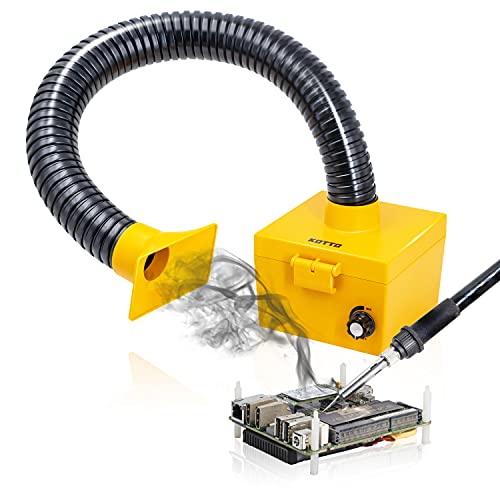
The KOTTO unit features a flexible 24-inch hose and a fume hood that can be positioned to capture fumes precisely where they arise. It offers adjustable high-suction performance with a 6000 RPM fan, delivering powerful smoke removal within a few inches of the source. The system supports operation while charging or plugged in, which can be useful during longer soldering sessions or detailed welding work. Static pressure and noise figures indicate a balance between strong performance and tolerable sound levels for workshop environments.
Key considerations: The hose-driven approach provides direct capture at the source, reducing air leakage and exposure. Users should assess whether the included tube length matches their typical workpiece size and whether the unit’s suction is sufficient for heavier welding fumes. The model’s portability and simple controls make it a practical choice for hobbyists and small businesses seeking quick setup and reliable extraction.
KQZ 150W Solder Fume Extractor

With a robust 150W motor and an air volume of 280 m³/h, this model emphasizes high airflow and filtration efficiency. It features a three-layer filtration system with pre-filter, HEPA, and high-iodine value activated carbon. The combination is designed to achieve up to 99.97% filtration for particles and odors, which is particularly effective for welding fumes that include smoke and volatile compounds. The unit offers intelligent LED control and a remote for convenient speed adjustments, timer settings, and anti-clog alarms, enabling precise control during carpentry or electronics work alongside welding or laser processes.
Key considerations: The advanced filtration stack helps address both particulate and VOC concerns common in welding environments. The intelligent features add convenience for multi-task workshops. It is suitable for laser engraving, 3D printing, and welding scenarios where consistent filtration and user control are valued. Slightly higher noise is a trade-off for greater suction and filtration capacity, so consider the noise tolerance of your workspace.
Upgraded ToolBud Solder Fume Extractor
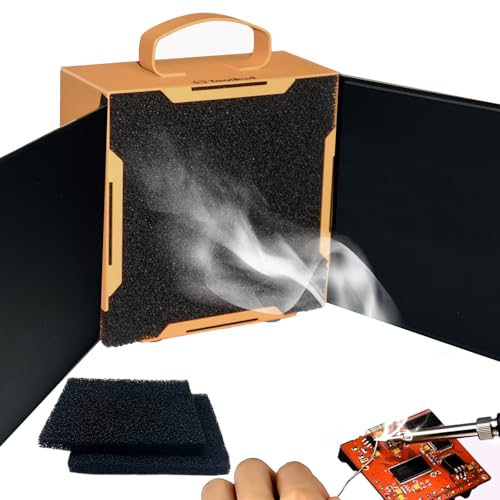
The ToolBud model emphasizes portability and modularity with removable magnetic flaps and two detachable filters. Its design supports quick expansion of coverage for larger work areas, particularly in compact spaces where smoke may spread if not captured near the source. The device uses two filters as standard and includes magnetic arms to secure workpieces or additional components during operation. This configuration is especially helpful for small electronics and jewelry work, where precise fume control is essential but mobility remains a priority.
Key considerations: The magnetic flaps enable rapid customization of airflow path, but users should confirm the exact suction power for their specific welding tasks. If you frequently switch between soldering and lighter welding, the ToolBud’s adaptability can be advantageous. Low-profile design helps with storage and transport in shared or multi-use studios.
KQZ 100W Solder Fume Extractor
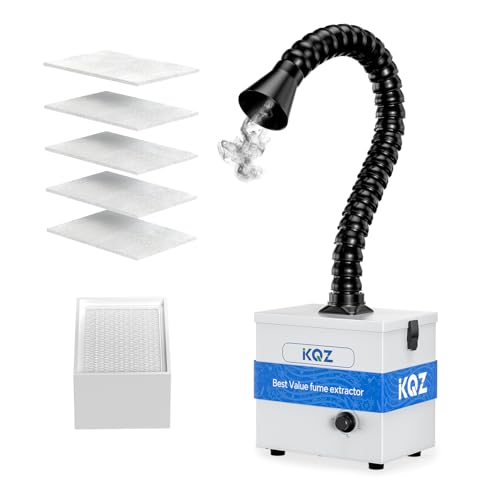
Within the 100W class, this KQZ model raises the bar with multi-stage filtration and a sealed construction that protects the internal components. It delivers up to 99.97% purification with a 70% carbon content in the filter, designed to reduce odors and fumes associated with welding, laser cutting, and 3D printing. A robust insulation approach and fuse protection contribute to safety and reliability during extended sessions. The product emphasizes airflow stability across speeds thanks to a proprietary vortex-based motor design, providing consistent extraction even under demanding workloads.
Key considerations: This unit targets a balance of cost and capability, offering high purification without demanding industrial-scale equipment. It is well-suited for home shops, hobbyists, and small studios where steady performance and odor control are priorities. It may pair well with smaller workstations where excessive footprint is a concern.
Buying Guide: Key Purchase Considerations
Airflow and filtration: Look for units with multi-layer filtration that combine HEPA with activated carbon to address both particulates and volatile compounds. Higher airflow benefits larger workspaces or more intense fumes, but consider room size to avoid overkill or excessive noise.
Filtration life and maintenance: Filters with replaceable cartridges and washable components save ongoing costs. Check filter replacement intervals and whether the unit supports easy access for cleaning and maintenance.
Source capture strategy: Hose-directed, hood-mounted, and compact source-capture designs provide different advantages. Flexible hoses and adjustable nozzles improve capture efficiency for soldering and welding, especially in tight spaces.
Noise and power: Heavy-duty units may generate more noise. If you operate in a shared space or long sessions, prioritize models with lower dB ratings or adjustable speed controls to balance performance and comfort.
Durability and portability: Steel housings and sealed constructions enhance longevity in workshop environments. Lightweight and compact models with carrying handles or wheels improve mobility between stations or jobs.
Control features: LED indicators, remote controls, timers, and anti-clog alarms help manage operation without constant monitoring. Consider whether you need smart features, such as automatic speed adjustments based on detected fumes.
Compatibility and expansion: If your workspace includes 3D printers, laser engravers, or multiple welding stations, consider units that can be upgraded with additional filters or extended hoses. Ensure the unit’s voltage compatibility matches your power supply.