Choosing the right pipe weld positioner can dramatically improve alignment, stability, and efficiency during welding projects. This guide examines five top-rated options that balance capacity, adjustability, and portability for American welders tackling butt welds, pipelines, and fittings. Each product offers distinct strengths—from compact, on-site clamping to heavy-duty table tilting and variable speeds—helping you select a model that matches your workflow and space.
| Product | Brand | Best For |
|---|---|---|
| Welders 3rd Hand – Portable Pipe Welding Clamp & Alignment Tool | Sawyer Mfg Company | Precise butt weld alignment, portable on-site jobs |
| KAKA INDUSTRIAL Welding Positioner | KAKA INDUSTRIAL | Heavy-duty rotation with tilt, large capacity |
| PreAsion 110V Tank Turning Welding Rolls | PreAsion | Wide diameter range, PU roller contact |
| INTSUPERMAI Pipe Tank Welding Linkage Roller | INTSUPERMAI | Pipeline welding support |
| LEHUNDI 10KG Rotary Welding Positioner | LEHUNDI | Compact yet capable turntable for small to medium work |
Welders 3rd Hand – Portable Pipe Welding Clamp

The Welders 3rd Hand from Sawyer Mfg Company is designed for butt welds and pipe fittings, providing precise alignment during welding. Its clamp system secures workpieces firmly while offering quick adjustments, which can improve throughput on challenging materials such as aluminum and steel. The device emphasizes portability, making it suitable for both on-site welding and shop environments. Its lightweight build does not compromise stiffness, enabling dependable positioning without introducing significant fatigue during longer weld runs. This tool supports efficient alignment and steady welding performance across various pipe sizes.
Key features include a versatile clamping system that maintains consistent alignment for butt welds, and a design focused on improving workflow efficiency. The tool aims to reduce movement during welds and provides an intuitive setup that benefits both novice and experienced welders. While compact, it delivers reliable grip and adjustability suitable for a range of pipe fitting tasks, contributing to faster setup times and more repeatable results in everyday welding projects.
KAKA INDUSTRIAL Welding Positioner 485 lbs Tilt 0-135º

The KAKA INDUSTRIAL welding positioner delivers robust rotational capability with a 0-135° tilt range and a 485 lb horizontal capacity. Powered by a 125W rotation motor and a 110V single-phase supply, this unit supports high-load welding operations with controlled, stepless speed adjustments from 0 to 5 RPM. An integrated table design and a self-locking worm gear mechanism help maintain precise positioning during welding. The combination of tilt and rotation makes it well-suited for pipe work that requires multi-axis alignment, enabling precise welds across varied orientations while maintaining stability under load.
Designed for heavier projects, its capacity and smooth speed control enable consistent weld quality on larger pipes and assemblies. It’s particularly beneficial when simultaneous clamping and positioning are needed to align complex joints before welding, reducing rework and improving overall productivity in fabrication shops and field environments.
PreAsion 110V Tank Turning Welding Rolls

The PreAsion tank turning rolls offer substantial load capacity and a broad diameter range, making them suitable for large pipe and tank welding projects. With a 2″-24″ working diameter range and a 2200 lb loading capacity, these rollers are built to handle substantial workpieces. The polyurethane rollers provide enhanced friction and surface protection, reducing slip while preserving the integrity of the workpiece surface. The adjustable roller configuration supports different piece diameters, and the rotation speed can be tuned to suit the welding process, providing a balance between speed and control.
Designed for versatility, these turning rolls are compatible with variable setups and can be adapted for both inline and off-axis welding tasks. The wide diameter range and robust construction make them a practical choice for shops that regularly move and weld large-diameter pipes, tanks, and other cylindrical fabrications.
INTSUPERMAI Pipe Tank Welding Linkage Roller
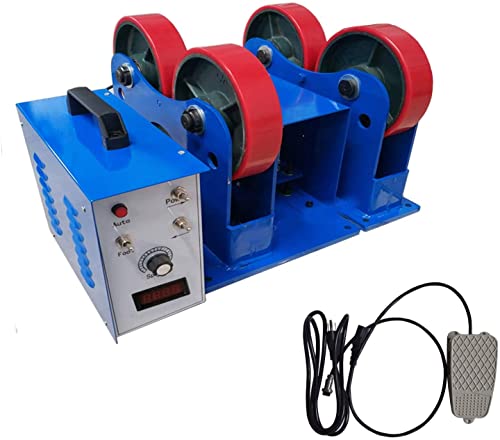
The INTSUPERMAI welding linkage roller provides a dedicated support system for pipeline welding, including both inside and outside pipe work. It emphasizes a clean, dry, and ventilated workspace to maintain safe operation and protect equipment. The design includes a ground-reliant safety requirement, which aligns with standard welding safety practices. The unit is tailored to professional welding scenarios where maintaining precise position and stable rotation is essential for consistent weld quality, especially when handling long runs or awkward pipe configurations.
As a dedicated welding aid, it complements other positioners by enabling smoother feed and rotation, reducing operator fatigue and ensuring more uniform welds. It is best used in controlled environments such as workshops where consistent electrical and grounding safety can be maintained throughout the welding process.
LEHUNDI 10KG Rotary Welding Positioner

The LEHUNDI HD10 offers a compact, portable turntable with a 10 kg capacity and a 180 mm (approximately 7 inches) working diameter. It tilts from 0° to 90° and provides a speed range from 2 to 20 rpm, enabling fast or precise positioning as needed. The 9 kg weight and manageable dimensions make it suitable for small to mid-sized welding jobs where space is limited, yet reliable positioning is still required. A three-jaw chuck provides a secure grip on small parts, reducing movement during welding and improving overall accuracy for pipe and small-diameter tube work.
Its portability and straightforward controls make it a practical option for hobbyists and professionals who need a reliable, space-saving positioner for routine welding tasks. The device is particularly useful for repetitive welds on shorter runs, where quick repositioning improves workflow without sacrificing stability.
Buying Guide: Key Purchase Considerations
- Load capacity and size compatibility: Match the positioner’s max load and clamping range to your typical pipe diameter and wall thickness. Heavy-duty units handle large pipelines, while compact models suit small-diameter tubes and projects with limited workspace.
- Tilt and rotation range: A wider tilt (0-135° is common) and rotation (0-5 RPM or higher) increases flexibility for multi-axis welding. Consider whether you need stepless control or discrete speed settings for precise welds.
- Power source and control: Most professional positioners run on 110V or 220V single-phase power. Features such as foot switches, programmable time controls, or remote operation can boost productivity in busy shops or on-site jobs.
- Roller and clamp design: PU rollers, adjustable diameters, and secure clamps reduce slippage and protect the workpiece. A good clamp should be adjustable for different pipe sizes without excessive repositioning.
- Portability vs. rigidity: Lightweight units offer excellent on-site versatility but may sacrifice some rigidity. Heavier units provide stability during long welds but require more space and setup time.
- Safety and grounding: Ensure proper grounding and adherence to safety guidelines, especially for units with exposed rotating parts and higher load capacities.
- Workspace and workflow fit: Assess your typical project types—inline pipe welding, tank fabrication, or bulk pipeline projects—and pick a positioner that aligns with those workflows to minimize transfer and re-clamping.
When selecting a pipe weld positioner, consider how often you need to reposition, the typical pipe diameters you weld, and whether you prioritize portability or maximum load. A balanced choice often involves a combination of rotation, tilting capability, and secure clamping that suits a range of pipe sizes without sacrificing stability. For on-site work, lightweight and portable options with straightforward setups can speed up job completion while maintaining weld quality. In a shop setting, heavier, more precise units with programmable controls and higher load capacity can maintain consistent results across multiple projects.