The following guide highlights leading pad printing machine manufacturers and their top models. Each entry summarizes capabilities, speed, and key features to help buyers compare options for metal, plastic, glass, textiles, and more. This overview focuses on machines that balance high throughput with precise imprinting on irregular surfaces.
| Product | Brand | Key Strength |
|---|---|---|
| Manual Pad Printing Machine, 3.5″ Ink Cup | Pazcii | Adjustable workbench; durable build |
| Pad Printing Machine, Pneumatic with Adjustable Head | Ynomdusa | High speed; easy operation |
| 110V Pneumatic Pad Printing Machine | TREMENPOW | High efficiency; versatile surfaces |
| TENNIEX Pneumatic Pad Printer | TENNIEX | Fast; large coverage patterns |
| HZOPUTLH Pad Printer | HZOPUTLH | Adjustable workbench; broad capabilities |
Manual Pad Printing Machine With Adjustable Workbench

This Pazcii model combines a robust metal frame with a silicone pad and an adjustable workbench to accommodate various item shapes and sizes. The design emphasizes durability through a silicon and aluminum build, plus a rust-resistant coating. Users benefit from consistent imprinting across repetitive tasks, making it suitable for small to mid-volume runs on metal, plastic, glass, and ceramics. The unit allows vertical and horizontal adjustments, enabling precise positioning for achieving clean, legible prints on raised or curved surfaces. The included rubber pad aids in achieving even ink transfer, helping logos and labels remain sharp on textured substrates. Operational precision supports consistent results in labeling and branding workflows.
Key features include a sturdy construction designed to resist wear, an adjustable footprint to align with different products, and a focus on reliable repeatability. This model is appropriate for DIY labels, small batch branding, and craft projects where control over transfer alignment is critical. It provides a balance between manual control and dependable output, making it a practical entry point for shops exploring pad printing without committing to fully automated systems.
Consider this option if you need a compact, versatile pad printer with strong durability, good payback potential, and straightforward operation. It is well-suited for craft studios and light industrial environments seeking dependable, repeatable results without the complexity of larger production lines.
Ynomdusa Pneumatic Pad Printing Machine

The Ynomdusa model is a high-velocity pneumatic pad printer designed for continuous production. Capable of handling up to 2,200 pieces per hour, it emphasizes speed without compromising accuracy. The machine includes an adjustable adhesive head and a foot switch for ergonomic operation, which helps streamline workflows in busy environments. With a generous print area, it supports patterns up to 75 millimeters in diameter and 50 mm x 50 mm in practice, enabling detailed, high-precision transfers on small consumer items, hardware components, and customized labels.
Users benefit from an intuitive control console that supports multiple printing modes and speeds, plus an integrated count display to track workload. This makes it suitable for label production, logo stamping, and short-run embossing tasks in small factories or design studios. The Ynomdusa unit is especially valuable for operations that prioritize throughput alongside precise, repeatable results on varied substrates.
In short, for teams seeking fast cycle times, reliable repeatability, and straightforward operation, this pneumatic pad printer provides a strong balance of performance and ease of use. It suits manufacturers and makers focusing on rapid customization without sacrificing print clarity on irregular surfaces.
110V Pneumatic Pad Printing Machine, Semi-Automatic

This semi-automatic unit from TREMENPOW focuses on high efficiency with a 2,200 pieces-per-hour capacity. It combines a pneumatic cup printer design with a flexible workbench that can adapt to irregular surfaces, including plastics, hardware, fabrics, and other substrates. The adjustable head supports precise alignment for each print cycle, helping to achieve consistent results across batch runs. Operators benefit from a straightforward control panel and a foot switch, easing mode changes and job tracking during production or studio projects.
Key advantages include fast throughput, robust printing quality, and a versatile footprint that accommodates a range of product shapes. The device is particularly well-suited for studios, craft shops, and small manufacturers that need reliable, scalable printing for branding, date codes, or decorative patterns on multiple materials. By enabling efficient, repeatable prints, it supports broader customization while maintaining print detail on uneven surfaces.
For buyers prioritizing speed and predictable output on diverse items, this model offers a practical, scalable solution that remains accessible to smaller operators while enabling growth into higher-volume projects.
TENNIEX Pneumatic Pad Printer

The TENNIEX pad printer emphasizes efficiency and large-area coverage. It delivers up to 2,200 pieces per hour, enabling rapid production cycles for single-color transfers onto three-dimensional objects. The device is designed to maintain precision and stability across continuous operations, making it suitable for studios and small manufacturing environments that require consistent imprint quality on various materials. The machine is capable of printing patterns with a maximum diameter of 75 millimeters and optimal results for patterns around 50 x 50 millimeters, balancing detail and speed.
With a semi-automatic workflow and a robust feed system, TENNIEX supports creative projects, branding runs, and prototype development. Its reliability makes it a practical choice for small-batch production, customization services, and educational settings where students or artisans practice pad printing techniques. The combination of speed, print area, and ease of operation addresses common constraints in entry-to-mid-level production lines.
Overall, this model suits buyers who want high throughput with dependable detail on standard shapes and sizes, while still maintaining a manageable footprint for smaller facilities and design studios.
HZOPUTLH Pneumatic Pad Printer
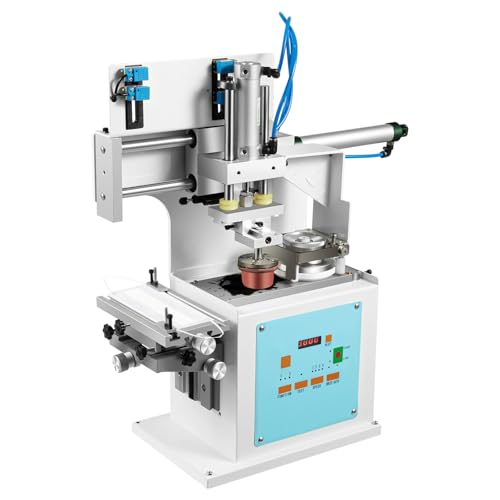
The HZOPUTLH pad printer emphasizes high efficiency and broad print coverage. With a claimed throughput of 2,200 pieces per hour, it is designed for continuous production in cosmetics, textiles, insoles, and toy manufacturing. The machine supports patterns up to 75 millimeters in diameter and favors a 50 x 50 millimeter work area for optimum detail. The adjustable workbench provides flexibility for irregular items, enabling operators to position the product precisely for consistent results across batches.
Users will appreciate the balance between speed and print quality, particularly on complex shapes where alignment and repeatability matter. The capability to adjust the workbench in multiple directions helps accommodate varied product lines without swapping equipment. This makes the HZOPUTLH unit a practical option for small factories or fulfillment workshops expanding into pad printing as part of their customization offerings.
For buyers evaluating throughput, versatility, and ease of setup, this model presents a robust choice that supports a range of materials and product geometries while preserving printing integrity.
YDOOLNG Pneumatic Pad Printing Machine

This YDOOLNG model highlights an oil cup system with magnets that aim to reduce ink leakage and evaporation. The sealed ink cup design helps minimize ink waste while maintaining a clean workspace, a practical feature for studios and small manufacturing floors. The machine supports rapid inking and consistent transfer at up to 2,200 pieces per hour, making it suitable for quick-turn projects and ongoing labeling tasks on varied substrates. A large maximum print diameter of 75 millimeters allows for substantial logo prints on many products, while the 50 x 50 millimeter sweet spot yields crisp and detailed imprints.
Operator-friendly features, including straightforward controls and stable pneumatic action, support efficient job switching and batch processing. This model is well-suited for shops that prioritize ink efficiency and stable, repeatable printing without sacrificing speed. It can serve as a reliable option for customization studios, gift manufacturers, and educational facilities conducting hands-on pad printing training.
MuChaIOAK Pneumatic Pad Printing Machine

The MuChaIOAK unit is a semi-automatic pad printer featuring a robust steel plate and a large work table. It is designed for ink pad printing across a range of materials with reduced ink leakage due to an improved sealed ink cup. The model supports up to 2,200 prints per hour and emphasizes a straightforward workflow, allowing operators to view printing counts and manage job sequencing easily. The design focuses on reliability in semi-automatic setups, making it a good choice for small-scale production lines, educational settings, and custom branding projects that require consistent prints over multiple cycles.
With its combination of strong structure, clean ink handling, and high throughput, this machine addresses common pain points in pad printing such as ink waste and misalignment. Buyers seeking a durable semi-automatic pad printer for diversified product lines may find this model especially compelling for its balance of speed and control.
ZYT-3C-250 Commercial Pneumatic Pad Printer

The ZYT-3C-250 from YIYIBYUS emphasizes precision and flexibility, featuring a sealed ink cup to minimize leaks and a work table that can be adjusted in multiple directions for versatile handling of various shapes. The machine supports one-handed operation, enabling simultaneous object placement and printing, which can improve workplace efficiency in production lines where operators manage several tasks concurrently. The microcomputer intelligent control system helps regulate energy consumption while maintaining stable print quality across repeated cycles, addressing both productivity and environmental considerations.
Advantages include strong color performance and broad printing adaptability—capabilities that help print on plastic, metal, glass, and sporting goods with consistent results. The YIYIBYUS model suits operations that require reliable, repeatable imprinting across diverse product families, including branding, decorative prints, and coding tasks. Its balance of control, stability, and adaptability makes it a viable option for small manufacturers and educational labs looking to explore pad printing techniques.
Buying Guide: Key Purchase Considerations
- Throughput vs. precision: Higher speeds are valuable for batch work, but verify that print clarity remains intact on your target substrates, especially irregular shapes.
- Substrate compatibility: Check maximum print diameter and area (often around 50 x 50 mm to 75 mm) and confirm alignment features for your product geometry.
- Ink management: Sealed ink cups reduce evaporation and leakage; look for models with easy maintenance and clean workspaces.
- Workbench adjustability: A multi-direction adjustable table helps in packaging, hardware, cosmetics, and textiles where product contours vary.
- User interface: Intuitive controls and counters aid workflow management, especially in smaller studios or beginning production lines.
- Durability and serviceability: Steel frames and rust-resistant finishes extend life; verify availability of replacement pads and spare parts.
- Electrical and safety standards: Ensure compatibility with local voltage (110V or 220V) and verify safety features for semi-automatic or pneumatic operation.
- Cost of ownership: Consider ink costs, maintenance, and potential need for additional jigs or templates to support different products.
In assessing options, buyers should weigh the balance between speed, adaptability, and print fidelity. For small studios and light industrial settings, models with adjustable workbenches, sealed ink systems, and clear job tracking offer practical value. For manufacturers moving toward broader customization, higher throughput alongside stable print quality across multiple substrates becomes crucial. The available selections provide options across these priorities, enabling informed decisions tailored to production needs and space constraints.