Finding the right nitrogen regulator is essential for safe, accurate HVAC purging, leak testing, and brazing work. The following picks come from reputable brands and are commonly used by professionals for consistent delivery pressures and reliable performance. This guide highlights five top options, comparing inlet connections, gauge readability, hose length, and overall reliability to help engineers and technicians select the best regulator for their setups.
Summary of chosen products
| Product | Inlet | Outlet | Delivery Range | |
|---|---|---|---|---|
| RX WELD Nitrogen Regulator with 0-800 PSI | CGA580 | 1/4" SAE Male Flare | 0-600 PSI (reads up to 800 PSI) | 60 inches (refrigeration hose) |
| Siasky Nitrogen Regulator | CGA580 | 1/4" Male Flare | 0-800 PSI | 78.7 inches |
| BETOOLL Nitrogen Regulator | CGA580 | 1/4" Male Flare | 0-600 PSI | 78.7 inches |
| Tutor Auto Nitrogen Regulator | CGA-580 | 1/4" Male Flare | 0-400 PSI (reads to 600 PSI) | 80 inches |
| SPARC Premium Nitrogen Regulator | CGA580 | 1/4" SAE Flare | 0-600 PSI | Standard full-size hose (about 6 ft) |
RX WELD Nitrogen Regulator With 0-800 PSI

The RX WELD regulator features a CGA580 inlet and a 1/4″ SAE male flare outlet. It includes easy-to-read 2-inch gauges with protective rubber boots and a refrigeration hose measuring 60 inches in length. The device is designed for versatile use in HVAC purging, inertization, leakage tests, brazing, and soldering. Input pressure ranges up to 4000 PSI, with an adjustable output that can be read up to 600 PSI, though the gauge may display up to 800 PSI in certain configurations. This makes it suitable for projects requiring steady, controlled nitrogen flow while maintaining a strong safety profile.
Key considerations:
– Inlet and outlet compatibility with common gas cylinders and hoses;
– Gauge readability in busy shop environments;
– Hose length that provides safe clearance from the work zone;
– Clear labeling of max rated pressure vs. practical working pressure to prevent over-pressurization.
Nitrogen Regulator 0-600PSI CGA580

From NAKAO, this regulator features a CGA580 inlet and 1/4-inch SAE male flare outlet. It is designed for HVAC purging, inertization, leakage testing, brazing, and soldering. The product emphasizes two 2-inch gauges protected by a rubber cover and plastic film for scratch resistance. With a 0-4000 PSI input and 0-600 PSI output (600 PSI max output on the gauge), it provides robust control for high-demand nitrogen tasks. The unit is compatible with nitrogen, argon, helium, and other inert gases, offering broad utility for shop operations that diversify gas supply needs.
Considerations include:
– Gauge protection and readability in dusty environments;
– The balance between high input capacity and a safe, lower output range for delicate testing;
– Cylinder compatibility across inert gases to simplify procurement.
Siasky Nitrogen Regulator with 78.7" Hose
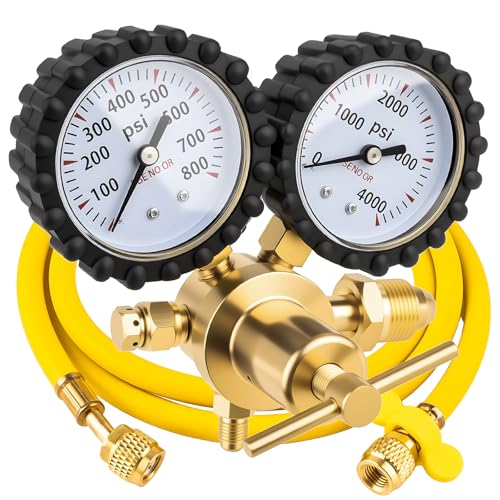
Siasky offers a nitrogen regulator designed for HVAC professionals, with a 0-800 PSI delivery pressure and a long 78.7-inch hose for safer distant operation. The CGA580 inlet and 1/4-inch male flare outlet ensure a secure fit on typical gas cylinders used for nitrogen purging and leak testing. The kit provides precise regulation for nitrogen testing, with durable brass construction suited for repeated shop use. This regulator emphasizes reliable performance and a straightforward setup for field and shop environments.
Buyers should evaluate:
– Hose length for your workspace layout and safety distance;
– Overall build quality and longevity in sweaty, high-temperature environments;
– Gauge visibility and ease of calibration during long jobs.
BETOOLL Nitrogen Regulator

BETOOLL’s regulator includes a 78.7-inch hose and offers 0-600 PSI delivery with a high-pressure gauge reading up to 4000 PSI. Its CGA580 inlet and 1/4″ male flare outlet deliver a solid, tool-friendly setup intended for HVAC purge, pressure testing, leakage checks, soldering, and brazing. The design emphasizes safety with two large gauges protected by rubber and a clear scale that helps technicians monitor live pressures during complex purge sequences. This model suits shops that perform frequent nitrogen-based testing and need extended reach.
Key considerations:
– Interaction between dual gauges and the need to interpret both low and high-pressure readings quickly;
– Hose robustness against kinks and abrasion in crowded work areas;
– Compatibility with common nitrogen cylinders and inert gas sources.
RX WELD Nitrogen Regulator With 5Ft Hose

This RX WELD regulator pairs a 0-600 PSI adjustable output with a 0-4000 PSI input, using the CGA580 inlet and a 1/4-inch male flare outlet. It includes a 5-foot refrigeration hose, extending the safe workspace between the tank and the work site. The gauges are protected by rubber boots, and the setup is aimed at HVAC purging, inertization, pressure testing, leakage testing, brazing, and soldering. The extended hose length is helpful in tighter spaces or where the tank can be kept away from the immediate work area.
Be mindful of:
– Hose length versus maneuverability in cramped spaces;
– The visual clarity of the gauges under bright workshop lighting;
– Properly securing connections to avoid accidental disconnections during testing.
Buying Guide: Key Considerations For Choosing A Nitrogen Regulator
To pick the right regulator for HVAC purge, leak testing, and brazing, consider these categories:
- Inlet and outlet compatibility: Most units use a CGA580 inlet and a 1/4″ flare outlet; verify that your cylinders and hoses match these fittings to avoid adapters that may introduce leaks.
- Pressure range and gauge interpretation: Commonly, regulators offer 0-600 PSI delivery with high-pressure gauges up to 4000 PSI. Note whether the gauge face displays 0-800 PSI or 0-600 PSI, and understand the practical working range for your tasks to avoid misreads during critical operations.
- Hose length and flexibility: Longer hoses improve safety distance but can reduce maneuverability. Choose a length that fits your workflow, workspace size, and safety protocol. Consider reinforced hoses for durability in tough environments.
- Gauge protection and durability: Rubber boots and protective casings help prevent damage from accidental bumps. This is particularly valuable on busy shop floors and in field work.
- Material and build quality: Brass bodies tend to offer good durability and corrosion resistance in nitrogen service. Ensure components are designed for inert gas usage and pressure stability.
- Safety features: Look for self-sealing or safety relief options and a regulator designed to prevent accidental over-pressurization, particularly during purging and leak tests.
- Service and warranty: Some brands advertise lifetime warranties or extensive support, which may be important for professional use and regular maintenance cycles.
Additional Considerations
When selecting a regulator, consider your typical workflow: the need for long purge sequences, repeated leak testing, or high-precision brazing. For extended purges, a regulator with a longer hose and stable output helps maintain consistent results. If you frequently switch between gases like nitrogen, argon, or helium, ensure the inlet connection remains compatible and that seals and o-rings are rated for inert gas use. Finally, verify supplier reliability and cross‑brand compatibility, so you can source cylinders and hoses without frequent adapters.