Needle roller and cage assemblies deliver high load capacity in compact spaces, making them essential for precision machines, robotics, and industrial equipment. This guide highlights five top options, detailing key features, size ranges, and performance characteristics to help you select the right thrust needle roller and cage assemblies for demanding applications.
Overview of selected products:
| Product | Brand | Approx. Size (ID x OD) | Notable Features | Best For |
|---|---|---|---|---|
| Koyo NTA-4052 Needle Roller and Cage Thrust Assembly | Koyo | 2-1/2″ ID x 3-1/4″ OD | Open steel cage, high dynamic load support, reduced cross-section | Heavy-duty, space-constrained setups |
| INA SCE2414 Needle Roller and Cage Assembly | SUN-BEARINGS | 38.10 x 47.625 x 22.22 mm | Compact, precise needle rollers with cage | Compact machinery and small bearings |
| Torrington B308 Needle Roller and Cage Assembly | SUN-BEARINGS | 47.63 x 57.15 x 12.70 mm | Thick needles for high stiffness, robust cage | Industrial-grade thrust assemblies |
| uxcell K121513 Needle Roller and Cage Assembly | uxcell | 12 mm bore x 15 mm OD x 13 mm width | PA66 cage, GCr15 rollers, high load capacity | Compact, affordable solutions |
| Koyo NTA-4860 Needle Roller and Cage Thrust Assembly | Koyo | 3″ ID x 3-3/4″ OD | Open steel cage, strong static/dynamic capacities | Higher-load thrust applications |
These selections cover a range of sizes and load ratings, helping engineers balance space constraints with required stiffness and longevity. Each option is designed to minimize friction and vibration while supporting dynamic operations in challenging environments.
Koyo NTA-4052 Needle Roller and Cage Thrust Assembly

The NTA-4052 is an open, steel-cage thrust assembly designed for applications with high dynamic loads. Its slim cross-section in restricted spaces supports robust axial loading while maintaining smooth rotation. The steel cage guides and evenly spaces rollers to reduce friction, vibration, and noise, contributing to longer service life in demanding machinery.
INA SCE2414 Needle Roller and Cage Assembly

The SCE2414 from SUN-BEARINGS provides a compact needle roller and cage assembly with precise guidance. The compact dimensions make it suitable for smaller assemblies where space is at a premium, while the needle rollers maintain good load support and smooth operation in axial directions.
Torrington B308 Needle Roller and Cage Assembly

The B308 assembly by Torrington features a B-308 designation with a 47.63 x 57.15 x 12.70 mm size. It is designed for high-load thrust applications, delivering rigidity through robust needle rollers and a dependable cage that helps maintain uniform spacing and reduced wear over time.
uxcell K121513 Needle Roller and Cage Assembly
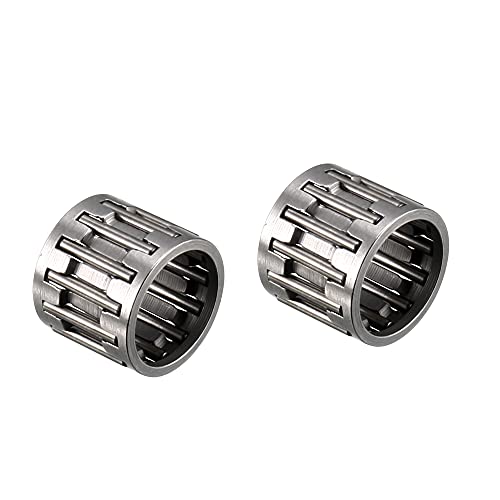
The K121513 variant from uxcell uses a PA66 cage with chrome steel needle rollers, providing a balance of stiffness and load capacity in compact form. The model specifies a 12 mm bore, 15 mm outer diameter, and 13 mm width, suitable for lighter-duty thrust applications or as a compact component in multi-axis systems.
Koyo NTA-4860 Needle Roller and Cage Thrust Assembly
The NTA-4860 assembly extends the thrust needle roller and cage family with a larger 3″ ID and 3-3/4″ OD. It provides strong static and dynamic load capacities, making it well-suited for high-load thrust environments where space permits a bigger bearing footprint. The open steel cage design reduces friction and supports even roller spacing.
Buying Guide
Key considerations when selecting needle roller and cage assemblies include load requirements, space constraints, and operating speed. Understanding these factors helps match a product to a specific application.
- Load capacity: Evaluate static and dynamic ratings to ensure the torque, axial, and radial loads can be sustained without premature wear.
- Size and fit: Measure bore, outer diameter, and width to ensure the assembly integrates with adjacent components and raceways.
- Cage material and design: Steel cages generally offer durability and low friction, while polymer options like PA66 can reduce weight and cost in lighter-duty use.
- Speed rating: Maximum rotational speed informs whether a thrust assembly can operate efficiently at the intended rpm without overheating or excessive vibration.
- Space constraints: In restricted spaces, look for assemblies with reduced cross-section and compact axial profiles.
- Installation and maintenance: Consider whether the assembly is pre-lubriated or requires regular lubrication, and whether it’s straightforward to replace in the field.
- Alignment and mounting: Ensure compatibility with mating components, including thrust washers or raceways designed for use with needle roller assemblies.
- Materials and corrosion resistance: Select materials suitable for the operating environment, including steel options for durability or corrosion-resistant alloys if needed.
Performance expectations vary by application. For high dynamic loads and restricted spaces, thrust needle roller and cage assemblies with open steel cages, like the Koyo NTA-4052 and NTA-4860, typically deliver robust stiffness and low friction. In compact machinery, smaller units such as the INA SCE2414 or uxcell K121513 can provide effective performance at a lower cost, while Torrington B308 offers rugged options for industrial thrust interfaces.
Always verify compatibility with existing components, including any thrust washers or raceways specified by the manufacturer. For critical machinery, verify supplier specifications and confirm that the selected product meets the required dynamic and static load criteria. Consider requesting engineering data sheets or CAD models to ensure precise fitment and to facilitate smoother integration into the mechanical assembly.