Choosing the right servo or electric motor is essential for reliable, high-speed industrial sewing. This guide highlights five top-rated motors that deliver energy efficiency, quiet operation, strong torque, and compatibility with a wide range of machines. Each option emphasizes reduced power consumption and smooth performance, making them suitable for factories or workshops seeking productivity and cost savings.
Summary of chosen products
| Product | Brand | Power | RPM Range | Key Benefit |
|---|---|---|---|---|
| Servo Motor Sewing Machine, 750W | Lonsge | 750W | 200-6000 | High efficiency, quiet operation |
| Industrial Sewing Machine Motor 550W | SMUDUKKIT | 550W | 200-6000 | High torque, good speed regulation |
| Servo Motor Sewing Machine, 550W | Lonsge | 550W | 200-6000 | Energy efficient, versatile compatibility |
| Industrial Servo Motor 750W | SMUDUKKIT | 750W | 0-? (adjustable) | Heavy-duty performance, low noise |
| 220V Servo Motor, 750W | SMUDUKKIT | 750W | Adjustable up to high speed | Powerful, energy-saving |
Lonsge 750W Servo Motor for Industrial Sewing

Compatibility and efficiency are central to this servo motor. It operates at AC110V, 750W (1HP) with a speed range from 200 RPM to 6000 RPM. The unit includes a brushless motor, controller, foot pedal, English manual, and mounting components. The design emphasizes high durability with a metal frame, pure copper coil, and an aluminum heat sink, ensuring long service life. It is suitable for belt-driven overlock, upholstery, flatbed, twin-needle, and most industrial sewing machines. A notable feature is energy savings of up to 70-75% compared with traditional motors, with quiet operation for factory or home use.
SMUDUKKIT 550W Industrial Sewing Machine Motor

This 550W, AC110V motor delivers high torque at low speeds due to carbon brush design, reducing stalling when handling thick or dense fabrics. It provides a wide range of speed adjustments from slow precision stitching to high-speed straight sewing, fitting various fabrics and techniques. The three-phase brushless setup promotes smooth operation with reduced noise and vibration, and the pulley is designed to align with market standards for easy installation. It targets reliability and cost-effectiveness in industrial environments.
Lonsge 550W servo motor, 3/4HP, 200-6000 RPM

With higher torque than a 450W option, this three-phase brushless servo motor offers strong performance across various industrial sewing machines. It includes a brushless motor, controller, foot switch, and installation parts. The motor starts at 200 RPM and provides smooth acceleration up to 6000 RPM. It emphasizes energy savings of up to 70% and quiet operation, making it cost-effective for long-term use in production settings.
SMUDUKKIT 750W Industrial Servo Motor with Controller

This 750W servo motor is designed for heavy-duty industrial sewing machines and includes a controller and foot switch. It emphasizes energy efficiency—saving up to 70% of electricity—along with a long service life and minimal noise or vibration during operation. The three-phase brushless design improves startup torque and overall performance, making it suitable for high-speed stitching and large-scale production lines.
SMUDUKKIT 750W High-Power Industrial Servo Motor
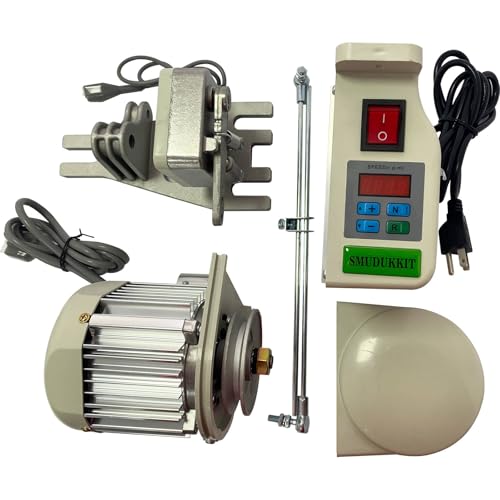
Engineered for commercial sewing machines, this 750W servo motor delivers high torque and robust performance with low noise and vibration. It is marketed for energy saving and stable acceleration, supporting both high-speed and precision stitching. The motor is suitable for factory environments where consistent performance and energy management are critical for daily operations.
Buying Guide: Key Considerations For Industrial Sewing Machine Motors
- Power and torque: Select a motor with sufficient wattage and torque for your fabrics and stitching requirements. Thicker materials benefit from higher torque to prevent stalling.
- Voltage and compatibility: Ensure the motor voltage matches your shop’s electrical setup (AC110V is common). Check compatibility with your machine’s drive system and pulley size.
- Speed range and control: Look for motors offering wide RPM ranges and smooth speed regulation. Brushless servo motors typically provide smoother acceleration and precise control.
- Energy efficiency: Motors designed to save electricity can reduce operating costs over time. Compare energy-saving claims and warranty terms.
- Noise and vibration: Lower noise and vibration improve worker comfort and production quality, especially in continuous operation.
- Durability and materials: A metal frame, copper windings, and heat sinks contribute to longevity in industrial settings.
- Inclusion of accessories: Controllers, foot pedals, manuals, and mounting components simplify installation and setup.
- Maintenance and serviceability: Consider availability of replacement parts and local support for ongoing maintenance.
- Installation footprint: Check dimensions and mounting compatibility with your existing sewing system to avoid fit issues.
Industrial sewing machines demand reliable performance, consistent speed, and energy efficiency. When evaluating options, compare torque, speed range, noise levels, and total cost of ownership. The five motors highlighted here balance power, efficiency, and compatibility across a broad set of industrial applications.