Having a robust metal dust collection setup is essential for maintaining air quality, protecting equipment, and ensuring a safer, cleaner shop environment. This guide highlights five reliable options that balance performance, filtration quality, and practical features. Each selection is evaluated for compatibility with common workshop tools, ease of installation, and real-world effectiveness in handling metal dust, chips, and fine particulates.
Product overview table
- WEN DC1300 1,300 CFM Dust Collector
- DEWALT Air Filtration System, 2-Stage
- VEVOR Cyclone Dust Separator
- POWERTEC 1 HP Wall Mount DC5371
- POWERTEC 1 HP Portable DC5372
WEN DC1300 Dust Collector For Woodworking

The WEN DC1300 offers strong airflow with 1,300 CFM and a 50-gallon collection bag, making it suitable for metalworking environments that generate a mix of chips and fine dust. Its dual 4-inch inlets allow attaching up to two tools simultaneously, which helps manage multiple machines without rerouting ducts. A vertical collection bag design simplifies emptying and reduces the need for frequent bag changes in busy shops. While primarily marketed for woodworking, the unit’s high capacity and straightforward maintenance translate well to metal dust tasks where higher throughput matters.
DEWALT 2-Stage Ceiling Dust Filtration
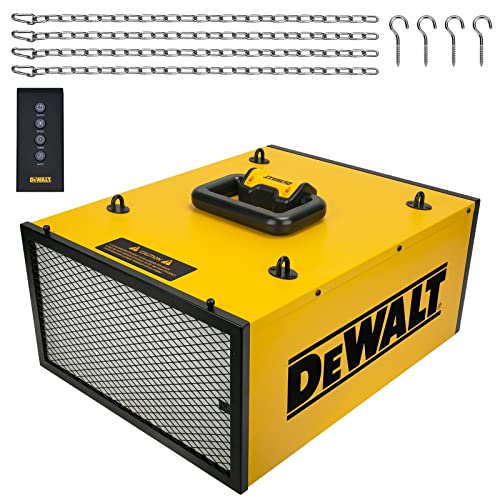
The DEWALT air filtration system features a two-stage filtration setup designed to capture fine metal dust particles. The pre-filter plus HEPA stage helps maintain cleaner air when metalworking reduces airborne contaminants. Remote control enables adjustments from across the shop, while multiple working modes and a programmable timer help automate purification while tools are in use or during breaks. This system emphasizes air quality management rather than direct collection, making it an effective complement to a primary dust collector in a metalworking shop with variable dust loads.
VEVOR Cyclone Dust Separator For 4″ Hoses

The VEVOR cyclone separator uses a high-separation rate (up to 99.61%) to remove dust from the air stream before it reaches the main dust collector. This reduces filter loading and maintenance, which is especially advantageous when working with metal shavings and chips. The unit features a fully transparent design for real-time monitoring and is compatible with standard 4-inch hoses, plus adapters for other hose sizes. This separator excels in boosting overall system efficiency by pre-clearing heavier particulates from the airstream.
POWERTEC Wall Mount DC5371 Dust Collector

The POWERTEC DC5371 is a compact, wall-mounted dust collector with a 1-horsepower motor and a reusable 1-micron bag. Its space-saving design is ideal for smaller shops or dedicated metalworking stations where floor space is at a premium. The unit includes a viewing window to monitor dust levels and a quick-release bag clamp for easy disposal. Vortex-based airflow design helps improve dust capture efficiency by reducing turbulence, delivering reliable performance for light to moderate metal dust tasks while freeing floor space for other equipment.
POWERTEC 1 HP Portable Dust Collector

This portable model offers 1 micron compatible filtration with a compact footprint and casters for mobility. Its removable bag and window enable quick visual checks on dust load and easy emptying. The combination of portability and solid airflow makes it well-suited for workshop setups where metalworking tools are mobile or where a single central collector is impractical. It complements a cyclone separator by handling localized dust collection near machines that generate fine metal dust and chips.
POWERTEC 1 HP DC1081 With Mobile Base

The DC1081 combines a 1 HP motor with a sturdy mobile base, offering 800 CFM of airflow suitable for mid-sized workshops. It includes 1-micron bags and clamps for quick bag changes. The portability and balance of suction and bag filtration make it a practical choice for shops that require relocation of dust collection or for processes that produce a mix of chips and fine dust. This model emphasizes ease of use and maintenance in metalworking environments where machine layout shifts seasonally occur.
Buying Guide: Key Factors For Selecting A Metal Dust System
- Airflow capacity (CFM) and static pressure: For metalworking, higher CFM helps move heavier chips, while sufficient static pressure ensures consistent suction across multiple tools and duct runs. Consider a system that supports 1,000–1,500 CFM with options to upgrade.
- Filtration quality: For fine metal dust, a 1-micron bag or equivalent filtration stage is beneficial. Consider systems with secondary filtration (HEPA or equivalent) or cyclone separators to reduce bag loading.
- Separation and pre-cleaning: Cyclones and separators can dramatically extend filter life by removing larger particles before they reach the bag. This is especially useful with metal shavings and debris.
- Portability vs. fixed installations: Wall-mount and mobile units save floor space, but fixed ducted systems can provide stronger, centralized collection. Choose based on shop layout and tool configuration.
- Ease of maintenance: Look for clear bags, see-through reservoirs, quick-release clamps, and accessible filter access. Easy-to-empty bags reduce downtime during production runs.
- Remote control and automation: Remote operation and timers can help maintain air quality when tools are unattended. Consider models with built-in timers or compatibility with smart controls.
- Noise and energy use: In louder shops, prioritizing models with efficient motors and sound-dampening designs can improve comfort and compliance with workspace regulations.
- Compatibility with existing hoses and tools: Check hose diameters (commonly 4 inches) and adapter options to ensure seamless integration with current equipment.
- Upgrade path: If your shop grows, choose a system that can connect with additional inlets or a larger main unit, or pair with a cyclone separator to optimize performance over time.
In summary, the best metal dust collection approach often combines a high-capacity main collector with a cyclone separator and targeted, portable collection near primary metalworking stations. This setup minimizes maintenance, extends filter life, and maintains cleaner air without sacrificing workflow flexibility.