Choosing the right load cell is essential for accurate weighing in DIY projects, kitchen scales, industrial scales, and automation systems. This guide highlights five well-regarded options that cover a range of capacities, from compact 0.5 kg sensors to heavy-duty 50 kg models, with diverse interfaces and mounting options. Each product is described with its key features to help you compare suitability for your application, whether you’re building a precision scale, an automation system, or a custom measurement device.
| Product | Capacity | |||
|---|---|---|---|---|
| ShangHJ 4 Sets | 5 kg | HX711 / Arduino | Direct wiring with 4 leads | DIY scales, portable weighing |
| Yanmis 2000 KG | 2000 kg | Analog/Sensor outputs | Shielded cable | Industrial scale applications |
| Walfront 2000 kg | 2000 kg | Analog | Mounting bracket option | Hoppers, bulk weighing |
| uxcell 500 g | 0.5 kg | Analog output | Wired | Kitchen, jewelry scales |
| Wishiot 50 kg | 50 kg | HX711 / amplifier | Feet and bracket | Portable benches, lab setups |
ShangHJ 5kg Digital Load Cell Kit for DIY Scales

The ShangHJ kit combines four load cells with an HX711 ADC module, ideal for Arduino- or Raspberry Pi-based weighing projects. It supports a 5 kg maximum load and outputs a voltage signal that changes with applied force. This setup is straightforward for hobbyists building a compact, portable kitchen scale or a precision mini-weighing device. The system requires a 5–10 V drive voltage and uses a standard four-wire connection (Red to E+, Black to E-, Green to A+, White to A-).
Key points: the kit emphasizes ease of use and compatibility with popular microcontroller platforms. While it is designed for DIY projects, it also suits education experiments or small-scale measurement tasks where cost and simplicity are important. The included HX711 module helps stabilize readings and improve resolution for small weight changes.
Yanmis 2000 KG Shear Beam Load Cell
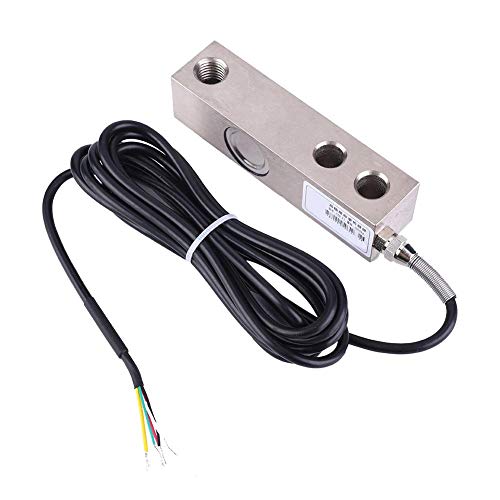
The Yanmis 2000 kg shear beam load cell is built from alloy steel and features a coating treatment for long-lasting protection. It is designed for rugged industrial environments and offers an IP67 rating after sealing. Its robustness makes it suitable for heavy-duty weighing applications, such as bulk material scales, large hoppers, or factory process control. The shielded construction helps reduce electrical noise and improve signal integrity in demanding settings.
Considerations include mounting accuracy, environmental exposure, and electrical compatibility with your data acquisition system. The high capacity is advantageous for bulk weigh tasks, but ensure your signal processing chain can handle the full-scale output without saturation. This sensor is well suited for systems where reliable, industrial-grade performance is required over long operation periods.
Walfront Portable S-Type 2000 kg Load Cell

The Walfront S-type load cell is a high-capacity sensor designed for hopper weighing and other bulk applications. It emphasizes portability and ease of installation, with its S-shaped design that can be integrated into various weighing frames. The product specifies an analog output, which makes it compatible with a wide range of signal conditioners and controllers. Mounting brackets and feet aid in securing the sensor and reducing measurement error due to movement or misalignment.
For users, considerations include the mechanical fit with your existing frame, corrosion resistance in the operating environment, and the precision required for your process. Analog output provides straightforward integration, but care must be taken to calibrate and shield the sensor from electrical noise to maximize accuracy.
uxcell 500 g Weighing Load Cell for Scales

The uxcell 500 g load cell is a compact, aluminum wired sensor intended for kitchen scales, jewelry scales, and small balances. Its 0.5 kg capacity is ideal for precise measurements of light loads, and the anodized surface offers durability and a lustrous finish. The product includes silica gel protection to guard against corrosion, moisture, and aging, enhancing reliability in humid or variable environments. This sensor is well-suited for compact, consumer-oriented weighing devices where space is at a premium.
Key considerations include drift, long-term stability, and the connector configuration for your controller. Its simple wired interface makes it accessible for hobby projects, but ensure your calibration routine accounts for the low-capacity range to maintain accuracy across readings.
Wishiot 50 kg Load Cell with Bracket

The Wishiot kit provides a 50 kg load cell with feet and mounting bracket to enhance stability and prevent slipping, which minimizes measurement errors due to movement. Its compact dimensions (about 30 × 25 × 13 mm) enable installation in tight spaces, and the design supports modular use or combinations to reach higher capacities (50 kg, 100 kg, 200 kg). This makes it adaptable for bench scales, lab setups, or small industrial weighings where space constraints are a consideration.
When evaluating, assess the mechanical integration with your frame, the suitability of the mounting hardware, and how the sensor’s output (often combined with an amplifier like HX711) will be read by your data system. The small size and modularity are strengths for flexible layouts in scalable weighing tasks.
Buying Guide: Key Considerations for Load Cells
- Capacity and range: Match the load cell’s maximum load to your expected weight without approaching limits that could cause nonlinearity or drift. Start with a cushion above typical loads.
- Output type: Analog vs. digital. Analog sensors require a signal conditioner or amplifier; digital options may incorporate built-in interfaces but can limit direct customization.
- Mounting and form factor: Ensure the sensor fits your frame, bracket, and mounting space. Brackets, feet, and S- or I-beam designs impact installation and stability.
- Electrical environment: Consider shielded cables, IP ratings, and environmental exposure (dust, moisture, chemicals). IP67-rated sensors perform better in harsh settings.
- Accuracy and precision: Look at the sensor’s resolution, repeatability, and drift under static and dynamic conditions. Calibration routines are essential for reliability.
- Signal integration: Plan for data acquisition hardware (like HX711) or direct microcontroller interfaces. Check wiring color codes and documentation for setup.
- Mechanical considerations: Alignment, mounting tolerance, and load transfer paths influence measurement accuracy. Use proper fixtures to minimize off-axis loading.
- Maintenance and durability: Choose materials (stainless vs. alloy steel) and protective coatings suitable for your environment to extend sensor life.
In practice, the best load cell choice balances capacity, environmental resilience, and ease of integration with your measurement system. For DIY projects, kits with HX711 modules streamline setup and calibration. For industrial applications, high-capacity, rugged sensors with strong mounting options and protective coatings are preferable. Always calibrate your system under real-use conditions and validate performance across the expected range of weights to ensure reliability and repeatability.