Choosing a laser engraver capable of detailed work on glass requires balancing power, precision, and usability. The following five models stand out for glass-friendly engraving, offering tight spot sizes, reliable accuracy, and beginner-friendly setups. Each product section includes key specs drawn from their listed features to help you compare at a glance.
| Product | Brand | Power | Working Area | Notes |
|---|---|---|---|---|
| ACMER S1 Laser Engraver (6000mW) | ACMER | 6000 mW | 130×130 mm | High precision; beginner-friendly |
| ACMER S1 Laser Engraver (3500mW) | ACMER | 3500 mW | 130×130 mm | Good balance of power and price |
| LONGER RAY5 (10000mW) | Longer | 10000 mW | 400×400 mm | Large work area; versatile attachments |
| LONGER RAY5 (5000mW) | Longer | 5000 mW | 400×400 mm | High precision with color options |
| TTS-55 PRO (5500mW) | Usongshine | 5500 mW | Various (user reports 1/32 inch focus) | Advanced features; offline and online engraving |
Note: All models listed support a range of materials beyond glass, and performance on glass depends on power, focus, and technique. When engraving glass, consider using masking or tape to protect the surface and to achieve consistent results.
ACMER S1 Laser Engraver 6000mW Review

The Acmer S1 6000mW model emphasizes ultra-fine accuracy with a 2mm focal length and a 455±5nm wavelength. Its 0.01mm repeatable positioning accuracy and a top engraving speed of 10,000 mm/min enable detailed glass markings, including frost-like textures or precise lines. The machine is described as 99% preassembled with quick setup, making it suitable for hobbyists transitioning to professional work. Its 130×130 mm working area supports small- to mid-sized glass pieces, jewelry plates, and signage. Material versatility extends to wood, acrylic, and metal coatings.
ACMER S1 3500mW Engraver for Glass

This version pairs 3500mW power with a similar 130×130 mm work area and 2mm focal length, aiming for strong engraving detail on glass with a balance of cost and capability. As with the higher-powered variant, it supports a 2-in-1 engraving and cutting workflow across common materials such as wood, acrylic, and ceramics. The unit ships mostly preassembled to minimize setup time and reduce the learning curve for beginners while offering room to expand into more complex projects as skills grow.
LONGER RAY5 10000mW Engraver
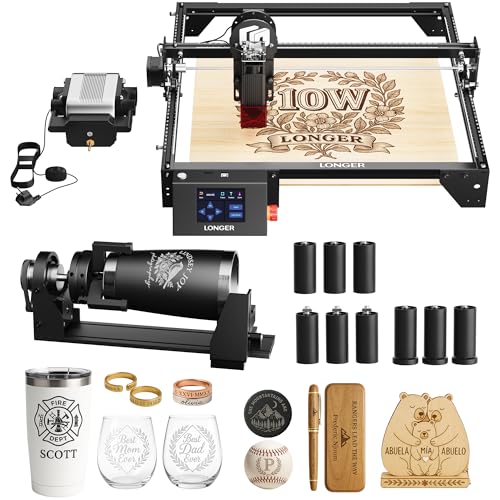
The Longer Ray5 10000mW model targets professional-level glass engraving with a large 400×400 mm working area and an ESP32-driven processor for faster multi-device control. Its 0.06mm laser spot and 0.01mm engraving precision deliver detailed results on glass, mirrors, and coated surfaces. The kit includes practical accessories like an air pump and a rotary attachment to handle cylindrical glass items, increasing versatility for awards, tumblers, and custom glassware. Connectivity options include USB, Wi-Fi, and app control, which aids workflow in both studio and workshop settings.
LONGER RAY5 5000mW Engraver

With 5000mW output, this model emphasizes speed and precision for a range of materials and takes advantage of a 0.08×0.08 mm laser point for clean, detailed engravings. The 400×400 mm working area supports larger glass pieces, plaques, and panels. A 32-bit ESP32 board and offline USB/LaserGRBL compatibility enable robust control, while the included accessories and offline capability simplify use in spaces with limited internet. The unit is described as beginner-friendly and one-piece delivered, helpful for first-time buyers seeking a straightforward setup.
TTS-55 PRO 5500mW Engraver

The Usongshine TTS-55 PRO introduces a 5500mW laser module with enhanced air-assisted nozzle and a red laser shield. The upgraded compression spot technology yields a fixed focus and a shorter focal length for stronger engraving and cutting on glass, metal, wood, and leather. A 32-bit motherboard and a 10,000 mm/min engraving speed offer solid performance for intricate glass designs and repeatable results. The model supports online and offline engraving via TF card or app control, allowing flexible workflows in production or hobby settings.
Buying Guide
Key purchase considerations
- Power and material compatibility: Higher wattage enables deeper cuts and faster engraving but can increase price and noise. For glass, consider models around 3500–10000 mW for crisp etching with safe operation.
- Focal length and spot size: A shorter focal length (around 2 mm) with a small spot (≤0.1 mm) yields finer detail on glass surfaces, which is important for accurate logos or portraits.
- Working area: Glass items vary in size. Choose a working area that fits typical pieces you intend to engrave, with room for fixtures or jigs.
- Accuracy and repeatability: Look for machines advertising 0.01 mm precision or better and low drift during longer runs to maintain consistency across designs.
- Ease of use: Preassembled units and beginner-friendly software help shorten the learning curve. Check for online support, tutorials, and community forums.
- Software and connectivity: Laser control software compatibility (LightBurn, LaserGRBL) and connectivity options (USB, Wi-Fi, TF card) affect workflow flexibility and collaboration with other devices.
- Safety features: Eye protection, enclosure options, and protective covers reduce risk when engraving glass. Verify included protective gear and guidelines.
- Accessory ecosystem: Rotary attachments enable cylindrical glass engraving, while air assist improves cutting efficiency and burn prevention on glass edges.
- Noise and ventilation: Some machines require dedicated ventilation, especially at higher powers. Plan for a suitable workspace that accommodates airflow needs.
How to compare for glass engraving
- Spot size vs detail: Prioritize small spot sizes for fine etching; test samples with sample logos or monograms to judge readability.
- Layered effects: For glass, consider engraving strategies such as masking, frosting, or etching to achieve different visual textures.
- Heat management: Higher power can cause micro-cracking if the glass isn’t properly supported or cooled. Use masking and light passes to minimize heat buildup.
- Maintenance: Check for belt wear, lens cleanliness, and alignment procedures. Regular maintenance preserves engraving accuracy over time.
- Price vs performance: Balance initial investment with the expected volume of work. For hobbyists, mid-power units with good software support often offer the best value.
This selection emphasizes models with solid glass engraving capability, while remaining versatile for other common substrates. The right choice depends on your typical project size, desired detail, and whether you value large working areas or compact, beginner-friendly machines.