Finding the right label applicator can streamline bottle and jar labeling for small businesses, craft creators, and makers. This guide reviews select users-friendly options that handle round bottles, jars, and cylindrical containers with accuracy and ease. Each product highlights a balance of durability, versatility, and value, helping you choose a labeling tool that fits your workflow and label sizes.
Summary Table — Selected Label Applicator Machines
| Product | Brand | Key Strength | Ideal For |
|---|---|---|---|
| TOPOWN Precise Label Applicator | TOPOWN | Adjustable platform, anti-slip feet | Small businesses labeling cans/bottles |
| VEVOR Semi-Automatic Round Labeling Machine | VEVOR | Smart sensor, durable aluminum body | Varied round bottles, high-volume labeling |
| Sumeve Manual Bottle Labeling Machine (White) | Sumeve | Extended length for more label sizes | Round bottles, jars, cans |
| The Label Ledge Original Candle Label Applicator | Label Ledge | Precision placement, no adapters needed | Candle makers, vintners, brewers |
| Primera AP380 Label Applicator | Primera | High throughput, quick setup | Cylindrical containers, large runs |
TOPOWN Precise Label Applicator for Bottles and Jars
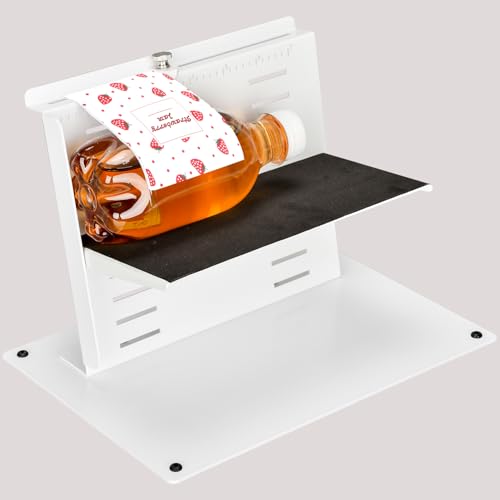
The TOPOWN labeling tool is a compact, manual machine designed for precise label placement on small batches. Its scaled platform helps users align cans and bottles cleanly, reducing crooked or misaligned labels. The device features a non-slip base to minimize movement on the work surface, making it suitable for quick-changeovers when labeling different product sizes. This tool appeals to small businesses or manufacturers seeking a simple, manual solution without heavy automation.
Key features include a quickly adjustable labeling platform for varying can and bottle specifications, a compact footprint, and a stable base that helps maintain consistent label alignment during labeling sessions. Users can perform repetitive labeling tasks with improved speed compared to hand-application, while preserving precise placement. This model emphasizes accessibility and straightforward operation for everyday packaging lines.
VEVOR Semi-Automatic Round Labeling Machine

VEVOR’s round labeling machine is designed for efficiency across a range of round bottles, including medicine, condiment, beverage, and wine containers. It prioritizes precision with a fiber optic sensor that detects label position, ensuring accurate placement. The device uses a robust aluminum alloy body that resists rust and wear, contributing to longer-lasting performance in demanding environments. A high-powered motor supports steady throughput for medium to high labeling volumes.
This unit is not suitable for transparent labels, but its versatility with non-transparent label formats makes it a good fit for many beverage and cosmetics lines. The combination of smart sensing and durable construction helps reduce labeling errors and maintenance downtime, providing consistent results across batches. It’s a strong option for businesses seeking semi-automatic efficiency without full automation.
Sumeve Manual Bottle Labeling Machine (White)

Sumeve’s manual labeling device is designed for round bottles, offering broad compatibility with glass, plastic, and metal containers. The tool supports bottles from about 0.6 to 4 inches in diameter and accommodates label widths up to roughly 5 inches. A pressing bar helps the bottle conform to the label, improving adhesion and alignment. The metal body is sturdy and durable, making it suitable for frequent use in small production settings.
With an extended labeling length and a straightforward design, this model suits workshops and home-based manufacturers who require flexible label sizing without investing in automation. It’s particularly effective for batches with varying label dimensions, allowing operators to adjust on the fly while maintaining consistent results across products.
The Label Ledge – Original Candle Label Applicator

The Label Ledge offers a patented, compact manual solution for precise label placement on jars, bottles, and candle vessels. The tool supports an adjustable range from 0.5 to 5 inches, making it suitable for a variety of small-scale product lines. It is designed for candle makers, vintners, brewers, and similar crafters who value a professional, uniform appearance without complex adapters.
Users benefit from a straightforward workflow that does not require specialized attachments if you are labeling with tape or spool forms. The device emphasizes ease of use, enabling consistent label alignment across different container shapes within its range, which helps improve packaging aesthetics and perceived value.
Primera AP380 Label Applicator for Cylindrical Containers
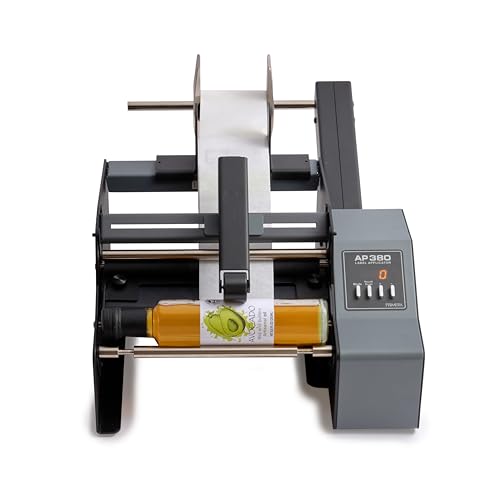
Primera’s AP380 is a semi-automatic labeling solution designed for cylindrical containers, offering quick setup and reliable operation. The unit is capable of applying one or two labels per container and can handle up to 1500 containers per hour, making it suitable for modest production runs or growing product lines. Its design emphasizes speed and accuracy, helping reduce manual labeling time while maintaining uniform label placement across batches.
This model is well-suited for users who need a higher throughput without full automation. It provides a balance between ease of use and productivity, ideal for brands expanding distribution, seasonal lines, or on-demand packaging projects.
Buying Guide: Key Purchase Considerations
- Container shape and size: Ensure the machine supports your bottle or jar diameters and heights. Some units excel with round bottles, while others offer broader adjustable ranges for jars or cylindrical containers.
- Label format compatibility: Consider label types (paper, film, non-transparent) and the inner/outer dimensions the device can accommodate. Some units are not suitable for transparent labels.
- Throughput needs: If you label many containers, prioritize semi-automatic or higher-throughput models (e.g., 1000+ per hour). For hobby or small runs, a compact manual tool may suffice.
- Precision features: Look for sensors (like fiber optic) or alignment guides that improve accuracy and reduce mislabels. A stable base and anti-slip features help maintain consistency.
- Durability and materials: Aluminum frames and metal bodies typically offer longer life in busy packaging environments, especially with frequent handling.
- Ease of use and setup: Quick setup, minimal training, and intuitive controls can shorten onboarding and changeovers between product lines.
- Maintenance and replacements: Check for readily available spare parts, replacement blades or rollers, and compatibility with your existing label inventory.
- Cost and scale: Balance upfront cost with expected throughput and labor savings. For growing brands, a scalable option with upgrade paths can be beneficial.
In choosing among these options, consider your usual batch sizes, label sizes, and how often you switch products. Manual and semi-automatic models offer simplicity and cost-effectiveness for small runs, while more robust semi-automatic machines deliver higher throughput for expanding product lines. Durability and sensor-assisted positioning can reduce waste and rework, especially in busy labeling environments. Evaluate your space, workflow, and maintenance capabilities to select the most reliable tool for long-term use.