The following article highlights top industrial-grade wireless temperature sensors suitable for professional or heavy-duty home use. These picks prioritize long-range wireless protocols, robust alerts, and reliable data logging to help you monitor fridges, greenhouses, industrial spaces, and more. Each product section includes practical features to compare capabilities such as range, battery life, and alert options.
| Product | Brand | Use Case |
|---|---|---|
| YoLink Smart Wireless Temperature & Humidity Sensor, 3-Pack | YoLink | Fridges, nurseries, barns, outdoor deployments |
| MOCREO WiFi Remote Thermometer Freezer Alarm | MOCREO | Freezers, greenhouses, RVs, cold storage |
| YoLink Smart Freezer Thermometer, LoRa Wireless | YoLink | Refrigerators, freezers, barns, multi-room monitoring |
| Indoor Outdoor Thermometer Wireless (U UNNI) | U UNNI | Indoor/outdoor temperature and humidity with broad range |
| SafeSense TempTouch WiFi Thermocouple Sensor | SAFESENSE | Ambient and probe temperature, humidity monitoring |
YoLink Smart Wireless Temperature & Humidity Sensor, 3-Pack

YoLink’s 3-pack offers a LoRa-based, long-range wireless solution designed to operate without congesting WiFi networks. These sensors are suitable for environments where traditional WiFi is unreliable or unavailable, such as outdoor locations, multi-floor facilities, or enclosures like gun safes or cold storage. The system emphasizes extended range, low power consumption, and the ability to monitor temperature and humidity in hard-to-reach places. Alerts can be delivered via app, email, or SMS, enabling proactive responses to environmental changes. This kit is ideal for industrial or large-scale deployments where network strain and placement flexibility matter.
MOCREO WiFi Remote Thermometer Freezer Alarm

The MOCREO model combines remote temperature monitoring with an IP66-rated design suitable for humid or harsh environments. It supports a broad temperature range and provides app-based dashboards with email alerts. The system includes a digital monitor hub and two wireless temperature sensors, making it practical for refrigerators, greenhouses, RVs, or outdoor setups. Note that the device emphasizes the durability of the hardware and the ability to export data for analysis, helping facilities track trends over time.
YoLink Smart Freezer Thermometer, LoRa Wireless

This 3-pack focuses on LoRa-based long-range monitoring for freezers and refrigerators. It claims significant open-air range and continuous updates to the YoLink app, enabling centralized monitoring across different locations. The device is designed for environments that are difficult to reach with WiFi, including multiple floors or remote buildings. Customizable alerts cover temperature conditions, helping prevent spoilage in cold storage scenarios. The hub-inclusive setup supports a cohesive sensor network with scalable expansion.
Indoor Outdoor Thermometer Wireless (U UNNI)
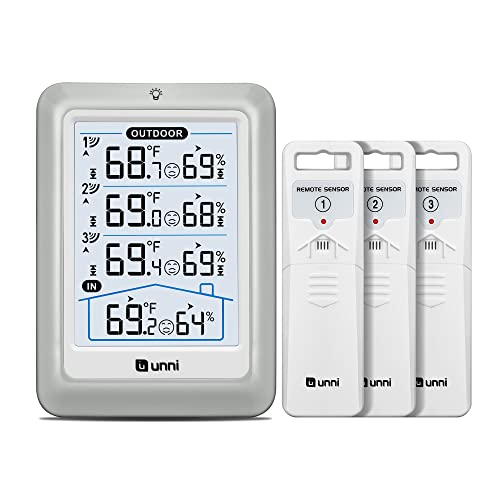
This device provides a 4.5-inch display for quick viewing of both indoor and outdoor temperature and humidity. It supports a wide range (-40ºF to 158ºF) with a stated accuracy of about ±1.8ºF for temperature and ±5% for humidity. The unit promises robust data transmission up to 330 feet and updates every 30 seconds, with features like trend indicators, MAX/MIN data, and a comfort indicator. It is suitable for factories, greenhouses, or large homes where a single unit must cover multiple zones.
SafeSense TempTouch WiFi Thermocouple Sensor

SafeSense TempTouch pairs ambient temperature monitoring with flexible probe sensing. It supports multiple thermocouple types (K, J, T, E, R, S, B, N) for a broad range of industrial applications, including HVAC, laboratories, and cold storage. The system emphasizes real-time data, cloud connectivity via a 2.4GHz WiFi network, and customizable alerts for both ambient and probe temperatures, plus humidity. This setup is well-suited for environments requiring precise probe-based readings alongside ambient conditions.
Buying Guide: Key Considerations For Industrial Wireless Temperature Sensors
- Communication Protocol: LoRa-based solutions offer long-range coverage with low power usage, ideal for multi-building deployments, outdoor enclosures, and facilities where WiFi is unreliable or unavailable. WiFi-based sensors are easier to integrate but may crowd networks and require a stable local network.
- Range And Penetration: Consider open-air vs indoor range, and whether signals must pass through metal enclosures, doors, or walls. Some devices note limitations when placed inside metal cabinets or thick doors.
- Power And Maintenance: Battery life varies by protocol and sensor activity. Long-range sensors often prioritize battery longevity to minimize maintenance, an important factor in remote or hard-to-reach installations.
- Alerts And Data Access: Look for multiple alert channels (app, email, SMS) and configurable thresholds. Some offerings provide data export (CSV) and historical charts for trend analysis, which is valuable for industrial record-keeping.
- Environmental Rating and Durability: IP ratings (IP66 or higher) indicate resistance to moisture and dust. For outdoor or humid environments, choose weatherproof designs.
- Sensor Type And Probes: If monitoring ambient and probe temperatures, ensure compatibility with your probes or multiple sensing points (e.g., greenhouse vs fridge). Some devices support a variety of thermocouple types for industrial-grade readings.
- Hub And Ecosystem: Some sensors require a hub for operation or to enable local networking. Confirm compatibility with your existing systems (IFTTT, Alexa, etc.) and whether a hub is included in the package.
- Data Logging And Export: For audits or compliance, data export in CSV or other formats helps with long-term analysis and reporting. Check the data retention period and access methods.
- Cost Of Ownership: Beyond upfront price, consider ongoing costs such as subscription fees for alerts or cloud services. Some sensors offer unlimited or no-subscription models.
These factors help determine which wireless temperature sensor best matches industrial monitoring needs, from small greenhouses to multi-location facilities. The selections above balance range, durability, alert options, and data capabilities for a comprehensive monitoring strategy.