Industrial environments demand sturdy, high-performance wireless-to-wired bridging that can withstand challenging conditions. This guide highlights five top options designed to convert WiFi to Ethernet or extend wired networks across DVRs, cameras, PLCs, printers, and other assets. Each product supports 2.4GHz or 5GHz bands, multiple operation modes, and rugged power options to suit demanding deployments.
| Product | Band | Ports | Key Use | Power |
|---|---|---|---|---|
| VONETS Industrial 2.4GHz WiFi Bridge VAP11S | 2.4 GHz | 2 x RJ45 | DVRs, IP cameras, PLCs | |
| VONETS VAP11G-300 | 2.4 GHz | 1 x RJ45 | Monitoring, scales, printers | |
| BrosTrend AC1200 WiFi To Ethernet Adapter | 2.4/5 GHz | 1 x Ethernet | Smart TVs, game consoles, printers | |
| VONETS VAP11S Industrial High Power | 2.4 GHz | 2 x RJ45 | IP cameras, DVRs, PLCs | |
| Vonets 1800Mbps WiFi To Ethernet Adapter (5.8GHz) | 5.8 GHz | 2 x RJ45 | 4K streaming, gaming, smart TV |
VONETS Industrial 2.4GHz VAP11S: Industrial WiFi Bridge

Designed for industrial environments, this device combines WiFi bridge, router, and repeater capabilities. It supports IP layer or MAC layer transparent transmission to connect Ethernet devices such as DVRs, IP cameras, PLCs, and printers to a wireless network. It includes two adaptive 10/100 Mbps Ethernet ports, external antennas, and multiple operation modes to extend coverage or bridge isolated networks. Power options include USB or DC, facilitating installation in compact or remote locations.
VONETS VAP11G-300: WiFi To Wired Bridge
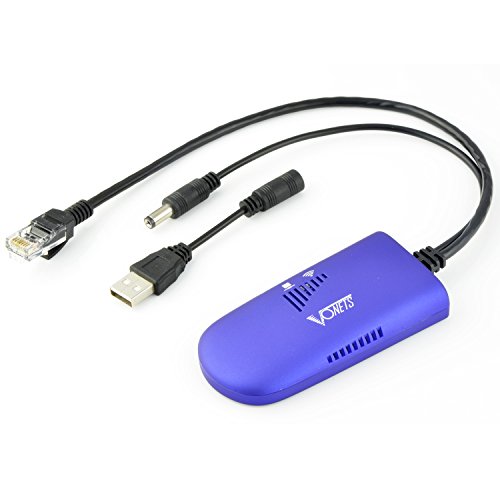
This compact industrial bridge converts WiFi to a wired connection with a single 10/100 Mbps Ethernet port. It supports 802.11 b/g/n and a top rate of 300 Mbps, suitable for monitoring devices, scales, IP printers, and other networked equipment. It can operate with USB or DC power and features a 5V–15V wide-voltage input. Its rugged design makes it a practical match for surveillance and industrial control systems where wired devices need reliable wireless backhaul.
BrosTrend AC1200 WiFi To Ethernet Adapter
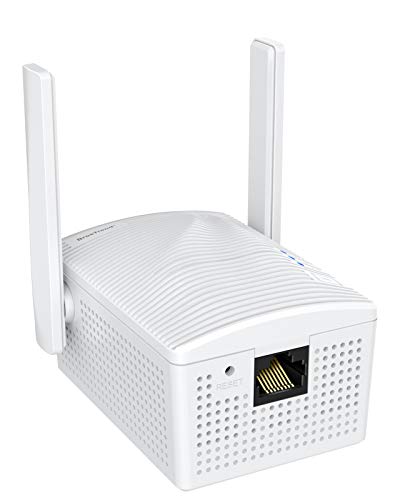
Providing dual-band performance, this adapter links wired devices to WiFi networks with ease. It supports 802.11ac and delivers up to 867 Mbps on 5GHz or 300 Mbps on 2.4GHz, making it suitable for streaming, gaming, and data-intensive tasks. No driver installation is required, and it is powered from a standard electrical outlet, which makes it simple to deploy for home offices or small industrial setups needing a quick wired-to-wireless bridge.
VONETS VAP11S Industrial High Power

Equipped with two external antennas and higher TX power, this model aims at extending coverage across facilities with challenging layouts. It functions as a bridge, repeater, router, or network access point, enabling seamless connectivity for IP cameras, medical devices, PLCs, and other industrial devices. Its rugged power options and IP-friendly modes support stable operation in environments with variable power and interference.
VONETS 1800Mbps 5GHz WiFi To Ethernet Adapter

This high-speed 5GHz bridge targets multimedia and gaming-heavy deployments with 1800 Mbps wireless-to-wired performance. It supports dual power input (DC or USB) and is designed for resilience in industrial and home-entertainment networks. Its cooling design and wide voltage tolerance help it maintain stability under demanding streaming, gaming, or multi-device scenarios, making it suitable for smart TVs, gaming consoles, and high-bandwidth peripherals.
Buying Guide: Key Considerations For Industrial Wireless Bridges
- Frequency band and speed: Choose between 2.4 GHz for longer range or 5 GHz for less interference and higher throughput. Consider if 300 Mbps is enough or if 867 Mbps/1800 Mbps is needed for your devices and applications.
- Ports and topology: Verify the number and type of Ethernet ports (RJ45), and whether devices require router, bridge, or repeater modes. Some models support IP or MAC layer transparency, which can simplify integration with existing networks.
- Power options: Look for USB, DC, or wide-voltage support (5V–24V or more) to fit your installation. Industrial environments benefit from robust overvoltage protection and wide temperature operating ranges.
- Environmental durability: If placed in outdoor or harsh settings, prioritize rugged enclosures, cooling features, and resistance to dust, moisture, and temperature extremes.
- Security and management: Check for encryption support, compatibility with existing network security policies, and ease of configuration through web interfaces or mobile apps.
- Installation complexity: Some devices offer plug-and-play setup with minimal configuration, while others provide extensive options for advanced networks and custom routing.
- Compatibility: Ensure the device supports the required network standards (802.11 b/g/n/ac/ax as applicable) and interoperates with your surveillance gear, PLCs, or industrial controllers.
- Future proofing: Consider models that offer firmware updates and multi-mode flexibility to adapt to evolving network needs.