Industrial sieves and screens are essential tools for laboratories, manufacturing facilities, and DIY workshops that require precise particle separation. This article highlights top sieve options designed for durability, corrosion resistance, and consistent aperture control. We examine five select products to help buyers compare materials, mesh sizes, and frame designs, so you can choose the right sieve for testing soils, powders, aggregates, and lab samples.
| Product | Mesh Size / Aperture | Diameter | Material | Key Benefit |
|---|---|---|---|---|
| LVDALAB 200 Mesh Lab Sieve | 200 Mesh / 0.075 mm | 12 inches | 304 Stainless Steel | Large, sturdy, corrosion-resistant sieve for high-precision screening |
| LVDALAB 100 Mesh Lab Sieve | 100 Mesh / 0.15 mm | 12 inches | 304 Stainless Steel | Durable, double-layer frame for easy stacking |
| TAMSOI 325 Mesh Lab Sieve | 325 Mesh / 0.045 mm | 2 inches | 304 Stainless Steel | Fine aperture with uniform, precise mesh |
| PATIKIL 200 Mesh Lab Sieve | 200 Mesh / 0.075 mm | 30 cm (11.81 inches) | 304 Stainless Steel | High-quality stainless steel with smooth edge design |
| LVDALAB 70 Mesh Lab Sieve | 70 Mesh / 0.25 mm | 2.4 inches | 304 Stainless Steel | Compact, stackable, with double-frame construction |
LVDALAB 200 Mesh Lab Sieve Screen
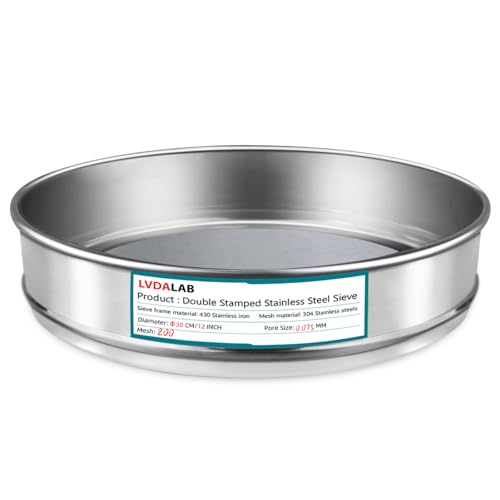
The LVDALAB 200 Mesh Lab Sieve is built from 304 stainless steel, combining high-temperature tolerance and excellent corrosion resistance. Its fine mesh supports precise particle separation while resisting rust in demanding environments. The double-layer frame design enhances stability and makes stacking straightforward for bulk screenings. With a 12-inch diameter, this sieve is substantially larger than standard sizes, offering a wide screening area for efficient sample processing.
LVDALAB 100 Mesh Lab Sieve

The 100-mesh variant from LVDALAB maintains the same premium material approach as its coarser sibling. Also made from 304 stainless steel, it affords robust resistance to corrosion and high-temperature exposure. The sieve’s double-layer frame provides easy stacking and secure handling, while the 12-inch diameter enables efficient processing of larger samples. This option is ideal for applications where finer fractions must be separated but still require a broad screening area.
TAMSOI 325 Mesh Lab Sieve

The TAMSOI 325 Mesh Lab Sieve features a compact 2-inch diameter with a 0.045 mm aperture, crafted from 304 stainless steel. The 325-mesh aperture supports very fine separation tasks, delivering uniform and precise filtering performance. Its double-layer frame construction aids durability and makes cleaning and maintenance straightforward, suitable for laboratory-grade material analysis or quality-control screening in production settings.
PATIKIL 200 Mesh Lab Sieve

PATIKIL’s 200-mesh sieve uses 304 stainless steel to deliver reliable corrosion resistance and high-temperature stability. With a 30 cm diameter, it provides ample screening area and includes a robust bottom edge that minimizes snagging and improves easy cleaning. The frame design is intended to prevent stress concentration, ensuring a long service life even with repeated use in busy lab environments.
LVDALAB 70 Mesh Lab Sieve

The 70-mesh variant from LVDALAB offers a compact 2.4-inch outer diameter with a double-stamped frame that stacks neatly with other sieves. Made from premium 304 stainless steel, this sieve balances a compact footprint with strong performance for quick, coarse separations or preparatory screening in limited-space setups. Its mirror-polished surface aids in easy cleaning and inspection of sample residues.
Buying Guide: Key Purchase Considerations
- Mesh size and aperture: Choose mesh sizes that match your target particle range. Coarser meshes (e.g., 70–100 mesh) are suitable for larger fractions, while finer meshes (e.g., 200–325 mesh) enable precise sub-sieve separations.
- Material and corrosion resistance: 304 stainless steel is common for lab sieves due to rust resistance and stability across a broad temperature range. For more demanding chemical environments, ensure the material can handle acids or alkalis if needed.
- Frame design and stacking: Double-layer or stamped-frame constructions improve rigidity and stackability, saving space when multiple sieves are used together.
- Diameter and height: Larger diameters provide broader screening areas, increasing throughput, while smaller diameters are more portable and convenient for bench-top use.
- Edge finish and safety: Smooth edges reduce the risk of injury during handling and reduce snagging on samples or gloves.
- Maintenance and cleaning: Look for seamless frame-to-mesh connections and robust edge designs that resist tearing and enable easy cleaning to prevent cross-contamination between samples.
- Use-case alignment: Match sieve selection to your application—soil sifting, powder screening, or lab sample analysis—considering both required precision and throughput.
Summary notes: The five selected sieves cover a spectrum from coarse to fine screening, all built with durable 304 stainless steel frames and reinforced designs. They are suitable for industrial laboratories, educational settings, and fieldwork where reliable, repeatable particle separation is essential.