When upgrading sewing capabilities in a shop or factory, a quality industrial servo motor can transform efficiency, noise levels, and energy use. This article highlights five top servo motor options compatible with a range of industrial machines, detailing what to look for and how each model performs. Read on to compare torque, speed, and build quality to make a smart, long-lasting investment.
| Product | Brand | Power | RPM Range | Notes |
|---|---|---|---|---|
| Servo Motor Sewing Machine (550W) | Lonsge | 550W | 200–6000 | Low-noise, energy efficient |
| Industrial Servo Motor (1000W) | Lonsge | 1000W | 0–6000 | Durable, high torque |
| Industrial Servo Motor (550W) | SMUDUKKIT | 550W | 0–3450 | High starting torque |
| Sewing Machine Servo Motor (550W) | Lonsge | 550W | 0–>3450 | Energy efficient, versatile |
| Servo Motor (750W, 1HP) | Lonsge | 750W | 200–6000 | Quiet operation, powerful |
Note: All models listed are designed for AC 110V operation, include a motor, controller, foot switch, and mounting hardware where applicable. They are suitable for a wide range of industrial machines, including flatbeds, twin-needle setups, and overlock systems, and emphasize energy savings and reduced noise during operation.
Servo Motor Sewing Machine 550W by Lonsge

This three-phase brushless servo motor is designed for industrial sewing machines, delivering 550W of power at AC110V. The package includes the brushless motor, controller, foot switch, and basic mounting components, along with an English manual. It operates within a 200 RPM to 6000 RPM range, allowing tighter control for precise stitches and faster production runs. The design emphasizes energy efficiency and low noise, making it suitable for environments where quiet operation is valued. Compatibility spans many industrial sewing machine models, ensuring a broad application scope.
Industrial Servo Motor 1000W with Controller
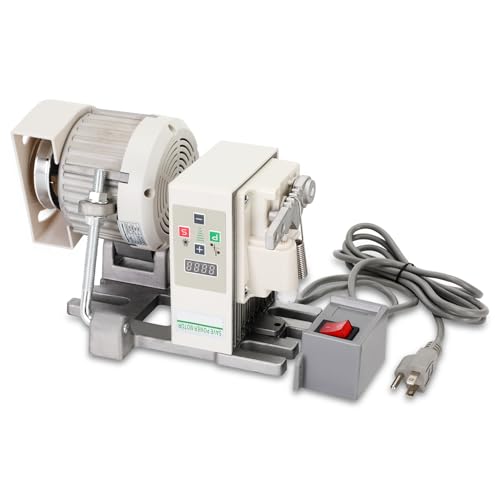
This 1000W servo motor is built for heavy-duty industrial sewing applications, offering up to 6000 RPM while maintaining smooth, quiet operation. The kit includes a brushless motor, controller, foot pedal, and mounting hardware, ensuring straightforward installation. Its robust metal frame, pure copper coils, and aluminum heat sinks contribute to durability and consistent performance under high temperatures. The motor is designed to withstand long sewing sessions with minimal noise and vibration, making it a practical upgrade for busy production lines that demand reliability and efficiency.
550W Servo Motor with High Starting Torque

Manufactured by SMUDUKKIT, this 550W servo motor features high starting torque and a 110V supply, enabling strong performance with thick or high-density fabrics. It provides wide speed adjustments to meet diverse sewing requirements—from slow, precise stitching to faster, straight-line sewing. Designed for compatibility with multiple machine types, it supports different industrial configurations and helps reduce fabric handling issues associated with stalling or gear wear. Its energy-efficient profile makes it a solid choice for shops prioritizing cost savings over their daily operations.
550W Sewing Machine Servo Motor by Lonsge

This Lonsge model emphasizes a durable metal case and protection design to prevent damage to control levers and belt guards. It claims compatibility with a wide range of industrial sewing machines, from flatbeds to twin-needle setups, including various brands such as Juki. The servo motor is designed for energy savings compared to traditional clutch motors, with approximately half to 50% savings reported in typical use. It aims to boost productivity by providing stable speed regulation and smoother acceleration, helping operators achieve consistent stitch quality across different fabrics.
750W Industrial Servo Motor, 1HP by Lonsge

This 750W, 1HP servo motor operates from 200 to 6000 RPM and features a brushless design with controller and foot switch. The unit is marketed for energy savings of up to 70–75% and quieter operation, which is particularly beneficial for environments where noise control is essential. The solid build uses a metal frame, pure copper coils, and an aluminum heat sink to sustain performance during long sewing sessions and elevated temperatures. Its broad RPM range supports both light-duty and heavy-duty fabrics with reliable acceleration and deceleration behavior.
Buying Guide: Key Purchase Considerations
- Power and torque: Higher wattage often correlates with greater torque, which helps with thick materials and dense fabrics. Consider the most demanding fabric types you sew to choose the appropriate horsepower (550W, 750W, or 1000W).
- Voltage and control: Most models here run on AC 110V and include a controller. Verify compatibility with your shop’s electrical setup and ensure the controller provides smooth speed changes without abrupt jumps.
- Speed range and starting torque: A broad RPM range (e.g., 200–6000 RPM) allows for flexible stitch control. High starting torque reduces stalling when starting on thick materials, reducing downtime.
- Durability and cooling: Metal frames, copper windings, and aluminum heat sinks improve longevity and heat management. Long production runs benefit from reliable cooling and low thermal drift.
- Noise and vibration: Servos typically run quieter than clutch motors. If your workspace requires a quiet environment or late shifts, prioritize models touting low noise ratings and smooth acceleration.
- Compatibility: Look for universal fit options or explicit compatibility with common brands (e.g., Juki, Brother, Singer). This reduces integration challenges with existing machines.
- Included accessories: Ensure the package includes a controller, foot switch, manual, and mounting hardware. Some sets also provide installation support for faster setup.
- Maintenance and service life: Durable builds with copper coils and heat sinks tend to last longer under industrial use. Check warranty terms and available replacement parts.
- Energy savings: Many models emphasize energy efficiency, potentially reducing electricity costs over time. Compare efficiency claims with typical usage to estimate savings.
- Operational fit: Assess whether the motor’s size, weight, and pulley compatibility align with your current machine’s configuration to minimize retrofit work.
Overall, choosing the right servo motor involves balancing power, speed control, durability, and noise. For busy shops, prioritizing high starting torque, broad RPM ranges, and robust construction often yields the best long-term value, while energy-efficient options help manage operating expenses without compromising performance.