Industry-grade laser cutting and engraving can elevate product design, prototyping, and production workflows. This guide highlights top-performing machines that balance power, accuracy, and usability for ambitious projects. Below, five picks emphasize higher power, larger work areas, and versatile materials. Each entry includes key specs and practical considerations to help buyers compare options for manufacturing, signage, or custom fabrication.
| Product | Brand | Power | Working Area | Notable Feature |
|---|---|---|---|---|
| C Render Falcon 10w Laser Engraver | CREALITY FALCON | 10 W | Varies (large) | High-speed cutting and safety features |
| Longer Ray5 20000mW Laser Engraver | Longer | 20 W | 400×400 mm | 256-color engraving; multi-machine control |
| Longer Ray5 10000mW Engraver | Longer | 10 W | 400×400 mm | Air assist, rotary kit included |
| Carverall K15 Pro 5W Laser Engraver | Carverall | 5 W | 200×300 mm | Real 5W power; broad material compatibility |
| AlgoLaser 10W Portable Laser Engraver | AlgoLaser | 10 W | Portable, offline capable | AlgoOS, wireless/Touchscreen |
CREALITY FALCON 10w Laser Engraver

The CREALITY FALCON 10w Laser Engraver combines high output power with robust safety and a 4-in-1 rotary kit. It can cut or engrave on wood, plastic, acrylic, urethane, and some metals and glass with a maximum pass speed of up to 10000 mm/min. Assembly is designed to be completed in about 10-20 minutes, and protective features include an anti-UV filter on the module and an emergency stop. The included 4-in-1 rotary roller expands capabilities for cylindrical objects and complex shapes.
Longer Ray5 20000mW Engraver

This model delivers a 20,000 mW laser for deeper cuts and faster material throughput. It supports 0.59″ pine, 0.05 mm stainless steel, and 8 mm acrylic in single-pass cuts, with multi-pass options for thicker materials. It includes a built-in 256-color palette for advanced, color-rich engraving and a 400×400 mm working area. The ESP32 chipset enables multi-machine control from a single computer, making it ideal for workshop environments with parallel workflows.
Longer Ray5 10000mW Engraver
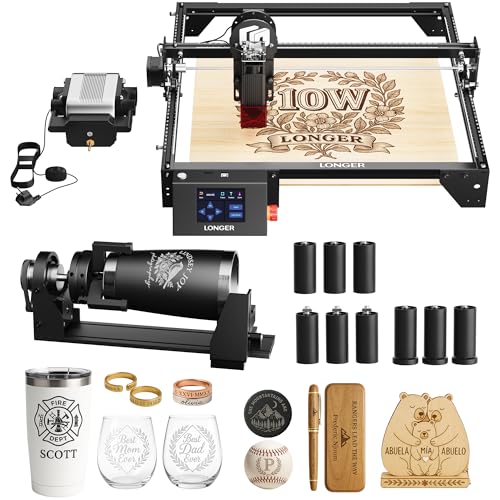
With a 10,000 mW laser and a 400×400 mm work area, this Longer model emphasizes speed and versatile material handling. A 3.5-inch touchscreen simplifies operation, and the device supports USB, Wi-Fi, TF card, and app connections for flexible workflow. Included accessories such as an air pump and a rotary attachment expand capabilities for cylindrical items, making it suitable for diverse production tasks.
Carverall K15 Pro 5W Laser Engraver
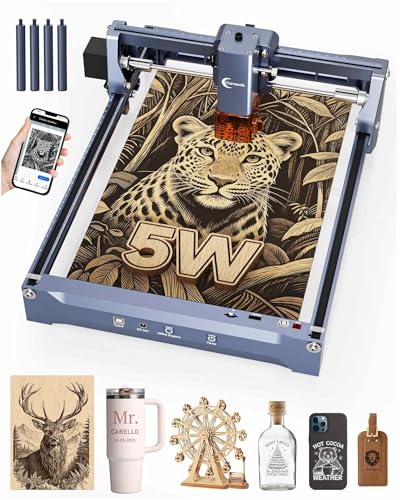
Carverall’s K15 Pro offers true 5W output with a compact 200×300 mm workspace. The machine emphasizes ease of setup—six screws and 90 seconds to ready—plus compatibility with popular software via CutLabX, LightBurn, and LaserGRBL. The system is designed for users who need reliable performance across a range of materials, including wood, coated metals, leather, and acrylic, with a focus on precise engraving at 0.01 mm resolution.
AlgoLaser 10W Portable Laser Engraver

The AlgoLaser Pixi 10W integrates AlgoOS with a touchscreen for direct design handling—no computer required. It supports offline operation and wireless transmission, making it ideal for small businesses and on-the-go production. Features include hand-drawn artwork capture via AlgoSketch, crisp text rendering with AlgoType, and safety-focused design with a Class 1 laser system and password-protected interface. This model emphasizes portability without compromising power or precision.
Buying Guide: Key Purchase Considerations
- Power and material depth: Higher wattage enables thicker cuts and faster milling on wood, acrylic, and some metals. For metallic work or thicker plastics, consider 20 W or higher and verify material compatibility.
- Working area: Larger beds increase project versatility. Balance workspace against machine footprint and enclosure options for safety and dust control.
- Engraving speed and precision: Look for high mm/min speeds and repeatability around 0.01 mm for fine detail. Consider dual-beam or multi-head features if production speed is a priority.
- Control ecosystem: Compatibility with LaserGRBL, LightBurn, and CutLabX affects software flexibility. ESP32-based controllers often support multi-machine synchronization for studios and shops.
- Safety and usability: Features like emergency stops, UV shielding, and auto-safety doors reduce risk. Assess assembly time, documentation quality, and included safety gear.
- Accessory ecosystem: Rotary rollers, air assist, and lens kits extend capabilities for cylindrical items, glass, and metal work. Check for included samples or starter kits.
- Maintenance and reliability: Look for preassembled units with straightforward calibration and accessible spare parts. Warranty length and vendor support influence long-term value.
- Portability vs. production scale: Portable units suit prototyping or DIY, while larger, more powerful machines suit small-to-medium production runs.
When selecting an industrial laser cutting machine, align the choice with intended materials, project scale, and software workflow. The five highlighted options balance power, area, and feature sets to support varied fabrication needs—from custom signage to jewelry and educational prototyping. Compare power levels, bed size, and accessory kits to identify the best fit for your workspace and production goals.