For warehouses, factories, and self-service terminals, fixed-position barcode scanners streamline throughput and reduce manual errors. This guide highlights five robust options that perform reliably in harsh environments, support multiple interfaces, and integrate smoothly with existing automation. Each entry includes practical benefits, key features, and integration considerations to help you compare effectively.
Summary of Selected Products
| Product | Brand | Key Benefit | Interface | Notes |
|---|---|---|---|---|
| NetumScan 2D Embedded Fixed Scanner | NetumScan | Four scanning modes and IP54 protection | USB | Excellent for self-service terminals and assembly lines |
| MUNBYN 2D Embedded Fixed Mount Scanner | MUNBYN | Auto-scan mode boosts throughput | USB | Simple plug-and-play installation |
| NETUM NT-EM61 Embedded Scanner Module | NETUM | Hybrid 1D/2D with multi-interface options | USB/TTL/RS232/RS485 | Compact, versatile for OEM uses |
| Symcode 2D Fixed Mount Scanner | symcode | Auto sensing, rugged metal housing | USB | High compatibility, easy embedding |
| EVAWGIB Embedded Mini USB Scanner | EVAWGIB | Dual-core style with compact form | USB | Solid build, good density handling |
NetumScan 2D Embedded Fixed Scanner

The NetumScan embedded fixed scanner supports four scanning modes: automatic sensing, continuous scanning, external trigger mode, and command trigger mode. This flexibility helps integrate with a wide range of automation equipment, from conveyor systems to self-checkout kiosks. The device is plug-and-play with a USB interface, requiring no drivers for Windows, Linux, MacOS, or Android. Its industrial-grade ABS housing and IP54 rating protect against dust and minor impacts, and it operates across -20°C to 50°C, suitable for many factory environments.
Key considerations when evaluating NetumScan include its four-mode operation and straightforward deployment. The USB connection simplifies integration into existing terminals, enabling rapid setup and reduced downtime. For facilities with harsh environmental conditions or frequent dust exposure, the IP54 rating and wide temperature range offer practical reliability. If you need a scanner that can be tucked into tight spaces while still delivering fast 1D/2D decoding, this model is a strong candidate.
MUNBYN 2D Embedded Fixed Mount Scanner

The MUNBYN embedded fixed scanner is designed for automated production lines and high-throughput applications. It emphasizes automatic scanning with minimal pauses between reads, helping protect productivity and raise throughput. The device uses a USB port for direct connection to a terminal, facilitating straightforward data transfer to a computer or control system. In addition to automatic scanning, it offers a manual trigger option, giving operators flexibility when needed. This dual-mode capability supports varied workflows across manufacturing floors or logistic hubs.
When selecting this model, consider its emphasis on speed and ease of installation. The USB interface reduces setup complexity, and the option to use manual scanning can be valuable for quality checks or selective reads. Its compact form factor allows integration into tight spaces without compromising scanning performance, making it a practical choice for assembly lines where continuous scanning is essential.
NETUM NT-EM61 Embedded Scanner Module

The NETUM NT-EM61 is a compact, embedded scanner module offering multi-interface support including USB, TTL, RS232, and RS485. It handles both 1D and 2D barcodes (EAN-13, QR Code, PDF417, DataMatrix, etc.), making it adaptable to diverse industrial settings. Its high-performance scanning, combined with motion tolerance and rapid decoding, suits high-speed production lines and busy reception points. The dual- or multi-interface approach allows integration with a range of host controllers and legacy systems, reducing the need for additional adapters.
For facilities that require flexible connectivity, the NT-EM61’s interface options enable a smoother integration path with existing automation and data capture workflows. Its compact footprint helps in fitting into limited enclosures, while robust decoding performance supports reliable operation in dynamic environments where barcodes may be moving or partially obscured.
Symcode 2D Fixed Mount Scanner
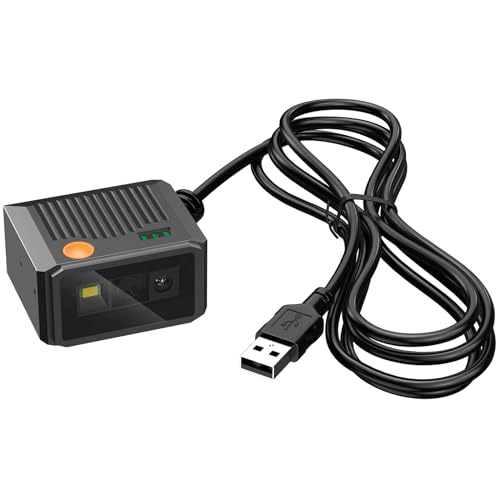
Symcode’s fixed-mount scanner emphasizes automatic scanning with a rugged, ultra-compact metal housing. It is designed to be embedded easily into various terminal devices and equipment such as lockers, kiosks, express cabinets, and self-service machines. The auto-induction trigger feature allows scanning to commence without manually pressing a trigger, which can streamline workflow in high-volume environments. The device supports a broad range of barcode types and functions as a keyboard device, inputting scanned data directly to the connected system.
For buyers, this model offers strong compatibility and simple integration, especially in self-service or automated check-in environments. The metal housing adds durability in dusty or high-traffic settings, and auto-sensing reduces operator steps. When choosing, confirm how the scanner will be mounted within your system and ensure the host supports HID/KBW input for smooth data capture.
EVAWGIB Embedded Mini USB Scanner

The EVAWGIB embedded mini USB scanner is a compact, fixed-mount module designed for easy USB integration with RS232 compatibility. It emphasizes a balance of resolution, decoding density, and reliability, featuring a modern programming approach to minimize discrete components. The device is constructed to withstand typical industrial use and passes drop tests to ensure durability in operational environments. Its small size makes it suitable for OEM applications where space is at a premium, while maintaining robust decoding performance for 1D and 2D codes.
When evaluating this model, consider the density and variety of barcodes you must read, and verify compatibility with your host device’s drivers and power supply. The rugged design is helpful in busy production lines or packing stations where equipment endures frequent use or minor impacts, ensuring continued operation over extended periods.
Buying Guide: Fixed-Position Industrial Scanners
Key purchase considerations
Availability of interfaces matters: USB is common, but RS232, RS485, and TTL may be required to fit legacy systems. Multi-interface models offer future-proofing as you upgrade hardware.
Durability and environmental suitability are critical. Look for IP ratings (IP54 or higher), temperature ranges that match your facility, and rugged enclosures (metal vs. plastic) to withstand dust, vibration, and impacts.
Scanning modes and speed impact throughput. Auto-sensing or triggerless modes reduce operator steps, while external triggers or command-based control can align with conveyor or automation logic. Consider motion tolerance for moving barcodes on bags, boxes, or fast-moving lines.
Code compatibility determines return on investment. Ensure support for 1D and 2D codes (including QR, DataMatrix, PDF417) used in your workflows. Some models handle higher-density labels or damaged prints better than others.
Integration and deployment ease affect total cost. Plug-and-play USB devices save time, but OEM-oriented modules (embedded scanners) require more integration work. Check for available software SDKs, sample wiring diagrams, and documentation to minimize installation time.
Comparative perspectives
- Plug-and-play USB scanners are ideal for quick deployments and retasking across stations, offering straightforward maintenance.
- Embedded modules suit OEMs and assemblies, enabling exact positioning and reduced form-factor constraints, but may require engineering effort for host integration.
- Rugged metal housings excel in dusty, high-traffic environments, where durability reduces downtime and replacement costs.
- Wide temperature and IP-rated devices support outdoor or harsh indoor environments, expanding where fixed scanners can operate.
- Auto-sensing features streamline workflows but verify compatibility with your control software to avoid unexpected behavior.
Choosing the right fixed scanner depends on how you balance deployment complexity, environmental demands, connectivity, and barcode landscape. By reviewing the five models above against your specific workflow—from assembly lines to self-service terminals—you can identify a robust solution that minimizes downtime and improves data accuracy across operations.