When you need reliable water transfer, dewatering, or circulating capability in industrial or demanding home settings, a robust electric water pump is essential. This guide highlights five proven options that balance power, durability, and practical features. Each entry includes core specs and what to consider when choosing the right pump for your application.
| Product | Brand | Key Use | Notable Feature |
|---|---|---|---|
| FOTING Sump Pump 1HP | FOTING | Pool, Pond, Basement draining | 10 ft cord, 1/5″ solids handling |
| VEVOR Deep Well Submersible Pump, 1.5HP | VEVOR | Industrial irrigation, well pumping | 33 ft cord, stainless frame, IP68 |
| Tsurumi HS2.4S Submersible Trash Pump | Tsurumi | Dewatering with debris | Agitator, semi-vortex, 20 ft cord |
| CRESTWAVE Fresh Water Pump | CRESTWAVE | Fresh water systems, RVs, irrigation | 5-chamber design, 10 ft lift, automatic switch |
| VEVOR Deep Well Submersible Pump, 3HP | VEVOR | Industrial, irrigation, home use | 640 ft head, stainless steel frame |
Industrial electric water pumps come in many configurations, from shallow well submersibles to trash pumps designed to handle solids and debris. Selection depends on flow requirements, head height, whether the pump travels underwater, and how long you’ll run it. The following sections summarize five solid options and highlight the strengths that suit heavy-duty use.
FOTING Sump Pump 1HP Clean/Dirty Submersible Water Pump
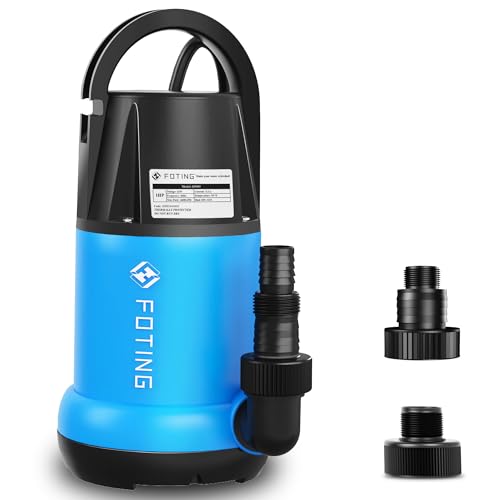
The FOTING 1HP sump pump is a compact submersible unit designed for transferring water and handling light solids. With a maximum flow around 4600 GPH (76 GPM) at 5 ft and a vertical lift up to 31 ft, it supports draining tasks in pools, ponds, basements, and hot tubs. The pump is built with thermoplastic housing for corrosion resistance and includes a 10 ft power cord for greater reach. A removable bottom screen makes cleaning straightforward, while the rounded handle design improves portability. This model targets lightweight to mid-range dewatering tasks where ease of use matters as much as raw pumping power.
VEVOR Deep Well Submersible Pump, 1.5HP

This deep well submersible pump delivers strong performance with a 1.5HP output and a max flow of 37 GPM and 207 ft head. The 4″ stainless steel construction and IP68 rating provide robust resistance to corrosion and immersion. A 33 ft electric cord adds convenience in locations without ready access to outlets. The copper motor and a built-in overheat protection offer reliability for extended operation in industrial or irrigation settings. Users should ensure well dimensions meet the 4″ pump requirement for optimal fit and performance.
Tsurumi HS2.4S Submersible Trash Pump

The Tsurumi HS2.4S is built for dewatering with solids handling. Its semi-vortex impeller and integrated agitator enable efficient pumping of water containing sand and debris up to 0.3 inches. A 1/2 HP motor powers a 2-inch discharge with a 20 ft cord. This pump is suited for construction sites and remediation projects where debris management is critical. The design emphasizes durability and clog resistance, making it a reliable choice for challenging water removal tasks.
CRESTWAVE Fresh Water Pump

The CRESTWAVE 5-chamber diaphragm pump is designed for stable, automatic operation in fresh-water systems. With a 10 ft self-priming lift and up to 157 ft of head, it suits RVs, marine applications, and yard irrigation. A built-in pressure switch enables automatic on/off cycling, reducing manual intervention. The unit supports vertical or horizontal mounting and includes a strainer and barbed adapters for quick, tool-free connections. This pump prioritizes steady flow and reliable pressure control for water distribution tasks.
VEVOR Deep Well Submersible Pump, 3HP

This higher-capacity VEVOR deep-well pump features a 4″ stainless steel design with 18-stage thermoplastic impellers, delivering up to 37 GPM and an impressive 640 ft head. An external control box and a 33 ft cord support convenient installation, while IP68 waterproofing adds rugged protection for wet environments. Built with a copper motor and overheat protection, this option targets heavier industrial pumping tasks where high head and reliable performance are required.
Buying Guide: Key Purchase Considerations
When selecting an industrial electric water pump, consider the following factors to match your application with the right model:
- Flow rate and head: Determine the required gallons per minute (GPM) and vertical lift (head). Higher head is essential for pumping from deep wells or uphill runs, while GPM determines how quickly water is moved.
- Submersible vs. dry-pit: Submersible pumps work underwater and minimize suction issues but require waterproof housing. Dry-pit or above-ground pumps may be simpler to service but need secure priming and priming accessories.
- Material and corrosion resistance: Stainless steel frames and thermoplastic components withstand harsh environments. For prolonged exposure to water, IP68 ratings indicate strong ingress protection.
- Solids handling: Debris or sand requires a pump with a robust impeller design (semi-vortex, agitator, or screen) to prevent clogs.
- Power and wiring: Verify voltage (110V vs. 115V vs. 230V), motor type, and availability of control boxes or automatic switches. Extended cords improve placement flexibility.
- Durability and protections: Overheat protection, thermal cutoffs, and solid motor windings (copper) contribute to longevity in demanding settings.
- Maintenance: Removable screens, accessible bottom housings, and ease of cleaning extend pump life and reduce downtime.
- Installation footprint: Check discharge port size (2″ to 1-1/4″ NPT) and the space needed for hoses and fittings.
For best results, align pump selection with your primary use case, whether dewatering a basement, supplying water to a remote system, or circulating water in industrial settings. Combining numerical performance data with practical features—such as automatic switches and corrosion resistance—helps ensure reliable operation over time.