Industrial dust collection systems are essential for maintaining air quality, reducing cleanup time, and protecting workers in woodshops and industrial spaces. This guide highlights top-capability options that balance performance, ease of use, and installation versatility. Each pick is accompanied by key features, so you can compare suction power, filtration, and portability. The buying guide at the end offers practical considerations for choosing the right system for your space and workload.
Summary of chosen products
| Product | Brand | CFM | Power | Notes |
|---|---|---|---|---|
| WEN DC1300 | WEN | 1,300 | 14 A | Dual inlets, 50-gallon bag |
| DEWALT DWXAF101 | DEWALT | Varies by mode | Remote, 2-stage | HEPA filtration, multiple modes |
| WEN 3417 | WEN | 556/702/1,044 | 110-120V | Three-speed, programmable timer |
| Dust Right Wall Mount 650CFM | Dust Right | 650 | — | Space-saving, upgradeable |
| POWERTEC DC5372 | POWERTEC | 560 | — | 1 micron bag, portable |
WEN DC1300 1,300 CFM Dust Collector

The WEN DC1300 delivers robust airflow at up to 1,300 CFM with a 14-amp motor, designed for mid-sized shops and woodworking tasks. Its dual 4-inch inlets let you connect up to two tools simultaneously, increasing efficiency during long sessions. A vertical 50-gallon collection bag reduces downtime for emptying and simplifies disposal. The unit is mounted on a mobile base, offering mobility around a busy shop floor. Noise levels stay within typical workshop ranges, making it a solid option where floor space and workflow efficiency matter.
Key features include high-volume air movement for dust and chips, two-tool support via dual inlets, and a large-capacity bag that minimizes frequent bag changes. The setup is straightforward for users with basic workshop plumbing, and the mobile base helps when the layout changes or when equipment needs to be repositioned. It’s well-suited for woodworking tasks such as planing, milling, and sanding where dust control is paramount.
DEWALT DWXAF101 Air Filtration System
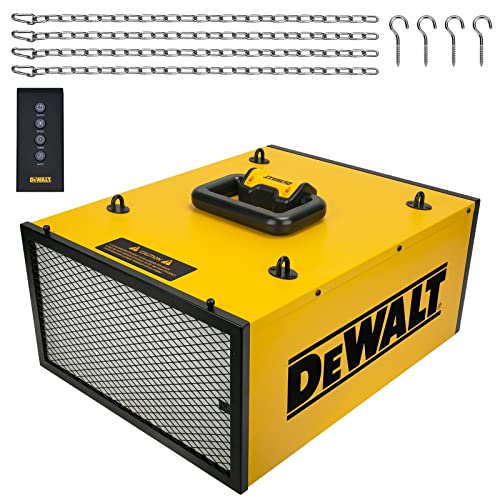
The DEWALT DWXAF101 is a ceiling-mounted, 2-stage filtration system designed for shop air quality improvement. Its 2-stage filtration includes a static cotton pre-filter and an H11 HEPA filter, capable of capturing a majority of fine particles as small as 0.3 microns. This system is ideal for users who want cleaner air with less maintenance overhead and can be controlled via a remote. It includes timer settings (1H, 2H, 4H, 8H) that automatically shut the unit off after the designated period, enabling convenient, unattended operation. The model supports multiple working modes, including HI, MID, LO, and AUTO, which uses automatic air-quality sensing to switch gears as needed.
Highlights include high filtration efficiency, convenient remote control for adjustments, and flexible operation modes to adapt to different workshop conditions. The ceiling-mount design frees floor space, making it suitable for compact or busy work areas where floor-mounted dust collectors would be in the way. It complements standalone dust collection systems or larger shop air-cleaning setups, offering targeted filtration where high dust generation occurs.
WEN 3417 3-Speed Filtration System
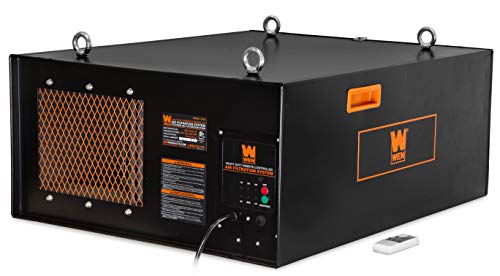
The WEN 3417 is a compact, remote-controlled air filtration system designed for smaller to medium-sized rooms. It offers three speeds (556, 702, and 1,044 CFM) to adapt to different dust loads and room sizes. The system ships with a 1-micron filter and a 5-micron pre-filter, both replaceable for ongoing performance. Dimensions are manageable for workshop placement, and the unit operates within typical household current requirements (110-120V). A programmable timer helps automate shutoff, reducing energy use when a space is unoccupied. It is suited for perimeters around tools or workstations that produce localized dust, as well as general room air quality improvement.
Performance consistency, easy filter replacement, and a quiet operation profile make this a practical choice for small shops or as a supplementary unit in larger setups. Its compact form factor allows flexible placement near dust sources without dominating floor space, enabling targeted airflow to improve overall air cleanliness.
Dust Right Wall Mount Dust Collector

The Dust Right Wall Mount 650 CFM unit emphasizes space-saving design with a vertical, wall-mounted configuration. This model supports multiple tools at once and is ideal for busy woodshops that need to maximize floor area. The unit features a clear 30-micron bag with a viewing window and a bottom zipper for straightforward cleanup. For finer filtration, it’s upgradeable to a 1-micron canister, enabling tighter control over nuisance dust in the shop. The modular approach helps you tailor a dust collection network to a wall, bench, or corner of the workspace.
Benefits include efficient space utilisation, simple maintenance, and upgrade potential to improve filtration. The wall-mount design is particularly attractive in small shops or garages where floor space is at a premium. The ability to scale filtration helps maintain air quality as tools and workflows evolve over time.
POWERTEC 1 HP 560 CFM Portable Dust Collector

The POWERTEC DC5372 is a portable dust collector with a 1-horsepower motor delivering up to 560 CFM. It includes a reusable 1-micron dust bag and a built-in window to monitor dust levels, plus a convenient disposal zipper to streamline cleanup. The Vortex Base design guides airflow to reduce turbulence, improving dust collection efficiency by an estimated margin over similar models. This setup is well-suited for hobbyists or small professional shops seeking a compact, mobile solution that can be relocated as projects shift. The combination of portability and filtration makes it a practical addition to a modular dust collection strategy.
Key advantages include easy mobility, visible dust levels, and straightforward maintenance. The model is especially useful in spaces where specific workstations need dedicated dust removal or where a flexible, on-demand dust collection approach is desired. It pairs well with other filtration or cyclone accessories to broaden collection reach in a diverse shop environment.
Buying Guide: How to Choose The Right System
- Shop size and dust load: Larger spaces with high dust production benefit from higher CFM ratings and multi-stage filtration. Consider whether you need ceiling or wall-mounted units to maximize floor space.
- Filtration and ducting: Two-stage or multi-filter configurations (pre-filter, HEPA) improve air quality and reduce maintenance. Look for easy filter replacement and upgrade paths to finer canisters if needed.
- Mobility vs. permanence: Portable units offer flexibility for rotating between tools and tasks. Fixed or wall-mounted systems save space but require upfront planning for placement.
- Noise and energy: Quiet operation is important in smaller shops or shared spaces. Check decibel ratings and load requirements to ensure compatibility with existing electrical circuits.
- Maintenance and disposal: Large collection bags reduce downtime but require periodic emptying. Look for transparent bags or quick-release features that simplify maintenance.
- Compatibility: Ensure the system can accommodate multiple tools and compatible duct sizes (commonly 4 inches). Dual inlets can improve workflow by serving two machines at once.
- Scalability: For growing shops, choose a system with upgradeable filtration or additional collection modules. A modular approach helps adapt to evolving needs.
Additional considerations
- Air quality impact: Invest in filtration levels that capture submicron particles if your work generates a lot of fine dust or finishes.
- Installation complexity: Ceiling-mounted or ducted systems may require professional installation, while portable units are typically DIY-friendly.
- Cost of ownership: Evaluate initial cost, filter replacements, and maintenance labor over time to gauge total cost of ownership.
- Safety: Ensure systems are properly grounded and used with appropriate dust collection canisters to prevent fire hazards and maintain safe operation.