The market offers numerous high temperature transfer pumps designed for moving hot wort and other brewing liquids. This guide highlights five reliable options, detailing construction, temperature tolerance, and key features to help you choose the right pump for safe, efficient transfers in American homebrewing setups and small-scale operations.
Summary of selected products:
- Ferroday Wort Brewing Pump — Stainless head, magnetic drive, 120°C heat resistance
- WELLBOM Wort Pump — 304 stainless, high temp up to 120°C, inline 1/2″ NPT
- MRbrew Wort Pump (Grey) — 304 stainless, magnetic drive, 120°C compatibility
- Chciyich Wort Pump — 304 stainless head, magnetic drive, safe transfer
- Delinx 12V Transfer Pump — Compact, portable, 1/2″ fittings, 1–100°C range
Ferroday Wort Brewing Pump

This pump uses a magnetic drive design to minimize leakage and vibration, enabling quiet operation while transferring hot liquids. The unit is designed to be non-self-priming; installers should position it at least 12 inches below the vessel and fill the pump with liquid before powering up. It boasts a maximum lifting height of about 2.7 meters and heat resistance up to 120°C (248°F). The magnetic coupling reduces motor contact with the liquid, enhancing safety and durability for homebrewing tasks.
Key considerations include its non-self-priming nature and the need for careful placement to ensure efficient transfer. It is suitable for high-temperature wort transfers but not recommended for high viscosity fluids. The pump is described as a high-output, quiet option ideal for both industrial and homebrew environments, with a robust magnetic drive limited by installation requirements.
Pros: strong heat tolerance, quiet operation, solid magnetic coupling, durable build. Cons: requires careful priming and positioning, not ideal for viscous liquids.
WELLBOM Wort Pump for Brewing
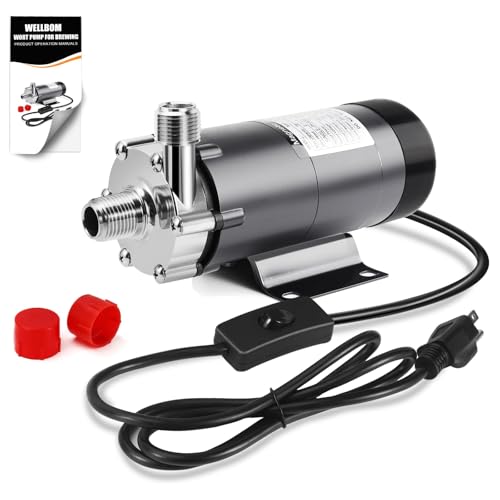
This food-grade magnetic drive pump is built from 304 stainless steel and features a 1/2″ NPT threaded head. It is designed for hot wort transfer with temperatures up to 120°C (248°F). The unit includes a 4.75 ft three-plug power cord and a fully sealed shaft to prevent leaks during operation. Inline temperature tolerance makes it suitable for recirculation or cooling as part of a wort transfer workflow, and the quick disconnect fittings simplify hose changes during brewing sessions.
Considerations include ensuring the inlet line is properly primed and that the pump is placed below the vessel to avoid starve or dry running. The 304 stainless steel construction supports long-term durability in hot, potentially corrosive wort environments. This pump targets serious homebrewers seeking reliable performance with straightforward maintenance.
Pros: strong heat tolerance, durable stainless build, leak-proof design, easy connections. Cons: not self-priming; requires proper priming and placement.
MRbrew Wort Pump With Switch

The MRbrew pump emphasizes high-temperature resistance, with a design that tolerates up to 120°C (248°F). It uses a magnetic drive and 304 stainless steel body for robust performance in hot wort transfers. The closed, static shaft seal aims to minimize leaks and maintain reliability across long brewing sessions. The pump is compatible with 1/2” NPT threaded heads, and its quiet operation is well-suited to garage or kitchen-based breweries where noise is a consideration.
Considerations include ensuring proper priming and avoiding dry starts, as with other magnetic drive units. Durability and corrosion resistance are major selling points, particularly for users who frequently switch between hot wort and cooled transfers. It’s presented as a solid all-around option for homebrewers who value reliability and quieter operation.
Pros: high temperature tolerance, durable stainless steel, reliable seal. Cons: non-self-priming; proper priming required for performance.
Chciyich Wort Pump For Homebrew

This magnetic-drive pump emphasizes easy operation and efficient liquid transfer, with a 304 stainless steel head and a food-grade impeller. It includes a safety switch and clamps for quick disconnects, aiming to reduce leaks and make transitions between hoses smoother. The kit-style presentation caters to homebrewers who prefer a complete set for wort pumping, with a focus on quiet operation and leak-free performance.
Important considerations include the pump being magnetic-drive rather than self-priming. Proper priming and orientation are necessary to ensure consistent flow, especially when moving hot wort between kettles or vessels. The combination of stainless steel and corrosion resistance supports long-term use in hot brewing environments.
Pros: complete transfer kit, quiet and leak-tight operation, food-grade materials. Cons: non-self-priming; requires correct priming and positioning.
Delinx 12V Food-Grade Water Transfer Pump

This compact, portable transfer pump runs on 12V power and includes 10 feet of silicone tubing plus filters. It delivers up to 2 L/min and is designed for a broad range of uses, including hot beverage transfers and outdoor setups. The pump’s small footprint makes it a versatile choice for minimal space, while its food-grade construction supports safe contact with drinking liquids and other brewing-related fluids. The 1/2″ fittings align with standard homebrew equipment.
Considerations include its portability and USB power options; users should verify compatibility with their power source and ensure that temperatures stay within the stated range for hot wort transfers. While not exclusively a high-temperature tool, its flexibility can complement a pumping workflow that occasionally involves heated liquids in smaller volumes.
Buying Guide: Key Considerations For High Temperature Transfer Pumps
- Temperature tolerance: Look for pumps rated up to at least 120°C (248°F) for hot wort handling. Higher ratings provide a safety margin when transferring near boiling points.
- Drive type: Magnetic drive pumps minimize leakage and maintenance, but require proper priming and orientation. Self-priming variants are easier for vertical setups but may introduce more vibration.
- Material compatibility: Stainless steel heads and food-grade impellers are essential for a sanitary brewing environment and long-term durability in contact with wort and cleaning agents.
- Seals and leaks: Closed static seals and well-sealed motor shafts reduce leaks and contamination risks. Check for leak-proof designs and compatible fittings (1/2″ NPT is common in brewing equipment).
- Priming and placement: Many units are not self-priming. Plan vertical spacing so the pump sits below the liquid level, with adequate headroom to avoid cavitation or air pockets.
- Flow rate and head: Assess gallons per hour or liters per minute and lifting height. Higher flow is beneficial for larger batches, but excessive flow may cause splashing or foaming in hot wort.
- Ease of maintenance: Look for simple disassembly, readily available replacement parts, and cleanability to ensure sanitary brewing processes.
- Accessories: Quick disconnects, clamps, and safety features (like switches) simplify setup and reduce the risk of leaks during transfers.
- Power requirements: 110–120V is standard in American homes; portable 12V options are convenient for small setups and field brewing but may offer lower flow.
When selecting a high temperature transfer pump, consider your batch size, vessel arrangement, and whether you prioritize quiet operation, portability, or a fully integrated kit. Magnetic-drive models are often preferred for hot wort due to their sealed design and reduced maintenance, while compact 12V options offer flexibility for outdoor setups or limited space.