When selecting a high speed planetary gearbox, engineers look for compact size, precise gearing, and reliable torque transmission. This guide showcases top options available on Amazon, highlighting gear ratios, input shaft sizes, and materials. Ideal for CNC machines, 3D printers, robotics, and camera rigs, these gearboxes balance speed and torque to meet demanding automation needs. The following picks emphasize quick response, low backlash, and durable construction, helping you choose hardware that fits tightly engineered systems and tight budgets alike.
| Product | Gear Ratio | Brand | Input / Output Notes |
|---|---|---|---|
| STEPPERONLINE 51:1 Planetary Gearbox | 51:1 | STEPPERONLINE | NEMA 17, 0.035 deg step angle |
| Nema 34 Planetary Gearbox 100:1 | 100:1 | TOSEASTARS | Input 86 mm frame, backlash < 35 arc-min |
| Nema 34 Planetary Gearbox 6:1 | 6:1 | HYYKJ-US | Output adjustable up to 3000 rpm |
| STEPPERONLINE 10:1 Gearbox | 10:1 | STEPPERONLINE | NEMA 17, 9.5 mm short shaft |
| STEPPERONLINE 14:1 Gearbox | 14:1 | STEPPERONLINE | NEMA 17, 0.131 deg step angle |
STEPPERONLINE 51:1 Planetary Gearbox High Torque Nema 17

This planetary gearbox delivers high torque at a relatively low speed, ideal for precision applications requiring stable output and compact form. It supports NEMA 17 bipolar 4-wire motors and features a 0.035-degree step angle for fine positioning. Its design emphasizes torque multiplication while maintaining a small footprint, suitable for compact automation systems and camera rigs demanding smooth, repeatable motion.
Nema 34 Planetary Gearbox 100:1 For CNC and More
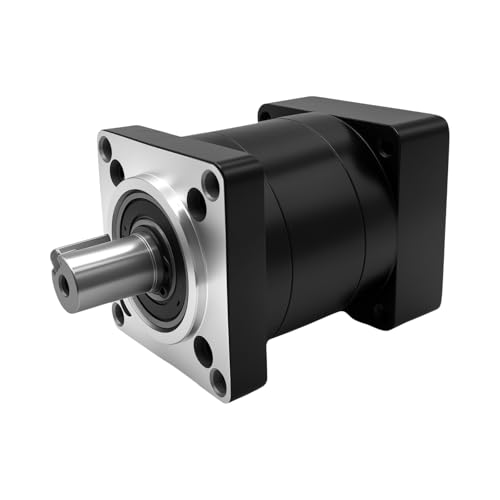
This 100:1 planetary gearbox targets higher reduction for demanding loads. The 86×86 mm frame, 16 mm output shaft, and 14 mm input shaft provide robust integration with Nema34 motors. Backlash remains below 35 arc-min, supporting precise control in CNC machines and 3D printers. With a long service life of up to 20,000 hours, it emphasizes durability in industrial or prototyping environments seeking strong torque at modest speeds.
Nema 34 Planetary Gearbox 6:1 For Dynamic Positioning

With a 6:1 ratio, this gearbox emphasizes speed alongside strong torque. It uses hard aluminum alloy for the housing, providing rigidity and longevity. A removable output shaft simplifies maintenance, while an enlarged base enhances stability during operation. This option suits applications that require quick acceleration and smooth transitions in a compact enclosure, such as small CNC modules or robotics hands.
STEPPERONLINE 10:1 Planetary Gearbox For 9.5mm Short Shaft

Designed for 9.5 mm short shaft NEMA 17 motors, this 10:1 gearhead provides a compact solution with reliable torque multiplication. Its precision gearing supports accurate motion control for CNC machines, 3D printers, and robotics projects requiring tight speed regulation and low backlash. The design focuses on easy integration and stable performance in space-constrained environments.
STEPPERONLINE 27:1 Planetary Gearbox Nema 17

With a 27:1 ratio and a 1.68 A motor allowance, this gearbox suits mid-range torque needs while maintaining responsiveness. The NEMA 17 bipolar 4-wire configuration enables broad compatibility with standard stepper motors. The compact form factor makes it suitable for hobby CNC builds, robotics demonstrations, and small-scale automation systems requiring precise control and reliable output.
Buying Guide: Key Considerations For High Speed Planetary Gearboxes
Choosing the right planetary gearbox involves balancing speed, torque, and durability. Consider these factors to align hardware with your application:
- Gear ratio: Lower ratios favor higher speed; higher ratios increase torque but reduce output speed. Match the ratio to the desired motor speed range and load requirements.
- Backlash: Lower backlash improves positional accuracy. Look for <18 arc-min or better for high-precision tasks; higher values may be acceptable for less demanding projects.
- Input/output shaft specifications: Ensure shaft diameter, length, and mounting align with your motor and mechanical design. Removable shafts and universal mounting options can simplify assembly.
- Material and construction: Aluminum housings provide light weight and corrosion resistance, while alloy steel gears offer durability under heavy loads and long duty cycles.
- Motor compatibility: Match with NEMA frame size (e.g., NEMA 17, NEMA 34) and current ratings. Bipolar 4-wire configurations are common in stepper-driven systems.
- Maintenance and service life: Look for gearboxes with longer expected lifespans and easy access for maintenance, such as cleanable shafts or modular components.
- Noise and temperature: Some gearheads run quietly with low noise (<60dB) and manage heat well under continuous operation—beneficial in enclosed or educational settings.
- Application fit: For CNC, 3D printing, and robotics, consider how the gearbox affects acceleration, repeatability, and vibration. Dynamic testing may be valuable before final integration.
In practice, users should assess the exact torque requirements, expected duty cycles, and space constraints. A slightly higher ratio may improve control during acceleration, while a modestly lower ratio can preserve speed in dynamic tasks. For multi-axis systems, selecting gearheads with consistent backlash and predictable loads across units supports finer synchronization and easier calibration.