Choosing a high pressure jet pump can boost irrigation efficiency, enhance water delivery from wells, and support outdoor cleaning tasks. This guide highlights five reliable models, outlining core specs and practical considerations to help you compare performance, energy use, and ease of installation.
| Product | Brand | Max Head / Lift | Flow (GPM) | Voltage |
|---|---|---|---|---|
| FOTING Shallow Well Pump | FOTING | 147 ft | Up to 1600 GPH | 115V |
| VEVOR 3/4HP SUS304 | VEVOR | 131 ft | 18.5 GPM | 115V |
| AQUASTRONG 1.6 HP | AQUASTRONG | 164 ft | 1340 GPH | 115V |
| AQUASTRONG 1.5 HP | AQUASTRONG | 108 ft | 4250 GPH | 115/230V |
| LANCHEZ Shallow Well Pump | LANCHEZ | 150 ft | 1340 GPH | 115V |
Note: All models listed are designed for domestic irrigation, garden watering, and water transfer tasks. Specific head and flow will vary with system configuration, pipe size, and the presence of pressure tanks or gauges. Always match a pump’s flow and head to your well or reservoir characteristics for best results.
FOTING Shallow Well Pump for Home Gardens

The FOTING model emphasizes a 1.6 horsepower high-power motor designed to deliver strong flow for irrigation and water transfer. It supports a maximum lift height up to 147 feet and a suction depth of 26 feet, which covers typical residential wells and rainwater harvest setups. The pump uses a stainless steel head and an aluminum body to resist corrosion and abrasion, making it suitable for outdoor use. An on/off switch is waterproof for safety, and the unit includes a self-priming mechanism to simplify operation. An automatic thermal overload protection helps prevent motor damage during dry running or overheating. This pump is positioned as a versatile option for water delivery to sprinklers, tanks, or irrigation lines.
Key considerations:
– Best use: Home gardens, light irrigation, water transfer
– Pros: Durable materials, high lift capability, built-in protection
– Cons: May require appropriate fittings for certain pipelines; check full wiring and priming steps in manual
– Maintenance: Regularly check for blockages and ensure the switch is dry after use
VEVOR 3/4HP SUS304 Shallow Well Jet Pump
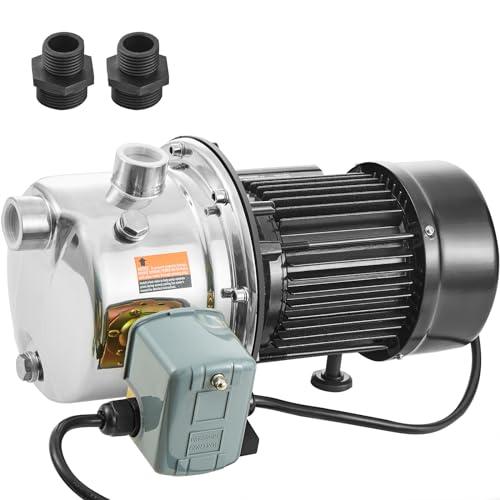
VEVOR’s jet pump delivers a robust 0.75 horsepower motor with a listed head up to 131 feet and a flow of about 18.5 GPM. It features an automatic pressure switch that engages between 20 and 40 PSI, aligning pump operation with faucet demand and helping to protect piping from pressure fluctuations. Setup is straightforward: connect the inlet and outlet, ensure the unit is primed with water through the filling nozzle, and secure the air vent. A drain procedure is recommended if the system will be unused for extended periods. This model is a practical choice for households needing reliable pressure for irrigation or domestic water supply.
Key considerations:
– Best use: Domestic water supply, garden irrigation
– Pros: Automatic operation, clear wiring/installation steps
– Cons: Requires priming and attention to air venting for optimal performance
– Maintenance: Periodic checks of pressure switch and seals
AQUASTRONG 1.6 HP Shallow Well Pump with Pressure Tank

This AQUASTRONG package pairs a 1.6 HP jet pump with a compact pressure tank, providing steady water pressure for home irrigation and garden watering. It delivers up to 1340 GPH with a maximum head around 164 feet, supported by a stainless steel housing for corrosion resistance. The unit features a pressure switch for automatic start/stop and includes a pressure gauge to monitor system performance. A temperature sensor with automatic overload stop helps protect the motor in challenging conditions, while a UL-listed 6.5-foot power cord adds safety and convenience. This setup aims to minimize cycling and extend pump life in typical residential applications.
Key considerations:
– Best use: Home irrigation, garden watering, pressure boosting
– Pros: Integrated pressure tank, metal construction, built-in safety features
– Cons: Slightly heavier due to tank integration
– Maintenance: Check tank air charge and pressure periodically
AQUASTRONG 1.5 HP Shallow Well Jet Pump

Designed for high-demand irrigation, this AQUASTRONG model achieves up to 4250 GPH with a max head of 108 feet. It features a 2″ NPT suction and a 1-1/2″ NPT discharge, enabling large-volume transfer for lawns, sprinkler systems, and gardens. The unit uses a reinforced impeller and diffuser to maintain efficiency, and it offers dual voltage operation (115/230 V), with factory setup at 230 V for easier installation in compatible homes. The 2 HP equivalent performance supports more extensive outdoor watering layouts and larger residential properties.
Key considerations:
– Best use: Large lawns, sprinkler systems, higher-demand irrigation
– Pros: High flow, dual-voltage flexibility, robust construction
– Cons: Higher upfront investment; ensure electrical supply matches voltage
– Maintenance: Inspect impeller/diffuser for wear, monitor for air leaks
LANCHEZ Shallow Well Pump with Glossy Tank

The LANCHEZ model combines a 1.6 HP motor with a 5-gallon pressure tank to stabilize pressure fluctuations and enhance pump life. It delivers strong suction up to 26 feet and up to 1340 GPH with a maximum head around 150 feet, making it suitable for garden irrigation and domestic water supply. It includes a robust carbon ceramic mechanical seal and an automatic overload stop feature for motor protection. The unit is designed for easy operation with 20 PSI to start and 40 PSI to shut off, and it’s built to withstand outdoor conditions while providing reliable water delivery.
Key considerations:
– Best use: Domestic supply, irrigation, pressure boosting
– Pros: Integrated tank, protective features, corrosion-resistant construction
– Cons: Requires correct sizing to match water source
– Maintenance: Regularly check seals, tank pressure, and overall wiring
Buying Guide: Key Purchase Considerations for High Pressure Jet Pumps
- Head and flow alignment: Choose a pump with a maximum head (lift) and GPM that meet or exceed your system’s requirements. Greater head helps push water to higher elevations; higher GPM supports rapid irrigation and transfer tasks.
- Power and voltage: Most residential jet pumps run on 115V or 230V. Confirm that your electrical supply and circuit capacity match the pump’s electrical requirements. Dual-voltage options offer flexibility for different homes.
- Automatic operation: A built-in pressure switch allows the pump to start and stop automatically with water use, improving efficiency and reducing wear. Consider units with adjustable cut-in/cut-out settings or an external gauge for monitoring.
- Durability and materials: Stainless steel heads, cast iron housings, and corrosion-resistant seals extend service life in outdoor or damp environments. If you expect hard water, assess any protective coatings or seals designed to resist mineral buildup.
- Pressure management: Many pumps pair with a small pressure tank to smooth pressure fluctuations and reduce cycling. A gauge helps you observe real-time pressure and adjust as needed.
- Maintenance needs: Look for accessible seals, impeller quality, and straightforward priming procedures. Regular dew and valve checks help prevent leaks and pressure drops.
- System integration: Ensure compatible inlet/outlet fittings (NPT sizes) and pipe diameters align with your existing irrigation lines, hoses, and sprinklers.
- Safety features: Waterproof switches, overload protection, and thermal protection reduce risk during operation. Use proper clearance around the motor and avoid exposure to standing water when wiring connections.
- Noise and energy: Higher-powered pumps can be noisier and consume more energy. Consider installation location and any sound-damping considerations in outdoor spaces.
The selection above covers typical residential needs—from compact setups with a pressure tank to larger flow requirements for expansive lawns. When evaluating models, rate them against your water source capacity, elevation changes, and desired irrigation coverage to determine the best fit for reliable, high-pressure jet pumping.