Choosing the right foam equipment can dramatically improve outcomes in Class A and other foam-assisted firefighting scenarios. This guide highlights top foam products from reputable brands, focusing on deployment ease, material durability, expansion performance, and safety features. Use the product table below as a quick reference for the items covered in detail.
| Product | Brand | Foam Type / Pack | Key Benefit |
|---|---|---|---|
| Flame-Foam Class-A Solid Cartridge System | Primo | Cartridge system (6 cartridges, ~3 hours foam) | Lightweight deployment with instructional support |
| 3M Fire Block Foam FB-Foam | 3M | 12 fl oz can | ASTM E84 Type V performance; fast sealing expansion |
| Kraken Bond Extreme Fire Block Foam (2x24oz) | KRAKEN BOND | 2 x 24 oz cans | High expansion, versatile gap filling |
| Kraken Bond Extreme Orange Fire Block Foam (12x12oz) | KRAKEN BOND | 12 cans of 12 oz | Large project efficiency; wide application range |
| TYTAN Fire Block Foam 24oz Gun Foam | TYTAN PROFESSIONAL | 24 oz gun foam (12 pack) | Extreme heat tolerance and solid gap sealing |
Flame-Foam Class-A Solid Cartridge System

The Primo Flame-Foam System is designed for rapid Class-A foam deployment with a lightweight, rugged glass-filled nylon construction. It includes six Flame-Foam cartridges, providing approximately three hours of foam production, plus an instructional DVD for operator guidance. This setup aims to simplify pre-treatment and extinguishment workflows in structural fires where Class A materials are involved. The system emphasizes portability and reliable performance under field conditions, making it suitable for both professional firefighting teams and training environments.
3M Fire Block Foam FB-Foam, 12 Oz Can

The 3M FB-Foam is a ready-to-use orange fire-block foam designed for in-place applications. It has undergone ASTM E84 (modified) testing as Type V residential fireblock material, and its polyurethane formula offers heat resistance up to 240°F (115°C). The foam expands up to 200% in volume upon dispensing, enabling quick sealing of openings to prevent fire spread and smoke migration in concealed spaces. It is a straightforward option for retrofit or new installations where rapid, dependable fireblocking is required.
Kraken Bond Extreme 2x24oz Fire Block Foam
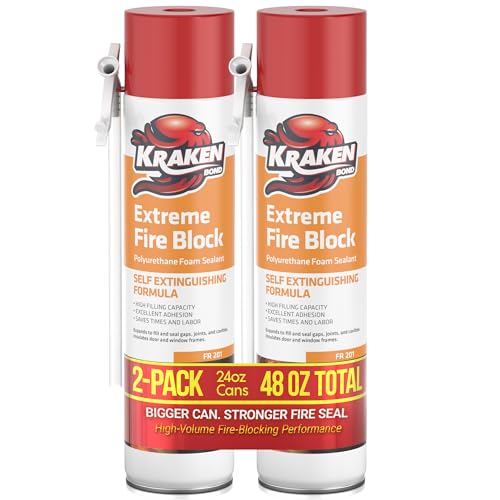
Kraken Bond Extreme Orange Fire Block Foam comes in a two-pack of 24-ounce cans, delivering high expansion and robust fire-retardant properties. This foam is designed for gap filling around windows, walls, joints, pipes, and other penetrations, enabling effective sealing in both new builds and renovations. Its versatility supports insulation and sealing tasks beyond basic fire safety, with reusability and cost efficiency as practical benefits for contractors and facilities teams.
Kraken Bond Extreme Orange Fire Block Foam (12x12oz)

This 12-pack of Kraken Bond Extreme Fire Block Foam expands quickly and fills large gaps efficiently. The product is designed to maintain performance across a range of temperatures (best results at approximately 68°F) and is suitable for projects requiring significant volume expansion. Its temperature guidance helps ensure consistent application in varying field conditions, supporting high-output sealing across multiple locations.
Fire Block 113 Orange Fire Blocking Foam Sealant (24oz Gun Foam)

TYTAN Fire Block Foam is a 24-ounce gun foam designed for gaps, cracks, walls, joints, and around electrical outlets and pipes. It meets Type V residential fire block requirements, ensuring code compliance for concealed spaces. The foam is formulated to resist extreme heat conditions—performance remains stable up to 113°F (45°C)—and expands to seal large gaps, making it a practical option for both new construction and retrofit applications where fire safety and air sealing are priorities.
Foam-Fast Wildfire Pre-Treatment Kit

The Foam-Fast Wildfire Pre-Treatment Kit from Primo offers a streamlined approach to deploying Class-A foam for pre-treatment or active extinguishment. It features a rugged glass-filled nylon construction and includes multiple foam cartridges for extended foam production, supplemented with an instructional DVD. This kit is designed to support rapid readiness in wildfire or structural fire scenarios where pre-treatment can reduce burn rates and improve containment.
Hero’s Edge Foam Fire Sword, 45″

The Hero’s Edge Foam Fire Sword provides a foam-focused tool option for demonstrations or training environments. Its 45-inch length and detailed red handle design offer a visible, functional prop for fire service training and public safety education. While not a primary foam product for structural suppression, it serves as a complementary training asset in educational settings and drills.
Firefighter Boots, Rubber Fighting Safety Boots

Although primarily a protective footwear product, the listed boots contribute to overall firefighting safety in environments where foam deployment and fire-suppression operations occur. Features include heat insulation, waterproof design, anti-collision elements, and a multi-layer construction for stability and protection during field work. Boots complement foam equipment by enabling safer, more efficient on-scene mobility for responders.
Buying Guide: Key Considerations For Foam Equipment Purchases
When selecting foam equipment for firefighting applications, consider the following:
- Foam Type And Compatibility: Ensure the foam is suitable for the target materials (Class A, Class B, or mixed environments) and compatible with your hoses, nozzles, and deployment systems.
- Expansion And Coverage: Look at expansion ratios and container sizes to match the scale of typical incidents you expect to encounter. Higher expansion can speed sealing of gaps but may require more careful application control.
- Temperature And Weather Tolerance: Choose products with performance at the expected ambient temperatures. Some foams perform better in cooler or hotter climates and in different humidity conditions.
- Application Method: Cartridge systems, gun foams, and ready-to-use cans each have deployment implications. Consider crew training needs and maintenance requirements for your operation.
- Safety And Compliance: Verify that foams meet applicable fire-block or building codes (such as Type V emissions in certain tests) and that packaging and labeling align with safety standards.
- Durability And Storage: Assess shelf life, storage requirements, and ease of handling, especially for field kits, vehicles, and remote locations.
- Cost Efficiency: Compare per-use cost, packaging size, and reuse potential. Larger packs may offer economies of scale but require adequate storage space and handling capabilities.
- Training And Support: Prefer brands that provide instructional materials, DVDs, or on-site guidance to ensure correct application and safety.
Across the tested options, selections emphasize reliable expansion, heat resistance, and practical deployment for structural and wildland contexts. Operators should balance immediate foam performance with long-term maintenance, storage, and training considerations to build an effective foam-equipped firefighting setup.