Choosing a high-performance laser engraver that can handle metal in seconds requires evaluating power, speed, accuracy, and material capability. The following selections represent leading fiber and dual-laser systems designed for metal, as well as compatible diodes for wood and other materials. Each product below is evaluated on metal engraving capability, depth, color versatility, and workflow features to support maker spaces, small businesses, and industrial hobbyists.
| Product | Brand | Material Scope | Notable tech | Approx. Peak Speed |
|---|---|---|---|---|
| xTool F1 Ultra | xTool | Metals, Wood, Acrylic, Leather, Glass | 20W fiber with 3D embossing, 16MP camera | 10,000 mm/s |
| xTool F2 Ultra | xTool | All metals, Wood, Acrylic, Leather | 60W MOPA fiber, 40W diode, 100+ color engraving | Up to 15,000 mm/s |
| xTool F1 2-in-1 | xTool | Metals, Wood, Leather | 2 lasers: 2W infrared and 10W diode, enclosed with air purification | ≈4,000 mm/s |
| LaserPecker LP5 | LaserPecker | Metals, Wood, Glass | 20W dual laser, 10,000 mm/s, 0.0027 mm precision | 10,000 mm/s |
| MR. CARVE S4-20W | MR. CARVE | Metals, Plastics | 20W fiber, Lightburn compatible | Not specified |
xTool F1 Ultra 20W Fiber & Diode Dual Laser Engraver

The xTool F1 Ultra combines a 20W fiber laser with a diode laser in a dual-laser setup, enabling rapid metal engraving and versatile non-metal marking. It supports 3D embossing and deep engraving across diverse materials, including gold and stainless steel. A 16MP camera facilitates precise alignment and detailed output, while the dual-laser design aims to streamline production workflows for small shops and hobbyists working with jewelry, metal tags, and decorative pieces.
xTool F2 Ultra 60W MOPA & 40W Diode Dual Laser Engraver

The F2 Ultra couples a 60W MOPA fiber laser with a 40W diode laser to handle all metals and many non-metals with vibrant color engraving and deep 3D effects. It is designed for color-rich metal etching, 2 mm metal cutting, and precise multi-material projects. The system supports black mark on aluminum, laser cleaning, and thin metal welding, delivering broad capabilities for professional jewelry creation, signage, and industrial prototyping.
xTool F1 2-in-1 Dual Laser Engraver

The F1 2-in-1 model offers a rapid 4000 mm/s engraving speed with two integrated lasers: a 2000 mW infrared laser for metal and a 10W diode laser for wood and acrylic. An enclosed design minimizes smoke and odor, complemented by an integrated air purifier (sold separately). It is portable, low-weight, and suitable for on-the-go engraving of metal tags, jewelry components, and gifts.
LaserPecker LP5 20W Dual-Laser Engraver

LP5 pairs a 20W dual-laser system with 10,000 mm/s engraving speed and 0.0027 mm precision, enabling color and grayscale engraving on metals, wood, and glass. The kit often includes an air purifier and modular extensions such as slide tables and rotaries to support storefront customization and rapid order fulfillment in retail environments.
MR. CARVE S4-20W Fiber Laser Marking Machine
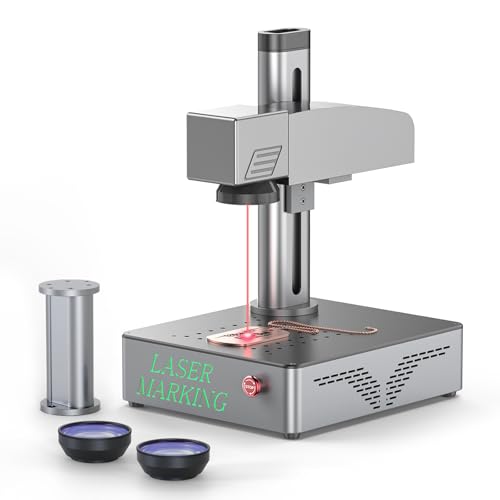
The MR. CARVE S4-20W focuses on 20W fiber laser marking for metals and plastics, with Lightburn compatibility for straightforward programming. Its 150×150 mm working area and Level 4 laser class emphasize precision marking and engravings suitable for jewelry components, tags, and small metallic parts within a compact footprint.
Buying Guide: Key Considerations For Metal Engraving Machines
- Power and material compatibility: For engraving metals, prioritize fiber laser output (20W, 40W, or higher). Consider dual-laser setups if you also need non-metal marking and versatility for mixed-material projects.
- Engraving speed and depth: Higher speeds reduce processing time but verify depth and 3D capabilities if your work requires deep engraving or embossing on metal surfaces.
- Color engraving and 3D capabilities: MOPA-based systems often provide multiple color engravings on metals; 3D embossing adds dimensional effects for richer jewelry and signage.
- Precision and optics: Look for higher resolution and stable optical systems; a good camera (e.g., 16MP) aids alignment for detailed work.
- Safety and enclosure: Enclosed designs reduce smoke and fumes, beneficial for shop or retail settings. Air purification and shielding are valuable features.
- Software compatibility: Lightburn compatibility or integrated software simplifies programming and reduces setup time. Ensure the machine supports common formats (PLT, DXF, BMP, etc.).
- Workflow and expansion: Consider built-in features like auto-streamline, 3D capabilities, and add-ons (rotaries, slides) that support batch production and storefront customization.
- Portability vs. workspace: Portable models are light and easy to move, but heavier, higher-power units may offer longer-term value for dedicated workspaces.
- Warranty and support: Check for manufacturer support, available spare parts, and clear maintenance guidelines to minimize downtime in production.
When selecting a fiber or dual-laser engraver for metal, balance power, speed, precision, and workflow features with your budget and intended use. For storefront or event-based engraving, consider models with enclosed cabinets, air filtration, and rapid setup capabilities. For studio use, prioritize color capabilities, 3D embossing, and multi-material compatibility to maximize output across products.