Digital air flow meters and anemometers provide precise measurements of wind speed, temperature, and flow for a variety of applications—from HVAC installations to drone operation and industrial testing. This guide highlights five top options, detailing their features and practical uses. Readers will find devices suitable for professional HVAC work, field testing, and personal projects, all designed to deliver reliable readings in compact, portable form.
| Product | Brand | Key Uses |
|---|---|---|
| BT-100 Handheld Anemometer | BTMETER | HVAC, wind speed, temp, wind chill, CFM calculations |
| TopTes TS-301 Digital Anemometer | TOPTES | Outdoor activities, sailing, drone flying, HVAC readings |
| Portable Digital Gas Flow Meter MF5706 | cjc | Air, oxygen, nitrogen, CO2 flow; RS485 Modbus option |
| HoldPeak 866B Handheld Anemometer | H HOLDPEAK | Bluetooth monitoring, wind speed, temp, humidity, CFM |
| Nascool Digital Peak Flow Meter | Nascool | Medical/respiratory flow measurements, portable testing |
Below are five detailed product profiles. Each entry summarizes essential specifications, capabilities, and ideal use cases, helping you compare options at a glance.
BT-100 Handheld Anemometer From BTMETER

The BT-100 is designed for versatility in air measurements. It reports wind speed and wind temperature, plus wind chill, on a bright backlit LCD. It supports five measurement units (m/s, km/h, ft/min, knots, mph) and a wide temperature range (-10 to 60°C, 14°F–113°F). Dual temperature sensors and eight vanes enhance sensitivity, making it capable of reading very low air flows in HVAC ductwork and measuring airflow for CFM calculations. A tripod mount enables hands-free operation when mounted for long-term monitoring or drone mounting during flights.
Digital Gas Flow Meter MF5706 (0-20 L/min)

This MEMS-based gas flow meter targets high sensitivity with a low start flow and supports various gases such as air, oxygen, nitrogen, and inert gases. It provides a direct reading of instantaneous and cumulative flow, with a 180° rotatable display for flexible viewing angles. It claims high accuracy without ambient temperature or pressure compensation and includes an LCD that clearly shows current flow, total flow, and battery level. RS485 Modbus compatibility supports networked data logging and PLC/SCADA integration for industrial environments.
TopTes TS-301 Digital Anemometer
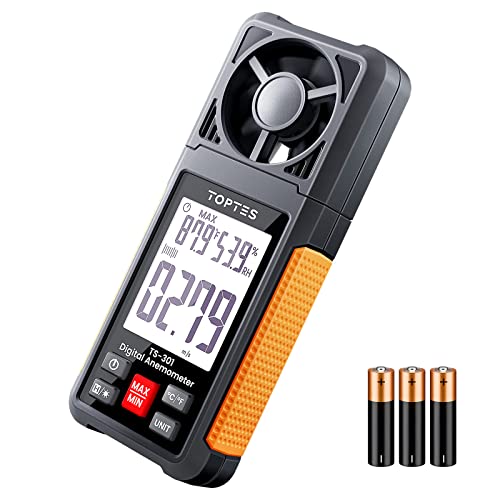
TopTes TS-301 focuses on readability and versatility. Its 2.26-inch backlit LCD makes wind readings easy in bright or dim environments. It measures wind speed and also includes wind humidity and wind temperature sensors, offering humidity in 0.0% to 99.9% RH and temperatures from -4.0°F to 140.0°F. The device supports six units for wind speed and provides a clear view of environmental conditions, making it suitable for sailing, drone operations, and HVAC testing. It notes a warming period for sensor stabilization in new environments.
HoldPeak 866B Handheld Anemometer

The HoldPeak 866B combines wind speed, wind chill, and temperature measurements with Bluetooth-enabled remote monitoring. It offers multiple unit options for wind speed (m/s, km/h, ft/min, knots, mph) and for wind temperature (°C, °F). Its features include max/min/average wind speed, battery status, auto-off, and a backlit display. The Bluetooth capability facilitates real-time data access via a mobile app, allowing users to track readings over time, which is valuable for fieldwork, outdoor activities, and drone operations when remote monitoring is preferred.
Nascool Digital Peak Flow Meter

This handheld peak flow meter is designed for medical and respiratory testing, providing accurate and repeatable flow measurements. It features a pressure differential sensor for precise readings and a compact, portable form factor suitable for home use or clinical settings. It includes a straightforward display and simple operation to track forced expiratory volume (FEV1) and peak expiratory flow (PEF), making it a practical choice for asthma and COPD monitoring in both adults and children.
Buying Guide: Key Purchase Considerations
- Measurement scope: Consider whether you need wind speed only, simultaneous wind speed and temperature, or additional humidity and flow rate data. Some models offer CFM calculations, which are helpful for duct work and HVAC sizing.
- Units and readability: Look for devices with multiple unit options (m/s, mph, km/h, ft/min, knots) and a clear, backlit display for use in sunlight or low-light environments. A larger LCD reduces eye strain during prolonged testing.
- Sensor sensitivity and range: If you work with low airflows or small ducts, prioritize meters with high sensitivity, multiple vanes, and low start thresholds. For outdoor use, stable temperature sensors help maintain accuracy in changing conditions.
- Data access and logging: Bluetooth or USB connectivity and data logging simplify analysis and trend tracking. RS485 Modbus support enables integration with industrial control systems and data historians.
- Portability and mounting options: A compact handheld design is versatile, but tripod mounts or wall/bracket compatibility helps in fixed or extended measurements, such as in lab benches or wind tunnels.
- Power and durability: Battery life, auto-off features, and rugged construction matter for field work. Rechargable batteries or the ability to operate on AC power can reduce downtime.
- Calibration and accuracy: Check stated accuracy, response time, and whether any calibration is required after purchase. Some models claim factory calibration with no further adjustments needed.
- Intended application: Choose devices aligned with your primary users—industrial HVAC technicians, drone operators, researchers, or medical practitioners—since features and interfaces differ across use cases.