Exploring the best options for printing with carbon fiber filaments requires a balance of speed, stability, and compatibility. This guide highlights top printers and carbon fiber filament choices that deliver strong, lightweight parts and reliable performance. Each pick emphasizes fast speeds, auto-leveling, and strong extrusion to handle carbon fiber blends effectively.
| Product | Brand | Key Feature |
|---|---|---|
| Creality K1C 3D Printer, 2025 New Version | Comgrow | 600 mm/s speed, auto leveling, carbon fiber-ready |
| Creality K2 Pro Combo 3D Printer | Creality | 600 mm/s, CFS multi-color, auto leveling |
| QIDI MAX3 3D Printer | R QIDI TECHNOLOGY | Fully auto leveling, large build, high-speed |
| ForceTracer Carbon Fiber Filament 1.75mm | Force Tracer | Carbon fiber reinforcement, low warp |
| Creality Hyper PLA-CF Filament 1.75mm | Creality | High-speed carbon fiber filament, low shrinkage |
Creality K1C 3D Printer: Fast, Auto-Leveling, Carbon Fiber Ready

The Creality K1C 3D Printer emphasizes high-speed performance with a claimed 600 mm/s print speed and 20000 mm/s² acceleration, making it suitable for rapid prototyping of carbon fiber reinforced parts. It includes auto leveling, auto Z offset, and auto input shaping to streamline setup. The clog-free direct extruder is designed to securely grip a range of filaments, including carbon fiber blends, while a durable nozzle and heatbreak support high-temperature printing up to 300°C. This model targets users seeking fast, hands-off operation with reliable print quality.
Creality K2 Pro Combo 3D Printer: Multicolor, Auto Level
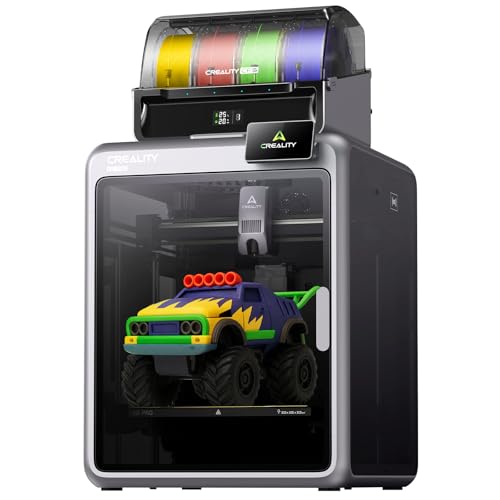
The K2 Pro Combo expands capabilities with the CFS Smart Filament System, enabling multi-color and multi-material printing, including carbon fiber blends. It offers a large 300×300×300 mm build volume, making it suitable for sizable prototypes, while reaching high print speeds up to 600 mm/s with rapid acceleration. Auto leveling and intelligent filament handling reduce manual adjustments, helping teams maintain throughput when printing carbon fiber composites.
QIDI MAX3 3D Printer: Auto Leveling & High Precision

QIDI MAX3 combines a large print area with Klipper firmware and CoreXY geometry for high-speed, reliable performance. It features fully automatic leveling and a robust all-metal frame to support stable operation at elevated speeds. The printer is compatible with a range of high-strength materials, including carbon fiber-reinforced filaments, and is suitable for professionals and enthusiasts seeking large-format carbon fiber prototyping with consistent results.
ForceTracer Carbon Fiber Filament 1.75mm

ForceTracer PLA-CF combines carbon reinforcement with PLA for ease of printing, high rigidity, and good impact resistance. The filament features good dimensional stability and a satin finish, making it suitable for mechanical parts and functional components. It is designed to minimize tangling and feeding issues, delivering reliable prints across a wide range of FDM printers that support carbon fiber blends.
Creality Hyper PLA-CF Carbon Fiber Filament 1.75mm

Creality Hyper PLA-CF filament is designed for high-speed carbon fiber printing, with claimed speeds up to 300 mm/s while maintaining good layer adhesion and dimensional stability. It offers higher mechanical properties compared to standard PLA, making it suitable for lightweight, strong structural parts. The filament is intended for use with most FDM printers capable of handling carbon fiber blends and higher print temperatures.
Buying Guide: Key Considerations for Carbon Fiber 3D Printing
- Printer compatibility with carbon fiber filaments: Look for hotends that tolerate higher temps (around 280–320°C) and robust extruders to prevent clogging when printing with carbon fiber blends.
- Auto leveling and calibration: Auto bed leveling and calibration reduce setup time and improve first-layer reliability, essential for consistent carbon fiber prints.
- Print speed vs. reliability: High-speed printers can dramatically boost throughput, but ensure the machine maintains print quality and minimizes artifacts like ringing or ghosting when printing CF filaments.
- Build volume: Choose a build size that matches your typical parts, especially for larger components or assemblies often associated with structural or drone applications using carbon fiber blends.
- Filament handling: Filaments with carbon fiber reinforcement are prone to snagging and moisture sensitivity. Desiccant-dried spools and reliable feeding paths help prevent issues during long print runs.
- Material properties: Carbon fiber filaments increase strength and stiffness but can be abrasive on nozzles. Consider hardened or stainless-steel nozzles and heat breaks designed for CF materials.
- Thermal management: A stable enclosure or chamber helps maintain consistent temperatures during high-speed trials and reduces warping, especially with CF blends.
- Post-processing: Carbon fiber parts often require deburring, sanding, or coating. Plan for post-processing steps to achieve desired surface finishes.
- Cost vs. value: CF filaments and high-speed printers are an investment. Assess total cost of ownership, including maintenance, replacements, and filament waste.
- Firmware and support: A printer with active firmware updates and reliable customer support helps address CF printing challenges and feature enhancements over time.