When every second counts, having the right confined space rescue equipment can make the difference between a successful mission and a hazardous delay. This guide highlights five top-rated kits and accessories designed for traditional confined spaces, focusing on reliability, portability, and safety features. Each selection is evaluated on winch capacity, build quality, included safety gear, and practical use scenarios to help responders choose the best fit for their needs.
| Product | Winch Capacity | Legs / Height | Cable Length | Includes | Ideal For |
|---|---|---|---|---|---|
| VEVOR Confined Space Tripod Kit (1800 lbs) | 1800 lbs | 7′ legs | 98′ cable | Harness, storage bag, fall arrester | Heavy rescue missions in rugged environments |
| VEVOR Confined Space Tripod Kit (2600 lbs) | 2600 lbs | 8′ legs | 98′ cable | Harness, storage bag, fall arrester | High-capacity rescue with demanding loads |
| VEVOR Confined Space Tripod Kit (1200 lbs) | 1200 lbs | 7′ legs | 98′ cable | Storage bag, fall arrester | Portable, mid-range rescue operations |
| TRSMIMA Confined Space Tripod Kit (1200 lbs) | 1200 lbs | 7′ adjustable | 98′ cable | Fall arrester, carry bag | Emergency responders and municipal projects |
| TROPOW Confined Space Tripod Kit (1200 lbs) | 1200 lbs | 7′ legs | 49.2 ft cable (self-retracting) | Locking device, protective features | Sewer and manhole rescues |
Note: The table above compares key features at a glance. Always verify compatibility with your team’s protocols and local regulations before deployment.
VEVOR 1800 lbs Tripod Kit For Confined Space Rescue

The VEVOR 1800 lbs Confined Space Tripod Kit combines a rugged metal body with a secure pulley system and a corrosion-resistant cable. The Φ5 mm steel wire cable supports up to 397 lbs for load handling versatility, while the 32.8′ fall protection reach aids in controlled descents. Included are a 350 lbs full-body harness and a fall arrester, all packed in a compact storage bag for on-the-go use. This kit is well-suited for challenging rescue scenarios where higher load capacity is required.
VEVOR 2600 lbs Tripod Kit With 8′ Legs
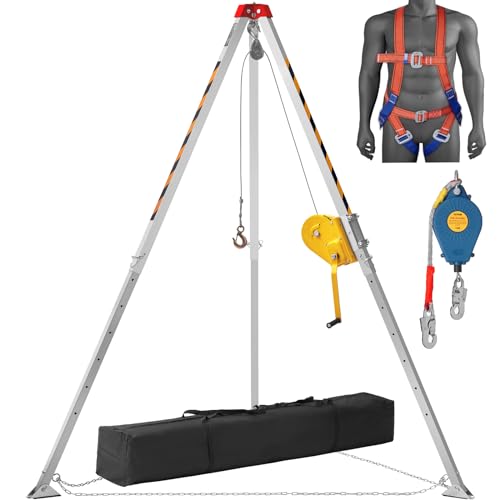
The 2600 lbs capacity tripod from VEVOR is designed for heavier rescue operations. The 8′ leg configuration provides added stability on uneven terrain, and the Φ6 mm steel wire cable maintains strong lifting capability. The kit includes a full-body harness and a fall arrester, with a compact storage bag to support rapid response teams during field operations. It’s a strong option for teams that expect higher-working loads and longer reach requirements.
VEVOR 1200 lbs Tripod Kit With 7′ Legs

This compact 1200 lbs capacity tripod remains a portable option for traditional confined space rescues. It features 7′ legs with a 98′ cable length and a one-piece molded durable design for robust field use. The kit includes a storage bag and an efficient fall arrester, offering essential protection for teams performing routine confined space recoveries in urban or industrial settings.
TRSMIMA 1200Lbs Heavy Duty Confined Space Tripod

TRSMIMA’s 1200 lbs tripod kit is built for demanding rescue operations with a foldable design, adjustable 7′ leg height, and a 98′ cable. The kit includes a fall arrester and a carry bag. Notable features include a self-locking mechanism and stainless steel wire sling compatibility, designed to reduce descent risk during ascent and descent in confined spaces. This option suits responders prioritizing a balance of portability and safety hardware.
TROPOW 1200 Lbs Tripod Kit With 49.2 Ft Cable

The TROPOW kit delivers a 1200 lbs lifting capacity paired with a 49.2 ft auto-locking cable. It uses a self-locking device to prevent accidental descents, and includes a heavy-duty tripod with adjustable legs. The combination of a secure locking system and a compact design makes it suitable for municipal sewer rescues and space-constrained environments where reliable control over lifting operations is essential.
Additional relevant devices include YATOINTO and 3M DBI-SALA retrieval wristlets, which support victim handling and extraction. These items complement tripod systems by enabling secure tethering and controlled recovery in tight spaces, improving overall rescue effectiveness when integrated into a comprehensive safety plan.
Buying Guide
Key purchase considerations for confined space rescue equipment:
- Load capacity vs rescue scenario: Match winch and tripod capacity to typical loads you expect, factoring potential rescues with equipment and PPE on site.
- Leg height and stability: Longer legs offer better reach and stability on uneven terrain; ensure the setup aligns with your working environment and surface conditions.
- Cable length and material: Longer cables extend reach but add weight; steel core versus anti-rotation designs improve durability and safety in corrosive or dusty environments.
- Safety features: Look for self-locking mechanisms, anti-slip bases, and fall arresters to minimize risk during ascent, descent, and rescue operations.
- Portability and storage: Lightweight, compact kits with carry bags speed up deployment and transit between sites.
- Compatibility with accessories: Ensure availability of compatible harnesses, wristlets, and retrieval gear to support coordinated rescue efforts.
- Maintenance and inspection: Regular inspection of cables, pulleys, and connectors is essential; check for wear, corrosion, and loose connections before each use.
- Training and SOP alignment: Operators should be trained in equipment use, fall protection, and confined space protocols; integrate gear into standard operating procedures.
- Certification and compliance: Validate that equipment meets applicable safety standards and local regulations to ensure legal and safe operation.
Depth of options varies by capacity, leg configuration, and included safety gear. For most agencies, selecting a primary high-capacity tripod (e.g., 2600 lbs) alongside mid-capacity alternatives (1200 lbs) provides flexibility for different rescue profiles while maintaining a consistent safety approach. Always pair tripod systems with appropriate harnesses, recovery lines, and wristlets to form a complete rescue toolkit.