Choosing the right commercial water filtering system helps ensure clean, safe water across a business facility, from kitchens and break rooms to labs and customer areas. This guide highlights reliable options designed for higher demand, including whole-house filtration, tankless RO units, and systems tailored for restaurant and office use. Each product profile includes core filtration strengths, capacity, and practical considerations to help you compare performance and maintenance needs.
Summary of Selected Products
| Product | Brand | Type | Key Benefit | Capacity |
|---|---|---|---|---|
| Express Water Whole House Filter System | Express Water | 3-stage whole-house | Significant reduction of chlorine, heavy metals, and scale; protects plumbing | Whole home |
| iSpring CRO1000 | iSpring | 4-stage tankless RO | High flow for commercial use; removes 99%+ contaminants | 1,000 GPD |
| iSpring RCS5T | iSpring | 5-stage tankless RO | PFAS removal plus low waste ratio; versatile for light commercial | 500 GPD |
| 3M Ice Maker System ICE120-S | Aqua-Pure | Commercial filtration for ice machines | Reduces sediment, chlorine taste/odor, scale inhibitors | 1.5 GPM |
| iSpring RCB3P | iSpring | Under-sink RO | High production, PFAS and heavy metals reduction | 300 GPD |
Note: This article focuses on systems suitable for small to mid-sized commercial settings, such as restaurants, offices, and facilities with multiple user points. It emphasizes reliability, filtration efficacy, and ease of maintenance.
Express Water Ultimate Protection System

The Express Water Whole House Filter System provides a three-stage filtration process designed to reduce chlorine, heavy metals such as lead and arsenic, and scale across the entire property. It’s built to protect pipes, appliances, and drinking water quality from every faucet. The system includes a deluxe frame for sturdy installation and user-friendly monitoring features like pressure gauges and easy-change filter buttons, facilitating routine maintenance in a higher-demand environment.
iSpring CRO1000 4-Stage Tankless RO

The iSpring CRO1000 delivers a true commercial-grade, tankless reverse osmosis solution with 1,000 GPD capacity. It features a 4-stage filtration lineup (PP sediment, carbon blocks, and a 1,000 GPD RO membrane) with gauges for easy pressure monitoring. The system is designed for high-output needs in restaurants or small businesses, with optional booster pump support for lower water pressure scenarios and a high-efficiency membrane to minimize waste while maintaining purification standards.
iSpring RCS5T Commercial Tankless RO
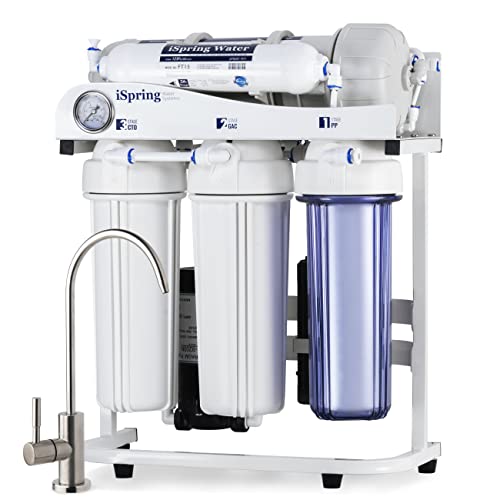
This 5-stage RO system emphasizes PFAS removal (including PFOA and PFOS) across stages, with a robust RO membrane to tackle heavy metals and pesticides. The design includes a low-waste ratio (1.5:1 pure to drain) and a built-in booster pump to maintain high production even when supply pressure is less than ideal. The unit is suitable for light commercial settings such as offices, salons, labs, and restaurants seeking dependable, on-demand purified water.
3M Aqua-Pure ICE120-S Filtration

Engineered for commercial ice equipment, the 3M ICE120-S filtration system reduces sediment and chlorine taste/odor while inhibiting scale to support consistent ice production. The unit provides reliable flow at up to 1.5 GPM and helps minimize downtime and service costs by reducing scale buildup that plagues commercial ice makers. It is well-suited for restaurants, cafeterias, and other foodservice operations requiring high-quality ice.
iSpring RCB3P Tankless Under-Sink RO

The iSpring RCB3P under-sink RO system delivers 300 GPD with a 1.5:1 pure-to-drain ratio, targeting residential or light commercial use where space is at a premium. It reduces PFAS, lead, chlorine, fluoride, and other common contaminants across multiple stages. The freestanding frame and mounting hardware support straightforward installation and service in compact areas like office kitchens or staff areas.
Buying Guide for Commercial Water Filtering Systems
Key considerations when selecting a system for a business setting include capacity, water quality targets, maintenance needs, and installation constraints. Below are multiple perspectives to help inform a balanced decision.
- Filtration goals: If you need overall building water protection, a whole-house system (like Express Water) can guard plumbing and multiple fixtures. For drinking water, countertop or under-sink RO units (such as iSpring RCB3P) address taste, PFAS, and heavy metals at specific points of use.
- Flow and demand: Commercial environments require higher flow. Tankless RO options (CRO1000, RCS5T) provide substantial daily output, reducing wait times during peak usage. Ensure the system matches peak demand without excessive waste.
- Contaminant coverage: PFAS, arsenic, lead, chlorine taste/odor, and scale inhibitors are common targets. Review each unit’s filtration stages to confirm it addresses your top concerns. PFAS-focused stages are especially important for facilities with well water or specific municipal challenges.
- Waste and efficiency: RO systems produce brine. Look for low-waste ratios (e.g., 1.5:1) when evaluating capacity. Booster pumps help preserve production under low pressure but add complexity and cost.
- Maintenance and parts availability: Systems with modular cartridges and clearly labeled gauges simplify monitoring and replacement. Consider brands with readily available replacement filters and responsive customer support.
- Footprint and installation: Under-sink or compact models suit space-constrained kitchens or offices. Whole-house solutions require space for tanks and filters but provide comprehensive coverage for the entire facility.
- Compliance and certifications: Look for NSF/ANSI certifications and industry-standard compliance to ensure filtration claims align with independent testing.
- Cost of ownership: Factor initial cost, filter replacement frequency, and labor for maintenance. A lower upfront price may incur higher ongoing filter costs or more frequent service.
When evaluating options, match system type to use case: point-of-use filtration for beverage stations or a whole-building approach for comprehensive protection. For mixed commercial environments, a combination—such as a whole-house filtration plus select RO units at water stations—can balance cost and performance while meeting multiple needs.