For woodworkers seeking precise, repeatable cuts without a full-size CNC mill, a desktop CNC router can be a game changer. The following selections focus on all-metal builds, strong spindles, and stable frames designed to handle wood, acrylic, and light metals. Each model below is evaluated for accuracy, durability, ease of use, and upgrade potential to suit hobbyists and intermediate crafters alike.
| Product | Brand | Working Area | Notable Strength |
|---|---|---|---|
| LUNYEE 3018 PRO MAX | LUNYEE | 300 x 180 x 80 mm | All-metal construction with long Z-axis travel |
| FoxAlien Masuter Pro | FoxAlien | Various (configurable) | All-metal frame with enhanced stability |
| AnoleX 4030-Evo Ultra 2 | AnoleX | XYZ 400 x 300 x 120 mm (approx) | Dual linear rails and ball screws |
| Genmitsu 3018-PRO | Genmitsu | 300 x 180 x 45 mm | GRBL control with broad community support |
| LUNYE 3018 Pro Ultra | LUNYEE | 300 x 180 x 80 mm | Enhanced linear guides and upgraded platform |
The five models below are highlighted for their balance of rigidity, precision, and upgrade potential. Each section provides a concise overview, key features drawn from the official specifications, and practical considerations for wood-focused projects such as engraving, inlay work, sign making, and small-batch prototyping.
LUNYEE 3018 PRO MAX: All-Metal, High-Precision Router

The LUNYEE 3018 PRO MAX features a 500W spindle with a claimed speed range of 0-12000 RPM and a maximum movement of up to 5000 mm/min. The all-metal frame is designed to resist wear and keep tolerances tight during long runs. A notable upgrade over many entry-level units is the extended Z-axis travel at 80 mm, which allows deeper pockets and more versatile material removal. The design emphasizes rigid aluminum profiles and a frame that minimizes flex under load, beneficial for consistent wood milling, engraving, and light composite work.
Operating practicality is enhanced with a 12 mm optical axis option and one-piece structural considerations aimed at improved subprocess accuracy. This model tends to suit projects requiring deeper milling depths or prolonged spindle runs in wood and softer metals. If you plan to pursue thru-cuts on thicker materials or engage in multi-pass engraving, the 500W spindle and robust frame can contribute to stable finishes and repeatable results.
FoxAlien Masuter Pro: Beginner-Friendly, All-Metal
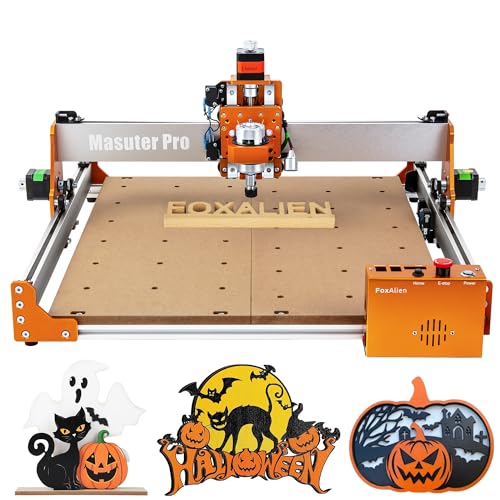
The Masuter Pro is built around an all-metal chassis with a rigid Z-axis supported by linear rails, offering improved stability for precise woodworking tasks. The kit emphasizes an accessible control layout with a dust-proof controller box and emergency stop. Its design accommodates flexible spindle options, including 60W and 300W alternatives, enabling users to tailor power for wood carving, inlay work, and light milling without sacrificing safety.
Upgrade potential and compatibility with additional spindles and clamps allow for experimentation with various wood densities and finishes. For hobbyists aiming to expand capabilities, the Masuter Pro provides a reliable platform with room to upgrade as skills progress—from simple engraving to more demanding relief carving and activity in composite materials beyond wood.
AnoleX 4030-Evo Ultra 2: Dual Rails, Ball Screws

The AnoleX 4030-Evo Ultra 2 is designed to balance metal construction with advanced motion components, featuring dual linear rails and 1204 ball screws on X, Y, and Z axes. This setup improves rigidity and reduces backlash—beneficial for wood projects that require detailed relief, signs, and inlay work. The GRBL_ESP32 firmware supports more modern control features, enabling potential expansion to laser engraving, 4th-axis integration, and other automation options.
With an 800W trim router and multiple speed settings, this model is geared toward serious hobbyists who want to tackle more demanding materials and persistent workloads. The combination of robust hardware and modern firmware makes it a solid choice for ambitious woodworkers who anticipate growing into more complex CNC tasks, including metal-friendly operations with appropriate tooling.
Genmitsu 3018-PRO: Entry-Level Classic

The Genmitsu 3018-PRO is a widely adopted entry-level kit famous for its accessibility and strong community support. It uses GRBL control, runs on a straightforward interface, and supports materials including plastics, soft metals, woods, and PCBs. The 300 x 180 x 45 mm working area is compact but adequate for small items, signs, and inlays. The kit includes software compatibility with drop-in spindles up to 20,000 RPM, simplifying ramp-up to full speed without extra G-code tuning.
For those who value a large user base and abundant tutorials, the Genmitsu platform offers quick-start experiences, ample troubleshooting resources, and a gentle learning curve. It’s a practical choice for beginners who want to build up to more ambitious woodworking projects, with a clear upgrade path into larger or more powerful units as skills advance.
LUNYE 3018 Pro Ultra: Upgraded Linear Guides

Building on the 3018 Pro Max concept, the LUNYE 3018 Pro Ultra advances with HGH15 linear guides on the X-axis and 4040 Y-axis profiles to improve stability and precision for metal engraving and detailed wood carving. The one-piece aluminum work platform and added T-track clamps contribute to surface flatness and workholding convenience. This model targets users who want higher rigidity and more reliable results in longer runs or complex layouts.
Longer Ray5 Laser Engraver (Optional Laser Engraving)

While primarily positioned as a laser engraver, the Longer Ray5 family demonstrates how similar platforms can be extended with laser capabilities for wood and other materials. The 20,000 mW version demonstrates high-speed engraving and cutting potential, with a 256-color palette and a 0.08 x 0.1 mm laser point offering fine detail. This comparison point helps woodworkers understand cross-compatibility between cutting/engraving tools and how a system might evolve to include laser functionality for layered wood projects and inlays.
Buying Guide: Key Purchase Considerations and Comparisons
- Working area and project scale: Choose a size that fits your typical project. Small signs and inlays benefit from 300 x 180 mm work areas; larger signs may require bigger beds or modular extensions.
- Rigidity and frame design: All-metal frames with linear rails and heavy spindles yield better accuracy and repeatability, especially on denser woods and multi-pass cuts.
- Spindle power and speed range: A 500W spindle can handle thicker materials and deeper cuts, but ensure the speed range aligns with your preferred wood species and bit types.
- Motion components: Ball screws and dual rails minimize backlash and wobble, improving cutting quality and tool life for complex engravings and relief work.
- Control software and firmware: GRBL-based systems are well-supported, with many tutorials. firmware options like GRBL_ESP32 add features but may require more setup.
- Upgrade paths: Look for models with upgrade kits, compatible spindles, and adjustable clamps to extend capabilities as skills advance.
- Ease of assembly and support: Community resources, official manuals, and readily available spare parts reduce downtime and frustration for beginners.
- Safety and reliability: Features such as emergency stops, dust protection, and stable workholding help reduce accidents and improve finish quality.
- Material versatility: For wood-focused use, verify compatibility with wood types, plywood, acrylics, and light metal work to maximize return on investment.
In selecting a CNC machine for wood, balance budget with intended workload. A solid all-metal frame, a robust spindle, and stable motion systems typically yield the best results for engraving, sign making, and practice cuts. Consider future-proof upgrades such as additional spindle options, larger work areas, and enhanced clamps to support ongoing projects and growing proficiency.