The right CFM (cubic feet per minute) meter helps technicians measure air flow accurately in compressed air systems, HVAC duct work, and environmental testing. This guide reviews five reliable options, focusing on CFM readouts, ease of use, and data utilities. Each product below includes key specs and how it supports CFM calculations, so you can compare performance and choose a model that fits your workflow.
| Product | Brand | CFM Capability | Data Features |
|---|---|---|---|
| BT-846A Pro HVAC Anemometer | BTMETER | CFM 0-999900 ft3/min | Current/Max/Min/Average, USB/Carrying case |
| Elitech ANE-200W | Elitech | CFM/CMM with wind speed and temperature | Bluetooth App, data logging, CSV export |
| Aicevoos H12 | Aicevoos | CFM reading included; 5-unit wind speed | Extended wind sensor, humidity and temperature |
| HoldPeak 866B | H HOLDPEAK | CFM and wind velocity | Bluetooth/app ready, Max/Min/Average, backlit display |
| Testo 405i | Testo | In-duct airflow with possible CFM after duct dimensions | Bluetooth and app operation, compact and portable |
BT-846A Pro HVAC Anemometer

BTMETER’s BT-846A Pro HVAC Anemometer provides comprehensive wind speed and temperature readings with CFM (CMM) display. It supports a broad wind speed range (0.001–100 mph) and records data in Current, Max, Min, and Average values. The CFM readout is synchronized with cross-sectional area settings, making it suitable for vent and duct measurements. A rugged carrying case helps protect the instrument during field use. The device is designed for professionals monitoring air flow in commercial HVAC or industrial environments.
Elitech ANE-200W Bluetooth Anemometer

Elitech ANE-200W combines wind speed, temperature, and airflow measurements with Bluetooth connectivity. It supports CFM/CMM airflow metrics and offers real-time monitoring via the Elitech App, along with data logging and CSV export. USB data export enables longer-term analysis on a PC. This makes it a strong option for HVAC professionals who need portable field measurements and easy data sharing for reports.
TopTes TS-301 Digital Anemometer
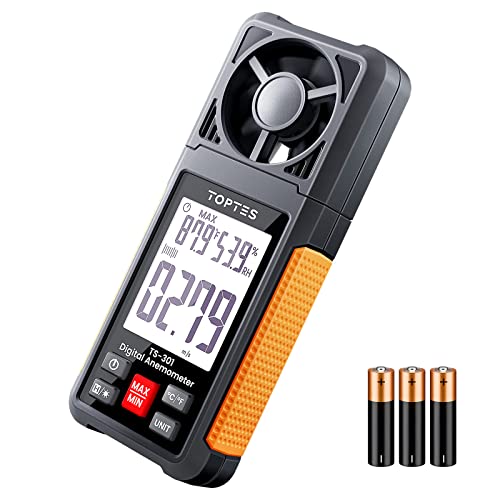
The TopTes TS-301 features a large backlit LCD and multiple units, making it versatile for outdoor and indoor airflow checks, including HVAC settings and drone monitoring. While primarily a wind speed meter, the device is commonly used to estimate air movement in environments where duct dimensions are known or where wind-driven airflow is being assessed. It is a compact choice for field technicians who value portability and readability.
HoldPeak 866B Bluetooth Anemometer

The HoldPeak 866B integrates Bluetooth with real-time wind speed, wind chill, and temperature readings. It supports multiple units and offers Max/Min/Average calculations. The extended features include a responsive app connection, backlit display, and a durable build suitable for HVAC installs and outdoor measurement tasks where rapid, repeatable data capture is needed.
Aicevoos H12 Digital Anemometer

The Aicevoos H12 offers an extended wind sensor with a range of 5 wind speed units plus CFM/CMM air flow readouts. It also measures wind temperature and humidity, with an extendable sensor that can reach up to 2.3 meters. This design supports easier readings in tight or elevated ducts and areas where mounting the sensor close to the flow is challenging, making it suitable for complex HVAC layouts and field testing.
Buying Guide: Key Purchase Considerations
- CFM and flow range: Ensure the model covers the typical duct sizes and flow rates you encounter. Look for explicit CFM or CMM readouts and the ability to input cross-sectional area for accurate calculations.
- Measurement units and accuracy: Many meters support multiple units (m/s, mph, ft/min, etc.). Check stated accuracy (often a percentage plus digits) and resolution to match your precision needs.
- Temperature and humidity: If you work in varying environments, sensors for wind temperature and humidity improve contextual interpretation of flow data.
- Data capture and export: Bluetooth or USB data logging, app connectivity, and CSV export streamline reporting and traceability for compliance and QA processes.
- Mounting and handling: Tripod compatibility, extendable probes, and backlit displays aid usability in ducts, outdoors, or hard-to-reach areas.
- Durability and calibration: Consider rugged casings for field use and verify calibration options or traceability if your work requires periodic verification.
- Software ecosystem: Apps and PC software can offer graphing, trend analysis, and batch data handling—useful for ongoing HVAC projects or environmental testing.
- Portability vs. functionality: Balance compact hand-held devices against more feature-rich units with data logging and cross-sectional area support for CFM calculations.
These five options cover a spectrum of needs—from quick spot checks in ducts to in-depth, logged measurements for professional HVAC and environmental testing. When selecting, align the device’s CFM capabilities, data export options, and sensor versatility with your typical workflow and the environments you service.