Choosing the right carbon dioxide data logger helps monitor indoor air quality, optimize ventilation, and support healthy environments in homes, offices, and classrooms. This guide highlights five reliable options with varying features, from USB loggers to wireless and wall-mounted units, all suitable for tracking CO2 levels, temperature, and humidity. Each product includes key data points to help you compare performance, battery life, storage capacity, and ease of use.
| Product | Brand | Key Features |
|---|---|---|
| Extech CO210 Air Quality CO2 Data Logger | Extech | 0–9,999 ppm CO2; temp & humidity; thousands of data points |
| INKBIRD WiFi CO2 Detector (INK-CO2W) | Inkbird | 3-in-1 CO2, temp, humidity; smart features; LCD display |
| GZAIR CO2 Data Logger Monitor | GZAIR | NDIR sensor; data logging up to 7 days; human/plant modes |
| Onset HOBO MX1102A | Onset | Bluetooth; CO2, humidity, temp; smartphone data access |
| Extech CO250 Portable Indoor Air Quality Meter | Extech | NDIR CO2; temp, humidity; dew point; 99 records |
Overview: This selection covers a spectrum from compact handheld meters to wireless and wall-mounted loggers. When evaluating options, consider measurement range, data storage capacity, calibration needs, ease of data retrieval, and how readings are logged or transmitted for reporting and compliance purposes.
Extech CO210 Air Quality Carbon Dioxide Data Logger

The Extech CO210 monitors CO2 in the 0–9,999 ppm range and provides an indoor air quality indication (Good, Normal, Poor). It also logs CO2, air temperature from –10 to 60 °C (14 to 140 °F), and relative humidity from 0.1% to 99.9%. With memory capable of thousands of data points—up to 5,333 entries per measured parameter—it suits sites needing long-term trend analysis. The device supports straightforward field setup and offers clear readings for HVAC technicians and building managers assessing occupancy and ventilation effectiveness.
Lascar USB CO Monitor Data Logger

This Lascar model offers direct-to-USB connectivity with user-programmable alarm thresholds. It provides straightforward data logging capabilities and includes software to analyze and view logged data. Ideal for desk-level or small office deployments, it emphasizes ease of use and quick setup, making it a practical option for ongoing CO2 monitoring and alert management in workspaces or classrooms.
INKBIRD WiFi CO2 Detector With Data Logging

The INKBIRD INK-CO2W combines a high-precision NDIR CO2 sensor with temperature and humidity monitoring, plus smart features. It can operate in grow tents, offices, or classrooms and is designed for environments where ongoing CO2 management influences occupancy comfort and plant growth. The device emphasizes quick calibration guidance and a bright LCD for easy readability, aiding rapid interpretation of readings in real time.
GZAIR CO2 Data Logger Monitor

GZAIR uses a high-precision NDIR sensor for fast response and stable CO2 detection, with data logging that supports trend reviews over up to a week. It features two modes—Human and Plant—to match monitoring objectives, whether assessing occupant health or plant growth conditions. The device emphasizes stable performance across typical indoor environments and offers built-in trend visualization to identify daily or weekly CO2 fluctuations.
Onset HOBO MX1102A Bluetooth CO2 Logger
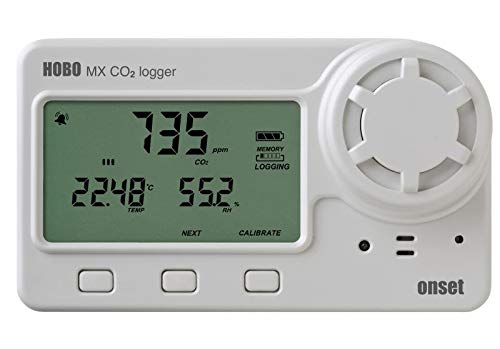
The HOBO MX1102A integrates carbon dioxide, humidity, and temperature measurements with Bluetooth LE for wireless data transmission to smartphones or tablets. It covers 0 to 5000 ppm CO2 and ranges for temperature (-20°C to 70°C) and humidity (1% to 90% RH) with stated accuracy. This model is suitable where remote data access and field mobility are priorities, enabling easy pairing with mobile devices for on-site or remote monitoring.
Extech CO250 Portable Indoor Air Quality Meter

The Extech CO250 measures CO2 from 0 to 5,000 ppm with an advanced NDIR sensor for reliable indoor air quality readings. It also provides temperature, humidity, dew point, and wet bulb readings, offering a comprehensive environmental assessment. The device is designed for portability and ease of use, featuring a large backlit LCD and intuitive controls for quick field assessments by HVAC technicians, inspectors, or facility managers.
Buying Guide: Key Purchase Considerations
To choose the best carbon dioxide data logger, buyers should assess several factors:
- Measurement range and accuracy: Ensure the CO2 range suits your indoor environment and that the sensor accuracy aligns with your monitoring needs. NDIR sensors often provide higher reliability and stability than simple electrochemical sensors.
- Data logging and storage: Consider memory capacity (number of data points), sampling interval, and whether the device stores data locally or transmits it wirelessly. Long-term trend analysis benefits from larger memory and flexible timestamps.
- Calibration and maintenance: Some models require regular calibration to maintain accuracy. Look for devices with straightforward calibration procedures and clear maintenance guidance.
- Connectivity and data access: USB, Bluetooth, or Wi-Fi options determine how readily you can retrieve data for reporting or alerts. Wireless options enable remote monitoring and notifications.
- Additional sensors: Temperature and humidity are commonly bundled with CO2 sensing. Multi-parameter devices provide more context for air quality assessments and ventilation decisions.
- Power source and battery life: Battery-powered loggers suit field use and locations without frequent power. USB-powered devices are convenient for desk setups, while wall-mounted options may require power access.
- Form factor and deployment: Handheld versus wall-mounted versus desktop units impact where the device is best used. Consider field technicians, classroom setups, or home environments when selecting a form factor.
- Data reporting and software: Some loggers come with software for visualization, export formats, and alerting. Access to reliable software improves data interpretation and compliance reporting.
- Environmental considerations: In grow rooms or clinics, ensure the device’s operation aligns with the environment and calibration guidelines recommended by the manufacturer.
Practical tips: For new deployments, start with a calibration check in an open, unoccupied space to minimize initial offset. If monitoring multiple rooms, ensure consistent placement height and ventilation exposure to obtain comparable data across locations.