Brinell hardness testing remains a staple for evaluating the mechanical strength of metallic materials, especially large or irregularly shaped parts. The following review highlights five portable and bench-ready Brinell hardness testers that align with common industrial needs—from field inspections to on-site evaluations. Each entry includes core features, practical applications, and how to choose the right model for your workflow.
Summary of chosen products:
| Product | Brand | Approach | Key Features | Typical Use |
|---|---|---|---|---|
| LS252D Leeb Portable Hardness Tester | Linshang | Portable Leeb-based | Dual coil, built-in direction sensor, D-type impact device | On-site steels and metals |
| BHYIQI Portable Brinell Hardness Tester | BHYIQI | Hammer impact Brinell | Brinell range < 450 HB, 10 mm ball, robust for large parts | Workshop and field applications |
| RASNDTV Portable Brinell/ Rockwell Tester | RASNDTV | Multi-device, memory data | 7 impact devices, up to 600 results storage, optional printer | Versatile metal testing with documentation |
| PHB-1 Pin Brinell Hardness Tester | SULMILE | Pin impact with shear pin control | 100-350 HBW range (650 HBW with optional indenter) | Assemblies and parts testing on-site |
| QIUSUO Leeb/Brinell/ Vickers Tester | QIUSUO | Scale conversions and DL probe | Leeb to multiple scales, dual-coil tech | Flexible hardness scale assessments |
Linshang LS252D Leeb Portable Hardness Tester
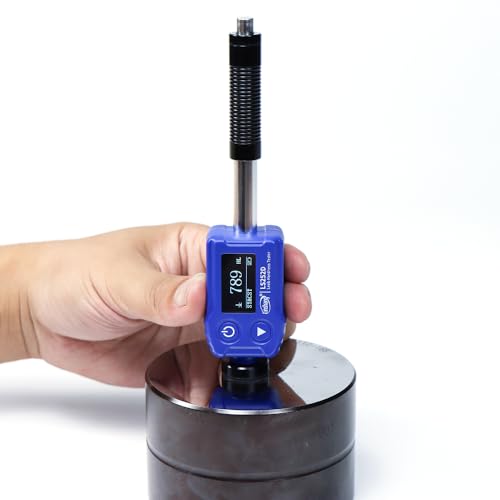
The LS252D combines portability with reliable Leeb measurement for a broad range of metallic materials. Its D-type impact device supports common hardness tests and the dual-coil system enhances repeatability and accuracy. A built-in direction sensor automatically compensates for measurement direction, reducing operator-induced errors in field environments. This model is well-suited for quickly assessing steel components, machine parts, and structural elements without requiring a fixed fixture or laboratory setup.
BHYIQI Brinell Hardness Tester

The BHYIQI unit offers a compact, hammer-based Brinell testing approach with a readout microscope for precise indentation measurements. With a Brinell range listed as less than 450 HB, and a 10 mm steel ball, it is particularly suitable for larger metal parts and field work where laboratory-grade fixtures are impractical. It enables quick assessment of black metals and non-ferrous constituents and supports work-site Brinell evaluations without extensive setup.
RASNDTV Portable Brinell/ Rockwell Tester

The RASNDTV device is designed for fast, accurate Brinell and Rockwell testing with seven optional impact devices to cover a wide range of materials. It stores up to 600 measurement groups and includes PC software for data management. An optional built-in printer supports on-site documentation, making it ideal for quality control records, traceability, and audits on production floors or remote sites.
PHB-1 Pin Brinell Hardness Tester

The PHB-1 adopts a pin-and-shear-pin mechanism to control test force and uses a reading microscope to obtain Brinell indent metrics. It supports a broad testing range and is designed for assemblies that are difficult to move to a lab. The device is versatile for testing forgings, castings, steels, and various alloys, including annealed and tempered parts, and can test upper, lower, or lateral sections of a specimen.
QIUSUO Leeb/Brinell/ Vickers Hardness Tester

The QIUSUO device stands out for its versatility, offering conversions among Leeb, Vickers, Brinell, and Shore scales with a single DL impact device. Its dual-coil technology supports improved measurement consistency, making it a flexible option for shops that require rapid cross-scale hardness assessments without switching instruments. This model suits metal producers, repair facilities, and testing labs needing multi-scale capability.
Buying Guide: Key Considerations for Brinell Hardness Testers
- Test scope and material compatibility: Determine if you primarily test steel, cast iron, aluminum, or nonferrous alloys. Some devices emphasize Brinell alone, while others offer Rockwell or Leeb options for broader coverage.
- Portability vs. fixture requirements: Portable handheld or hammer-based testers excel in fieldwork, while benchtop units may offer more stable measurement environments with fixtures for large parts.
- Impact device and indenter options: A wider range of indenters (e.g., 10 mm steel ball or optional carbide variants) expands the testing envelope, especially for hard or brittle materials.
- Measurement accuracy and repeatability: Look for devices with compensation features for impact direction, memory storage, and calibration support to ensure consistent results across operators.
- Data handling and connectivity: Consider whether the tester stores results locally, in memory, or via PC software. Data export capabilities improve traceability and reporting.
- Ease of use and field practicality: Features such as built-in digital readouts, microscopes for indent measurement, and intuitive interfaces reduce training time and improve throughput.
- Maintenance and spare parts: Check for available replacement parts, indenter options, and service support in your region to minimize downtime.
In choosing a Brinell hardness tester, assess your typical part size, the environment (shop vs. field), and the required documentation. For on-site inspections of steel components or assemblies, portable Leeb and hammer-based Brinell units provide rapid, credible results. For laboratories or plants requiring data logging and multi-scale capabilities, models with memory, PC software, and cross-scale conversions are advantageous. Finally, match the instrument’s indenter options and testing range to the largest expected specimen geometry to avoid re-tests and spare downtime.