Finding the right bottle label applicator machine can streamline labeling workflows for small shops to larger operations. This guide highlights five reliable options that fit a range of bottle sizes and production speeds. Below is a quick snapshot of the chosen models to help you compare at a glance.
| Product | Brand | Key Feature |
|---|---|---|
| VEVOR Manual Round Labeling Machine | VEVOR | 15-20 bottles per minute, adjustable diameter |
| Zyphor Semi-Automatic Round Bottle Labeling Machine | Zyphor | 20-50 bottles per minute, precision sensor |
| Sumeve Manual Round Labeling Machine (Black) | Sumeve | All-metal, versatile 0.6″–4″ bottles |
| Hanchen Manual Round Bottle Labeling Machine | Hanchen | 20-40 pcs/min, comfort press handle |
| Primera AP380 Label Applicator | Primera | Up to 1500 containers per hour, quick setup |
Each model offers varying levels of automation, durability, and fit for cylindrical bottles. The following sections dive into five selected products, detailing how they work, their strengths, and ideal use cases to help you decide which one suits your production needs.
VEVOR Manual Round Labeling Machine

The VEVOR manual round labeling machine is designed for speed and simplicity. It supports bottle diameters from 0.78 to 4.72 inches and can handle label rolls with widths from 0.39 to 5.12 inches. Users benefit from a round bottle press bar and a rubber roller to minimize air bubbles and ensure smooth label adhesion. With an estimated output of 15-20 bottles per minute, this model targets small to medium production lines seeking efficient, low-effort labeling. The all-metal construction provides durability for daily operation in busy environments.
Key features include adjustable diameter compatibility, bubble-free labeling with the press bar, and compatibility with various label roll sizes. The device is suited for users who value straightforward setup and reliable performance without the complexity of fully automatic systems. Ideal applications include cosmetics, beverages, and household products that rely on consistent, clean label placement.
Zyphor Semi-Automatic Round Bottle Labeling Machine

The Zyphor semi-automatic labeling machine focuses on efficiency and precision. It is capable of labeling 20–50 bottles per minute and uses an advanced optical sensor to detect and align labels accurately, reducing waste. The unit is built from stainless steel and aluminum alloy, offering rust and wear resistance suitable for long-term use. Adjustable rollers accommodate a range of cylindrical bottles, making it a solid option for small to mid-sized production lines that require dependable performance and easier maintenance.
Key advantages include higher throughput than purely manual models, precise label placement due to sensor detection, and robust construction. This makes it well-suited for cosmetic, beverage, and food packaging where labeling accuracy is critical and downtime should be minimized.
Sumeve Manual Round Labeling Machine (Black)
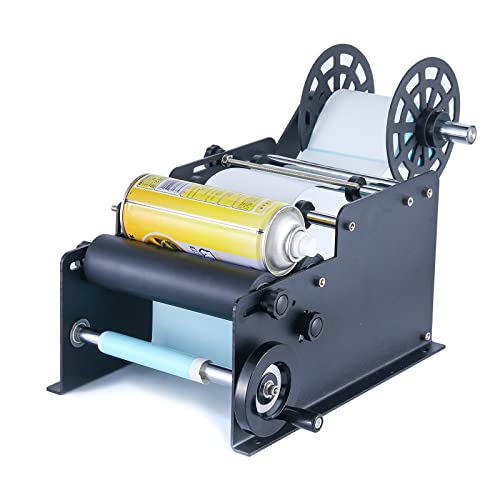
The Sumeve manual labeling machine provides a broad application range for round bottles, including glass, plastic, and cans. It works with bottle diameters from 0.6 to 4 inches and supports label widths from 1 to 5.1 inches, with label lengths up to 10 inches. The machine is an all-metal design, built for durability, and is extended in length to accommodate a wider variety of label sizes. It includes a pressing bar to help the label conform to the bottle, reducing wrinkles and misalignment during labeling.
This model is particularly suitable for small operations that need a robust, repeatable manual solution with flexibility in label format and bottle shape. It balances simplicity with performance, making it a practical choice for hobbyist to small-scale manufacturing environments.
Sumeve Manual Bottle Labeling Machine (White)

The Sumeve white model shares core capabilities with its black variant, supporting cylindrical bottles from 0.6 to 4 inches in diameter and label rolls with inner diameters of at least 0.78 inches. It accommodates label widths of 1 to 5.1 inches and lengths of 1 to 10 inches. A longer machine body enables more label size combinations, and the added pressing bar helps ensure labels adhere flatly without wrinkles. This option targets SMEs needing a dependable, adjustable labeling solution for varied product lines.
Hanchen Manual Round Bottle Labeling Machine

The Hanchen manual model emphasizes precision and speed for labeling vial and small bottles. It features an ergonomic pressing handle for comfortable, controlled operation and a belt traction system to improve mechanical stability. The labeling pace ranges around 20–40 bottles per minute, depending on bottle shape and size. It supports cylindrical bottles with diameters from 15 to 120 mm (0.59–4.72 inches) and promises tight label placement with minimal bubbles or wrinkles. The machine is designed for food, beverage, cosmetics, and pharma-related labeling tasks requiring accuracy.
Primera AP380 Label Applicator
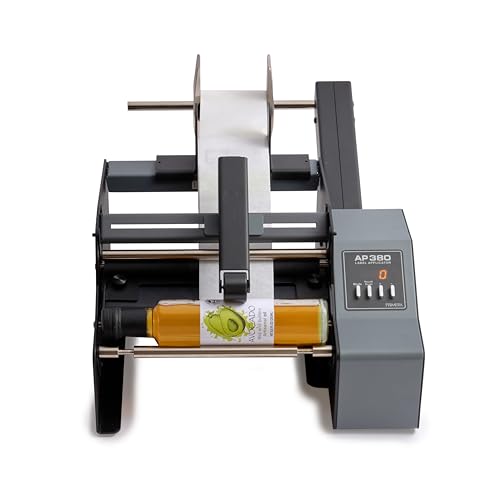
The Primera AP380 offers quick set-up and easy operation, capable of applying one or two labels to cylindrical containers. It can handle up to 1500 containers per hour, making it a strong choice for higher-volume labeling sequences while maintaining accuracy and alignment. The device is designed for semi-automatic use, providing a blend of throughput and control that suits moderate to large labeling runs in packaging lines that prioritize speed without sacrificing label quality.
Buying Guide: Key Purchase Considerations
- Bottle size compatibility: Confirm the diameter range the machine supports and ensure it matches your product lineup to minimize bottlenecks and reworks.
- Label format flexibility: Consider label width and length ranges, inner spool sizes, and whether your labels require bubble-free adhesion or special surface treatment.
- Throughput needs: Determine expected bottles per minute to choose between manual, semi-automatic, or higher-end semiautomatic configurations.
- Ease of use and maintenance: Look for ergonomic handles, clear setup procedures, sensor-assisted accuracy, and durable materials like stainless steel to reduce downtime.
- Durability and environment: Assess rust, wear, and corrosion resistance if your production area has humidity, cleaners, or varying temperatures.
- Industry suitability: Some models emphasize cosmetic and beverage labeling, while others are tailored to pharmaceuticals or food products—ensure compliance with relevant regulations and labeling standards.
- Portability and footprint: For small spaces or modular lines, a compact manual unit may be preferable, whereas larger lines may benefit from semi-automatic systems with higher throughput.
- Cost of ownership: Consider initial cost, maintenance parts, and potential downtime when choosing between manual and semi-automatic options.
When selecting a bottle label applicator machine, balance speed, accuracy, and versatility with the specific bottle shapes, label materials, and production scale of your operation. A semi-automatic model with a high-precision sensor can deliver consistent results for varied label sizes, while a manual unit may suffice for small batches or custom runs. Durability and ease of maintenance are additional factors that influence long-term cost efficiency and downtime.