For shops, studios, or serious hobbyists tackling thick fabrics and high-volume production, an automatic or servo-powered industrial sewing machine can dramatically boost efficiency and stitch quality. This guide highlights top options that balance power, durability, and user-friendly features. Each entry summarizes key capabilities and how they fit different sewing tasks—from leatherwork to heavy denim and upholstery. Below is a quick overview of the featured products to help you compare at a glance.
| Product | Brand | Key Strength | Typical Use |
|---|---|---|---|
| VEVOR Industrial Sewing Machine | VEVOR | 550W servo, 5000 spm, LCD control | Heavy denim, upholstery, thick fabrics |
| Juki TL-2010Q | JUKI | High-speed quilting and stitching, automatic trimming | Quilting, tailoring, home decor |
| Leather Sewing Machine (Marsyyds) | Marsyyds | Industrial leather capacity, oil spray, low noise | Leather, upholstery, thick materials |
| SINGER Heavy Duty 4432 | SINGER | 110 stitch applications, powerful motor | Heavy fabrics, fabrics with layers |
| SINGER Heavy Duty 4452 | SINGER | High-speed, heavy-duty construction | Durable seaming, upholstery tasks |
VEVOR Industrial Sewing Machine With 550W Servo Motor

The VEVOR industrial model combines a robust metal chassis with a 550W servo motor, delivering strong feed and piercing power for fabrics up to approximately 0.4 inches (9 mm) thick. It can maintain up to 5000 stitches per minute with reduced vibration and noise, making it suitable for dense materials like denim or canvas. A clear LCD touchscreen provides intuitive control for speed, direction, needle position, and start/stop settings. The machine’s smart features include a down-needle hold and automatic presser foot lift, aiding precise cornering and stitch uniformity. It also supports manual darning and thread tension control, enabling custom repairs and durable finishes.
Key considerations: servo-driven speed control can improve energy efficiency and quiet operation in busy workshops. The machine’s weight and metal construction suggest long-term durability, though initial setup may require a stable stand or table. Users should verify compatibility with household power if used in smaller spaces and check compatibility with various thread types and needle systems for upholstery or denim projects.
Juki DDL-8700 Lockstitch With Ergonomic Setup
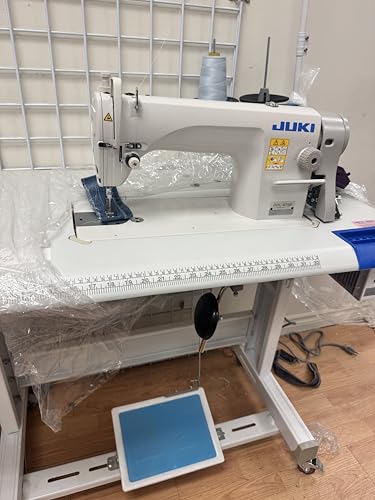
The Juki DDL-8700-based setup presents a lockstitch sewing solution suited for lightweight to medium-weight fabrics, with an electronic servo motor and an ergonomic workstation. It includes a knee lifter, a threading stand, oil pan, multiple bobbins and needles, and a sturdy table with heavy-duty legs. Notable specifications include a maximum stitch speed around 5500 stitches per minute and a stitch length of up to 5 mm, with a needle system compatible with common DB x 1 needles. The combination of a compact footprint and high-speed performance makes it well-suited for garment construction, alterations, and light-to-medium upholstery tasks, especially where precise control and reverse stitching are needed.
Important factors: this model emphasizes speed and reliability for moderate fabrics. It might not handle many layers of thick materials as robustly as dedicated leather or denim machines. Ensure a suitable table setup and workspace clearance for operation, and confirm that the motor and electronics match your local voltage and power preferences.
SINGER Heavy Duty 4432 High-Speed Sewing Machine

The SINGER 4432 is a robust option designed for heavy fabrics and layered materials, featuring a high-powered motor and 110 stitch applications. Its metal frame supports durability under demanding workloads, and the machine includes a one-step buttonhole and an LED light to improve visibility on dense seams. Enhanced piercing power helps traverse thicker textiles, while the wide range of stitch options supports basic to decorative stitching in upholstery projects or rugged apparel production. This model is often favored for home studios and small workshops requiring reliable, fast sewing with solid stitch consistency.
Tradeoffs: while not an “industrial” long-arm unit, the 4432 delivers strong performance for home-based professional work. It may require more frequent maintenance when used on heavy-duty tasks. Compatibility with leather, denim, or multi-ply fabrics can vary by needle type and tension settings, so plan for regular tune-ups and quality thread choices.
SINGER Heavy Duty 4452 High Speed Black Sewing Machine
The 4452 model emphasizes speed with a high-performance motor, capable of up to 1100 stitches per minute for faster seams on stubborn materials. It features 110 stitch options, enabling versatility for basic to intermediate repairs and garment construction. Like other heavy-duty Singers, it benefits from a full-metal frame for stability and long-term durability. The machine is well-suited for projects requiring quick seam finishing, heavy fabric handling, and dependable driving power on multi-layer tasks. Maintenance and correct needle/thread choices help maximize stitch quality and reliability.
Buying Guide: Key Considerations For Industrial-Grade Sewing Machines
- Material compatibility and motor type: Servo motors deliver smooth speed control and energy efficiency, while clutch motors supply higher raw torque. Choose based on the typical fabrics you expect to sew—thicker materials often benefit from robust servo systems paired with a sturdy frame.
- Stitch control and automation: Look for automatic thread trimming, needle position control, programmable stitch lengths, and start/stop functions. These features reduce operator fatigue and increase repeatable results on dense projects.
- Speed versus control: High top speeds like 5000–5500 stitches per minute are impressive but require precise guiding and a well-tuned machine. Ensure the model offers adjustable speed with consistent thread tension as fabrics increase in thickness.
- Durability and build: A metal frame and heavy-duty construction improve longevity in production environments. Consider machines with sealed gearings or oil lubrication features for heavy usage and noisy workspaces.
- Table and workspace ergonomics: A stable table, knee lifter, and proper needle clearance enhance efficiency for long sewing sessions. Ergonomics reduce operator strain and improve accuracy on complex seams.
- Maintenance needs: Leather and denim work require regular lubrication and needle changes. Check for user-friendly oiling points and accessible bobbin systems to minimize downtime.
- Cost of ownership: Beyond initial price, account for needles, thread types, presser feet, and potential service costs. A model with readily available replacement parts and local support tends to be more economical over time.
- Application fit: Distinguish between heavy-duty, industrial, and domestic machines. While some domestic units offer high performance, true industrial machines deliver more consistent power, larger work areas, and better durability for continuous use.
- Voltage and regional compatibility: Verify electrical requirements align with local power standards. Some machines offer dual-voltage options or step-up/down transformers for global use.
When selecting an industrial-leaning or automatic sewing machine, balance your anticipated workload, fabric types, and required precision with the machine’s control features and durability. The options above provide a spectrum from high-speed lockstitchers to leather-capable industrials, enabling you to match a tool to your production goals.