Automated label applicators speed up packaging lines, improve accuracy, and reduce labor costs. This guide highlights five top options that fit a range of bottle shapes, label sizes, and production speeds. Each product is evaluated for sensing accuracy, speed, compatibility, and ease of setup to help buyers compare effectively.
Summary of chosen products:
- YUZSU Automatic Label Dispenser
- Primera AP380 Label Applicator
- CGOLDENWALL Upgraded Automatic Label Dispenser
- U.S. Solid Automatic Label Dispenser
- CGOLDENWALL Automatic Label Rewinder Machine
YUZSU Automatic Label Dispenser

Product overview: The YUZSU model is designed for quick, automatic label dispensing across a range of bottle types. It features smart sensing to automatically detect and peel labels, with a counting display to help track production. The system supports adjustable speed and length settings, making it adaptable for varying label sizes and line speeds. It is suitable for different label formats and can integrate into compact or larger labeling stations. The key value proposition is efficient label feed and a practical control interface for continuous operations.
Key considerations:
– Sensing and auto-feeding: Reduces manual handling and improves throughput.
– Speed and length adjustments: Allows tailoring to different label dimensions.
– Compatibility: Works with common label sizes and standard roll cores, aiding integration on small or medium lines.
Potential workload fit: Suitable for small to mid-scale packaging lines or lab environments where consistent, hands-off label application is desired. It provides reliable automation without requiring a full-scale industrial labeling system. This makes it a strong option for startups or facilities updating from manual labeling.
Primera AP380 Label Applicator
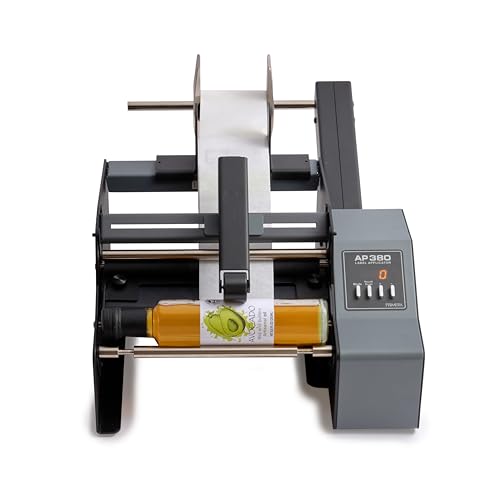
Product overview: The Primera AP380 offers a semi-automatic approach with a focus on cylindrical containers. It supports quick set-up, precise single or dual-label application, and can handle up to 1500 containers per hour in optimal conditions. While semi-automatic, its design emphasizes accuracy and repeatability, making it ideal for mid-volume lines that require consistent label placement without investing in a full automatic system. It pairs well with standard bottle shapes and is appreciated for ease of operation.
Key considerations:
– Throughput: High capacity for a semi-automatic device, making it suitable for growing production.
– Precision labeling: Accurate placement helps reduce waste and rework.
– Setup and operation: Simple controls reduce operator training time.
Potential workload fit: A good fit for small to medium-sized manufacturers, contract packagers, or beverage operations that want reliable labeling without full automation. It complements incremental automation strategies or hybrid labeling setups.
CGOLDENWALL Upgraded Automatic Label Dispenser

Product overview: This upgraded automatic label dispenser emphasizes multi-row counting and high-precision sensing. It can manage up to nine rows of counting, helping track batches with clarity. The device automatically peels labels, advances the next one, and rewinds the liner as needed. A redesigned baffle reduces misalignment and jams, while a core diameter range ensures compatibility with common label rolls. It’s a strong choice for facilities that require reliable automated feeding with minimal downtime and tight label alignment on a variety of label formats.
Key considerations:
– Multi-row counting: Useful for batch management and audit trails.
– Auto sensing and jam resistance: Improves uptime and labeling accuracy.
– Core compatibility: Handles standard and slightly larger label rolls with stable operation.
Potential workload fit: Well-suited for mid-to-large production environments that label diverse products and demand consistent cycle times. It integrates with existing labeling lines to improve overall throughput.
U.S. Solid Automatic Label Dispenser

Product overview: The U.S. Solid model is a versatile dispenser designed for translucent and opaque labels across a range of widths and lengths. It supports fast dispensing speeds and is designed for easy setup and operation without the need for specialized tools. This makes it attractive for teams seeking a robust, user-friendly unit that can adapt to different label types, including applications on clothing, electronics packaging, or logistics lines. The device is built for continuous use in busy environments.
Key considerations:
– Wide label compatibility: Handles a broad range of label formats, reducing the need for frequent roll changes.
– User-friendly: Simple installation and operation minimize downtime.
– Application breadth: Suitable for multiple industries and label types.
Potential workload fit: A solid choice for manufacturers needing flexibility in label formats and straightforward control, especially in mixed-product lines where one dispenser must handle various labels over time.
CGOLDENWALL Automatic Label Rewinder Machine

Product overview: This bidirectional rewinder supports core sizes of 1″, 1.5″, and 3″ as well as coreless use with the L-rod option. It offers speed control, including a printer-synced mode, to align rewinding with printing operations. The unit is designed to reduce waste by ensuring tight, flat rolls and easy threading. It handles a variety of label widths and can manage the demands of mass labeling workflows, making it a strategic addition for high-volume packaging lines where rewind efficiency matters.
Key considerations:
– Core versatility: Works with multiple core sizes and coreless setups.
– Bidirectional rewinding: Flexibility to match printer outputs and storage needs.
– Speed control: Fine-tuned to printer pace, reducing misfeeds and jams.
Potential workload fit: Ideal for facilities that label at high volumes and require synchronized rewind with print workflows, such as contract packagers or beverage and consumer goods manufacturers with complex labeling lines.
Buying Guide: Key Purchase Considerations For Automatic Label Applicators
-
<li Throughput and speed
- Label compatibility and core sizes
- Sensing technology and accuracy
- Ease of setup and maintenance
- Integration with existing packaging lines
- Reliability and support
<li Budget and total cost of ownership
Throughput and speed: Determine your required labeling rate (labels per minute) and ensure the machine can sustain that pace without bottlenecks. Some models offer adjustable speeds to accommodate different production runs.
Label compatibility: Consider label width, length, and core sizes. If you frequently switch label formats, choose a dispenser with broader compatibility or easy core changes. Rewinders should support your typical roll diameters and core types.
Sensing and accuracy: Smart sensors improve label pickup and placement. Look for auto-feeding, auto-peel, and alignment features that minimize misfeeds and waste. Multi-row counting can aid batch tracking in larger operations.
Ease of setup: Quick setup reduces downtime between runs. Look for models with intuitive controls, minimal calibration steps, and clear display readouts. For rewinder units, ensure straightforward threading and tension control.
Line integration: Assess how well the dispenser fits into your current labeling station. Check dimensions, power requirements, and compatibility with existing conveyors or frames. Some products offer off-the-shelf mounting options to simplify installation.
Reliability and support: Choose brands with reliable parts availability, straightforward maintenance, and accessible customer support. This is especially important in 24/7 or high-demand environments.
Budget and total cost: Beyond the upfront price, factor in maintenance, spare parts, and potential downtime. A slightly higher upfront investment can yield lower operating costs over time through higher accuracy and less waste.