Choosing an automatic bag packing machine can streamline handling powders, grains, seeds, tea, and other packaging needs. This guide highlights five top options, summarizing their capabilities and how they fit different production scales. Each entry includes quick-access details, performance notes, and practical considerations to help you compare features such as sealing style, weighing accuracy, and ease of use.
| Product | Brand | Core Function | Sealing Type | Approximate Throughput |
|---|---|---|---|---|
| VEVOR Automatic Particle Packaging Machine 1-100g | VEVOR | Automatic weighing, filling, sealing | Three-side seal | 10-15 bags/min |
| Particle Filling Machine, 10-999G | HASANEN | Intelligent filling with weight control | Not specified (filling-based design) | 12-15 bags/min |
| Moonshan Bag Sewing Machine 2s/bag | Moonshan | Bag closing/sewing | Bag closing stitch | 2 seconds per bag (≈2600 spm) |
| Cyuanll Mini Bag Closing Machine | Cyuanll | Battery-powered bag closing | Bag closing stitch | 2 seconds per bag |
| Bag Closing Machine, Cordless | SANJIAN | Cordless bag sewing and closing | Line stitching | ≈2 seconds per bag, 2600 spm |
This summary table presents a quick snapshot of how these machines perform in real-world packaging lines. The choice depends on whether you need integrated weighing and sealing, rapid bag formation, or portable closing capabilities for smaller operations. The following sections provide detailed looks at each selected model to help you assess fit, durability, and long-term maintenance needs.
VEVOR Automatic Particle Packaging Machine

The VEVOR system combines weighing, blanking, packaging, and cutting into a single automated workflow. A micro-computer controls the process ensuring consistent weighing and efficient sealing. It features dual vibration systems to maintain smooth material flow, reducing misfeeds and jams. Users should note that film rolls must be purchased separately, since this machine does not include film stock by default.
Sealing is performed with a three-side seal design, which confines the product on three sides to create compact bags. The typical packing speed falls in the 10-15 bags per minute range, contingent on item type and quality. Adjustable paper width and length translate to bags around 3.2 inches wide and 0.4-6.3 inches long. The machine supports a packaging range from 1 to 100 grams (0.035 to 3.53 oz).
Microcomputer control provides accurate and rapid calculations, with dual digital displays for straightforward operation. This model is well-suited for powders, seeds, grains, and similar materials where precise weight targets are important and space is constrained in a production line.
HASANEN Particle Filling Machine

This unit emphasizes intelligent filling and a robust stainless-steel construction suitable for heavy-duty use. It integrates a control panel with weight adjustment and speed control to tailor the fill volume for different materials. The design accommodates a broad filling range from roughly 0.02 to 2.2 pounds and offers two filling outlets to handle diverse containers.
With dual vibration to feed and fill, the machine aims to improve accuracy and reduce material volatility during packaging. The stainless-steel build supports corrosion resistance, enabling reliable operation in challenging environments such as spice blends or herbal products. Overall, it’s a strong option for mid-volume lines seeking streamlined filling alongside adaptable sealing or downstream packaging steps.
Moonshan Bag Sewing Machine 2s/bag
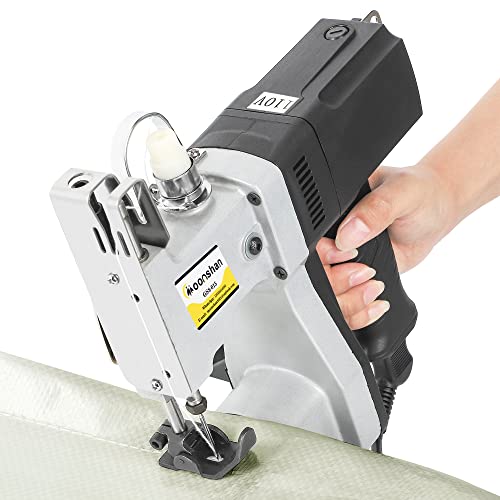
This bag closing machine is a portable, high-speed seaming tool designed for non-woven fabrics, leather, textiles, and similar packaging materials. It boasts a capable speed profile—over 5,000 bags per day—and a sewing rhythm of about 2 seconds per bag with around 2,600 stitches per minute. The 190W motor delivers steady performance across thicknesses up to 5 mm, depending on material.
Portability is a core feature, with a compact 6.4-pound frame and an ergonomic handle, which helps operators move between stations. While it excels in fast closing of multi-material bags, it is best suited for production floors where quick turnaround and robust stitching are prioritized over full automation of weight-based filling.
Cyuanll Mini Bag Closing Machine

This upgradeable, battery-powered bag closer emphasizes cordless operation without sacrificing speed or reliability. It includes a 36V 2.6Ah battery allowing mobility across workspace areas away from outlets. The unit’s 210W motor supports sewing thicknesses from 0.2 to 10 mm, with a stitch rate typically around 1500–1700 stitches per minute, and capable of higher speeds up to approximately 1800–2100 stitches per minute in some modes.
Constructed with an aluminum die-cast body and reinforced parts, the Cyuanll model is designed for durability in fieldwork and small-to-medium scale facilities. It’s a favorable choice for operations needing portable closing capability without a fixed power supply, especially when paired with stand-alone filling or sealing equipment.
Cyuanll Mini Bag Closing Machine — Blue variant

The blue variant of Cyuanll’s mini bag closer shares core features with the standard model, including a strong copper motor and a battery-powered design. It supports similar sewing thicknesses and speeds, and emphasizes portability for crews that shuttle between packing lines. This option is well-suited for applications that require rapid, cordless bag sealing on a small to mid-sized scale, where a fixed power source is impractical.
ONEVAN Cordless Bag Closing Machine

The ONEVAN cordless bag closing machine uses a brushless motor for improved efficiency and reliability. Its power management supports sustained performance with minimal heat buildup and a longer lifespan. It seals at a typical rate of about 2 seconds per bag, delivering roughly 2,600 stitches per minute across a typical range of 0.3 to 5 mm thickness.
The package includes two 20V 3000mAh batteries, enabling extended operation without frequent recharging. This makes it a practical choice for mobile workflows or facilities with limited access to power outlets. The model emphasizes durability, battery life, and consistent stitching quality for fast-paced packing environments.
YOULIAN Automatic Vertical Pouch Filling and Sealing Machine

This model emphasizes customization by accommodating bag size variations through special configuration options. It’s designed for vertical pouch filling and sealing and can be tuned for specific bag dimensions. A notable advantage is the option to tailor the machine setup before ordering, helping ensure compatibility with your existing packaging films and bag materials.
Potential buyers should engage with the seller for pre-order inquiries to confirm the exact bag dimensions and film types supported. This approach helps maintain production continuity when switching between product lines or different packaging formats.
Buying Guide: Key Purchase Considerations
- Application match: Determine whether your priority is integrated weight-based filling with sealing (for powders and granules) or fast bag closing for non-woven materials and textiles. Some machines excel at high-speed closing rather than precise filling, and vice versa.
- Sealing method and bag size: Three-side seal designs offer compact bags, while other units rely on end-seal or straight-line stitching. Confirm the maximum bag width and length your products require to avoid bottlenecks.
- Power and portability: Cordless bag closers improve flexibility in larger facilities or remote lines, but may require battery management planning. Consider whether you need stationary equipment or mobile units for floor-to-floor use.
- Material compatibility: Materials like powders, seeds, grains, and textiles demand different feed mechanisms, vibration profiles, and corrosion-resistant construction. Stainless steel is a plus for durability where humidity or salt exposure is a factor.
- Maintenance and consumables: Some machines require separate film rolls or specialized packaging films. Budget for consumables and routine servicing, including seals, blades, and motors, to minimize downtime.
- Throughput and scalability: If you anticipate growth, choose equipment with adjustable speeds and bag dimensions, and verify compatibility with existing upstream/downstream equipment (weighers, conveyors, and bag printers).
- Support and warranty: Check vendor support terms, parts availability, and warranty coverage. For industrial gear, access to spare parts and technical help can significantly affect uptime.