Automated and gravity roller conveyors help move materials smoothly across workshops, warehouses, and assembly lines. This article highlights five practical options that pair solid construction with versatile setups, offering reliable infeed and outfeed support for saw stands, tables, and workstations. Each selection emphasizes durable rollers, stable framing, and adaptable heights or widths to fit a range of tasks. Read on to compare core features and how these systems can fit into your workflow.
| Product | Brand | Key Benefit | Typical Use |
|---|---|---|---|
| Ultimation Gravity Conveyor Roller Table Set | Ultimation | Adjustable height; steel 1.9″ rollers | Saw stands, unload stations |
| Heavy-Duty Gravity Conveyor 18″ x 5′ | Ultimation | High load capacity; long length | Distribution, assembly, industrial runs |
| Light-Duty Gravity Conveyor 18″ x 3′ | Ultimation | Compact, versatile | General material handling |
| Bora PM-2700 Adjustable Roller Stand | BORA | Expandable, portable, adjustable height | Infeed/outfeed support for varying setups |
| Ultimation 2-Pack Heavy Duty Rollers | Ultimation | Durable galvanized rollers; high capacity | Outfeed, table, equipment feeds |
Ultimation Gravity Conveyor Roller Table Set
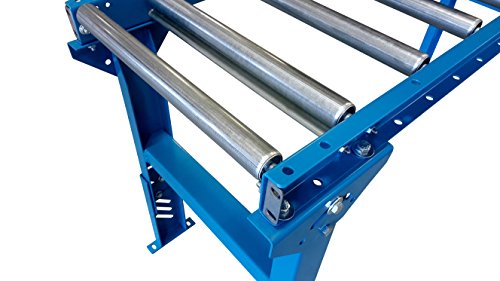
The complete gravity conveyor set includes a 5-foot long roller table and two adjustable leg stands, designed as an unload or outfeed system for saw stands and woodworking workstations. The frame uses a powder-coated 16-gauge steel construction with 1.9″ galvanized steel rollers mounted on 6″ centers, supporting up to a practical load per roller. Adjustable legs provide height flexibility from 22-1/16″ to 28-1/16″, enabling standalone use, extensions, or support for large materials. This option offers a straightforward, dependable solution for material handling in shop environments.
Heavy-Duty Gravity Conveyor 18″ Wide 5′ Long

This 18″ wide gravity conveyor spans 5 feet with 1.9″ dia galvanized rollers set on 6″ centers. A durable steel frame (2-1/2″ deep, 10 ga) with a powder-coated finish yields strong performance for heavy-duty material transport. Capable of handling up to 2,680 pounds when fully supported, it suits high-volume distribution, table or ladder workflows, and carpentry tasks where long, reliable runs are needed. The design supports smooth transitions and steady motion for efficient throughput.
Light-Duty Gravity Conveyor 18″ x 3′
This lighter 3-foot model provides an 18″ width with 1.5″ diameter galvanized rollers and a 16-gauge steel frame. With a shorter length, it’s well-suited for small workspaces, assembly lines, and transfer points in warehouses. Roller centers are 6″ apart, delivering smooth movement and dependable service, while the frame offers robust support for a range of light-to-medium materials. It’s an efficient option when space is at a premium but steady gravity-fed flow is required.
Bora Portamate Adjustable Conveyor Roller Stand PM-2700
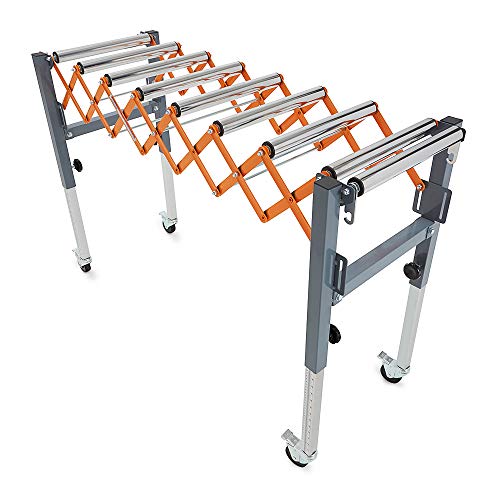
The PM-2700 is a portable, expandable conveyor roller system with a height range of 23″ to 36″ and an adjustable base to support 14″ to 50″ extension widths. The frame expands to accommodate slight angles while maintaining roller operation. It features 14 wide rollers with a 300-pound load capacity and locking swivel casters for mobility. This option is ideal for flexible feed, at-line processing, and setups that require rapid reconfiguration for varying material lengths and alignments.
Ultimation 2-Pack Heavy Duty Rollers

Two galvanized steel gravity conveyor rollers (21″ frame spacing, 1.9″ diameter) designed for heavy-duty material handling. Built with crimped, oil bearings, these rollers deliver smooth rolling performance and support up to 267 pounds per roller. They are suitable as add-on components for existing conveyor setups, outfeed tables, or custom linear transfer lines in industrial or workshop environments. Durable construction helps maintain long-term efficiency in demanding tasks.
Ultimation Light-Duty Gravity Conveyor – 18″ x 5′
This 5-foot long, light-duty gravity conveyor is designed for 18″ width with 1.5″ rollers and 4.5″ centers. The rollers handle up to 742 pounds when fully supported, with a per-linear-foot rating of about 106 pounds. The frame uses 12-gauge powder-coated steel, providing stable support for general material handling, assembly line feeding, and light shop tasks. It balances portability with durability for cost-conscious setups.
Buying Guide: Key Purchase Considerations
- Load capacity and roller diameter: Higher loads require larger rollers (1.9″) and robust frames. Check per-roller and total system ratings to match your materials.
- Center-to-center spacing: Closer spacing (e.g., 4.5″ or 6″) yields smoother movement for smaller parts but adds cost. Choose spacing that suits your product dimensions.
- Frame material and finish: Powder-coated steel frames resist corrosion and wear in workshop environments. For wet or dusty spaces, consider additional protective treatments.
- Height adjustability: Adjustable legs or stands enable use as standalone tables or as extensions from existing equipment. Ensure the range meets your workspace height requirements.
- Portability and modularity: Portable stands and expandable sections provide flexibility for changing workflows. Verify caster quality and lock mechanisms if mobility is critical.
- Intended use: Distinguish between light-duty, heavy-duty, and general-purpose conveyors. Choose based on typical material sizes, lengths, and transfer distances.
- Maintenance: Bearings, lubricants, and wheel alignment affect performance. Favor models with easily serviceable components and available replacement parts.
Comparative Considerations
- Durability vs. cost: Heavier, higher-capacity models cost more but offer longer service life in demanding environments. Assess your anticipated throughput and maintenance budget.
- Integration with existing tools: If you need to connect to saw stands or outfeed systems, look for adjustable heights and compatible mounting options.
- Space constraints: Shorter lengths and narrower widths save space but may require more transfers. Balance conveyor length with floor real estate.