Assembly line conveyor belts streamline production, packaging, and material handling in both industrial and home settings. This guide highlights reliable options suited for different scales—from desktop helpers to larger table-top systems. Each product below offers specific features like stepless speed control, durable belts, and versatile direction options to match diverse workflow needs.
| Product | Brand | Key Features |
|---|---|---|
| Moonshan Belt Conveyor 20 inch Desktop | Moonshan | Reverse switch, stepless speed regulation |
| Moonshan Belt Conveyor 39 inch Desktop | Moonshan | Stepless speed regulation, PVC belt |
| VEVOR Belt Conveyor 59 x 7.8 inch | VEVOR | Industrial stainless steel, adjustable speed 30–120 rpm |
| DC 12V Electric Desktop Conveyor | KZU | Compact 19.7″ x 3.9″ with adjustable speed |
| Moonshan Climbing Belt Conveyor 39 inch | Moonshan | 4-inch baffles, climbing/ lifting capability |
Moonshan Belt Conveyor 20 Inch Desktop Version

The Moonshan 20 inch desktop conveyor features a reverse switch to change transport direction mid‑process, supporting flexible assembly line workflows. Its stepless speed regulation allows quick, granular speed adjustments to match product size and production tempo. Ideal for packaging lines, small-scale manufacturing, and home setups requiring precise control over item flow.
Moonshan Belt Conveyor 39 Inch Desktop

This Moonshan 39 inch model provides a longer belt for medium‑length production lines with stepless speed regulation. The PVC belt is durable and water resistant, suitable for continuous material movement in packaging, assembly, or research settings. The design supports stable operation and quick speed changes to accommodate varying task lengths.
VEVOR Belt Conveyor 59 x 7.8 Inch

VEVOR’s 59 x 7.8 inch conveyor uses industrial-grade stainless steel for durability in harsh environments. The wear‑resistant, anti‑static PVC belt handles a range of items, with a rotating screw that adjusts belt tension and infinitely adjustable support feet for stability. It offers speeds from 30 to 120 rpm and reversible operation, making it versatile for packaging, coding, and assembly tasks.
DC 12V Electric Desktop Conveyor Belt

Designed for compact workspaces, this DC 12V desktop conveyor belt measures 19.7″ by 3.9″ and offers adjustable speeds from 0 to 116 RPM. The integrated speed controller enables precise workflow control, making it suitable for small production lines, friction experiments, or packaging demonstrations where space is at a premium.
Moonshan Climbing Belt Conveyor 39 Inch
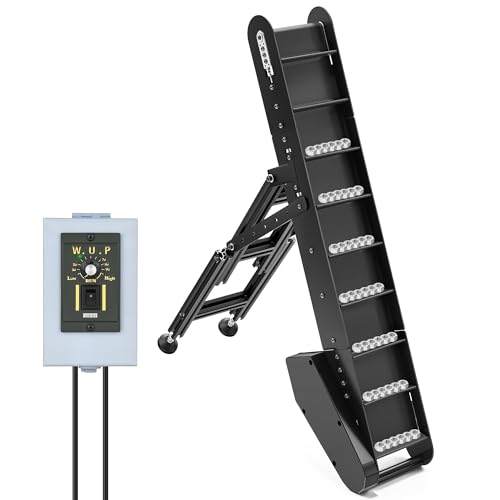
The Moonshan 39 inch climbing belt adds lifting capability with 4-inch spaced baffles on the PVC belt, enabling transport of items to higher levels on the line. The integrated stepless speed control provides a flexible speed range to suit different process stages, and the PVC belt remains waterproof, flexible, and wear‑resistant for reliable use in varied environments.
Buying Guide: Key Purchase Considerations
When selecting an assembly line conveyor belt, consider how the device will fit into your space, process, and budget. The following perspectives help buyers compare options objectively:
- Size and footprint: Desktop models suit small workstations, while longer belts support higher throughputs on production lines.
- Speed control: Stepless or wide-range RPM adjustments enable precise synchronization with other equipment and operators.
- Direction features: Reversibility and dual‑direction setups improve flexibility for rework or batch changes.
- Material and durability: Stainless steel frames and anti‑static PVC belts offer longevity in industrial settings; PVC belts are generally cost‑effective and versatile.
- Power and wiring: Check voltage compatibility (some models are 110–220V, others DC 12V) and whether universal adapters are needed.
- Maintenance and cleaning: Waterproof belts and corrosion-resistant frames simplify sanitation in packaging or lab environments.
- Modularity and upgrade options: Some systems allow adding guardrails, height adjustments, or tension screws to tailor behavior to tasks.
- Cost versus throughput: Higher-capacity, variable-speed units typically justify higher upfront costs through reduced manual handling and faster processing.
- Application fit: For coding or labeling lines, motors with stable speeds and precise belt tension improve consistency; for educational settings, compact, easy-to-use models may be preferable.
Across these options, users should map each conveyor’s capabilities to their specific workflow—whether it is a desktop setup for prototyping and testing or a robust, stainless steel line for ongoing production. Consider compatibility with existing equipment, such as packaging machines, printers, or sensors, to minimize integration challenges.